Learn how to effectively bring growth mindset into your community and classroom by choosing impactful language.
From the authors of the bestselling
The Growth Mindset Coach, this handy companion is a must-have if you want to empower students through purposeful praise and feedback. Here are the key strategies, helpful tips and go-to phrases for helping students transition thoughts, words and actions into the growth-mindset zone.
Designed for ease of use and packed with over a hundred specific examples, this book offers a "say this, not that" approach to communication that will help you model and cultivate growth mindset in the classroom. For example:
Fixed Mindset:
• You're so smart.
• You're wrong.
Growth Mindset:
• l like how you used different strategies to figure out these problems.
• That didn't work out for you. How could you approach the problem differently?
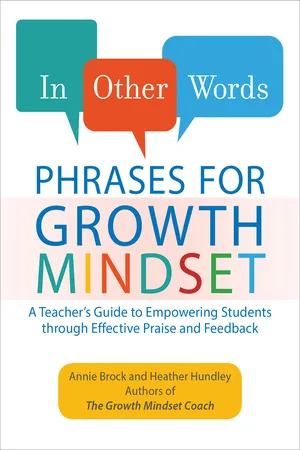
eBook - ePub
In Other Words: Phrases for Growth Mindset
A Teacher's Guide to Empowering Students through Effective Praise and Feedback
- 160 pages
- English
- ePUB (mobile friendly)
- Available on iOS & Android
eBook - ePub
In Other Words: Phrases for Growth Mindset
A Teacher's Guide to Empowering Students through Effective Praise and Feedback
About this book
Information
Print ISBN
9781612437910
Subtopic
Education GeneralSECTION THREE
TEACHER-TO-STUDENT COMMUNICATION
Growth-Oriented Feedback

In this section, we are going to focus on teacher-student communication—both verbal and nonverbal. Specifically, we’ll focus on how to offer growth-oriented praise and feedback, and the non-verbal cues that will support your verbal messages. When it comes to growth mindset, actions speak louder than words. Remember Dweck’s assessment of the “false growth mindset”? Much of that comes from teachers claiming to have a growth mindset, but whose actions and practices demonstrate a fixed mindset about learning, intelligence, and talent. But before you make any big changes to the way you are communicating with students, spend a week mindfully monitoring what you are saying to kids.
Ask yourself…
•How do I most often praise my students?
•How do I most often provide feedback to my students?
•How do I respond to mistakes made in class?
•What do I do when students get all the answers right?
Once you have developed an honest picture of the language you are currently using in class, it’s time to make a plan. Making a concerted effort to infuse your language with the growth mindset should not be viewed as a temporary solution. Our goal is not to help you pick up a few tricks to be more growth mindset-ish today; it’s to provide you with the tools to construct a future built on a foundation of growth mindset. This will take time. You will mess up. You will want to quit. This is change, and intentional change is good.
There’s a saying, “Don’t let perfect be the enemy of good.” This is particularly relevant here, because many teachers with whom we have worked realize they have been saying and doing things in their classrooms that may have led to fixed mindsets. They feel defeated. They want to give up before they start. But, don’t! Don’t let perfect be the enemy of good! Try to get better a little each day, and before long, you’ll have developed strategies and routines that you can sustain over time. No one is asking anyone to have an unimpeachable growth mindset—heck, we write books about growth mindset, and still catch ourselves in the fixed mindset all the time. You’ll never be perfect, but you can always be better.
THE POWER OF PRAISE
When we use the word “praise,” what we are really talking about is a very specific kind of encouragement of effort known as “process praise.” “You’re so smart,” is a commonly heard example of another kind of praise: person praise. Person praise focuses solely on personal traits and qualities of the student. The problem with person praise is that it sends the message that a student succeeded because of some inherent, inborn quality they possess (in this case, intelligence), rather than the effort they put into the task. Process praise, on the other hand, acknowledges effort, strategies, or actions that contributed to the success of a task. It sounds more like this: “You worked really hard at that,” and sends the message that the amount of effort put into the task led to success. Let’s look at some differences between person praise and process praise.
Person Praise | Process Praise |
You’re a natural at math. | These problems didn’t give you much challenge. Let’s move on to something that will really stretch your brain! |
You’re so smart. | I like how you used different strategies to figure out these problems. |
You’re such a good boy. | I appreciate that you cleaned up the art center without being asked. |
What a brilliant pianist! | Your effort in learning to play piano was apparent in your recital. |
You’re a born writer. | Your writing shows you understand the value of word choice. |
The same idea can be applied to constructive critique and feedback, as well. Person critique is feedback that blames a failure or setback on a quality of the person: “You’re just not good at math.” On the other hand, process critique focuses on the effort, or lack thereof, put into the task: “That strategy didn’t work for you. What else could you try?”
Person Critique | Process Critique |
You really messed this up. | This didn’t seem to work out for you. How could you approach this problem differently? |
You did your best, but it’s just not good enough. | You didn’t meet your goal, but what did you learn? |
Maybe piano just isn’t your thing. | Keep practicing. Every day you get closer to mastering this. |
You’re such a naughty boy. | You made a bad choice. What will you do differently in the future? |
See the difference? Because person praise or critique is directly tied to a student’s intelligence or some other personal quality, it can make them feel insecure about tackling challenges and potentially making mistakes in the future. Better safe than stupid, right?
When the teacher ties success or failure to effort, strategy, or action, the child is not evaluated globally, but just on that one thing—right here and right now. In that moment, unrelated to intrinsic qualities and personal traits, the student can better understand the connection between effort and achievement. In that moment, it has nothing to do with being smart or stupid; it has everything to do with perseverance and the process of learning.
“When adults praise students’ intelligence after a student performs well, they send a fixed-mindset message: you’re intelligent and that’s wh...
Table of contents
- Cover
- Title Page
- Copyright
- Contents
- Section One: Introduction
- Section Two: Self-Talk
- Section Three: Teacher-to-Student Communication
- Section Four: Peer-to-Peer Communication
- Section Five: School-to-Home Communication
- Section Six: The Whole-School Mindset
- Notes
- About the Authors
Trusted by 375,005 students
Access to over 1.5 million titles for a fair monthly price.
Study more efficiently using our study tools.
Frequently asked questions
Yes, you can cancel anytime from the Subscription tab in your account settings on the Perlego website. Your subscription will stay active until the end of your current billing period. Learn how to cancel your subscription
No, books cannot be downloaded as external files, such as PDFs, for use outside of Perlego. However, you can download books within the Perlego app for offline reading on mobile or tablet. Learn how to download books offline
Perlego offers two plans: Essential and Complete
- Essential is ideal for learners and professionals who enjoy exploring a wide range of subjects. Access the Essential Library with 800,000+ trusted titles and best-sellers across business, personal growth, and the humanities. Includes unlimited reading time and Standard Read Aloud voice.
- Complete: Perfect for advanced learners and researchers needing full, unrestricted access. Unlock 1.5M+ books across hundreds of subjects, including academic and specialized titles. The Complete Plan also includes advanced features like Premium Read Aloud and Research Assistant.
We are an online textbook subscription service, where you can get access to an entire online library for less than the price of a single book per month. With over 1.5 million books across 990+ topics, we’ve got you covered! Learn about our mission
Look out for the read-aloud symbol on your next book to see if you can listen to it. The read-aloud tool reads text aloud for you, highlighting the text as it is being read. You can pause it, speed it up and slow it down. Learn more about Read Aloud
Yes! You can use the Perlego app on both iOS and Android devices to read anytime, anywhere — even offline. Perfect for commutes or when you’re on the go.
Please note we cannot support devices running on iOS 13 and Android 7 or earlier. Learn more about using the app
Please note we cannot support devices running on iOS 13 and Android 7 or earlier. Learn more about using the app
Yes, you can access In Other Words: Phrases for Growth Mindset by Annie Brock,Heather Hundley in PDF and/or ePUB format. We have over 1.5 million books available in our catalogue for you to explore.