Discipline Strategy
eBook - ePub

Discipline Strategy

  1. 224 pages
  2. English
  3. ePUB (mobile friendly)
  4. Available on iOS & Android
eBook - ePub

Discipline Strategy

About this book

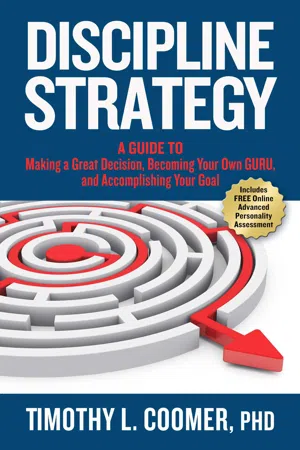
Change begins with a decision. To move beyond that decision to positive life change requires discipline. In Discipline Strategy, Dr. Coomer translates the word DISCIPLINE into an acronym for a ten-step life change process. Don't be uncertain or confused for another day. You can become the hero of your own life's story. The DISCIPLINE STRATEGY® approach works for both business and personal challenges and will guide you from the point of decision to accomplishment.Dr. Coomer is a serial entrepreneur and personality researcher with a deep understanding of how personality impacts performance. To enhance your ability to implement the DISCIPLINE STRATEGY® process, this book includes a free comprehensive personality assessment.Many of today's self-help books offer a prescription for change but fail to provide an answer to your specific challenges. A better approach is to learn a process that supports genuine change and allows you to become your own customized expert. In this way, you'll learn to: • [ D ECIDE] Make sound decisions.• [ I NVESTIGATE] Investigate relevant topics.• [ S ORT] Sort through information with a critical eye.• [ C ONCEIVE] Conceive a detailed plan.• [ I MPLEMENT] Implement the plan.• [ P ERSEVERE] Move forward with passion and perseverance.• [ L OOP] Use a feedback loop to evaluate your progress and make adjustments where needed.• [ I NTENSIFY] Intensify your efforts where appropriate.• [ N OTICE] Take notice of what you have accomplished.• [ E NJOY] Enjoy the fruits of your labors using the positive psychology concept of PERMA.This is your roadmap for change, the ultimate guide to making a great decision, becoming your own guru, and accomplishing your goal.
Tools to learn more effectively

Saving Books

Saving Books

Keyword Search

Keyword Search

Annotating Text

Annotating Text

Listen to it instead

Listen to it instead

Information

PHASE 1

CHOOSING THE DESTINATION AND PREPARING FOR THE JOURNEY


CHAPTER 1 DECIDE

“It is in your moments of decision that your destiny is shaped.”
—TONY ROBBINS
The power of a decision cannot be underestimated. As I mentioned in the Introduction, the Latin root word for “decision,” decidere, literally means “to cut off.” So when you make a decision, you cut off all other paths. Making a decision is not wishing that something will happen or thinking that maybe it will happen; it means taking action to cause something to happen. It is one of the most powerful things we can do to change ourselves and our future.
Our capacity for conscious evaluation and decision is one of the many things that distinguishes humans from other mammals. But our decision-making process is driven by a brain that has evolved from a very different context, with different environmental conditions and threats. As a result, the decisions we make often leave us unfulfilled. Because the journey into the DISCIPLINE STRATEGY begins at the point of decision, you must understand the power and pitfalls of decision-making.

THE GROUND-LEVEL VIEW (WHAT THIS LOOKS LIKE IN REAL LIFE)

Bobby had chased a dream, based on a decision made many years before, to become a high-powered corporate lawyer. He had worked hard to get into one of the nation’s best law schools, and he fought to get the right internships and to impress his prospective employer’s partners. The result was the fulfillment of Bobby’s dream—a job as a junior associate at one of Atlanta’s largest law firms. Now, just six months into this fabulous dream career, Bobby was miserable. He was working seventy-plus hours per week, leaving him with little time for his girlfriend, Rhonda. He was getting out of shape physically and was on a downward mental slide. At 3:00 a.m. one sleepless night, tossing and turning in bed, he asked himself, What went wrong?
Bobby’s story is common. Many of the decisions we make are based on an attempt to project ourselves into the future and into a situation we know very little about. Bobby was a twenty-year-old undergraduate at the University of Tennessee when he formed his vision of being a corporate lawyer and made a major life decision to pursue the path of law school, choice internships, and a coveted slot at a big law firm. Now at age twenty-six, Bobby is $175,000 in debt (mostly school loans), single (Rhonda found better options), and still wondering what went wrong.
On the other side of the country is Phil, age sixty-one, a retired production supervisor from a mid-sized manufacturing company just outside Portland, Oregon. The plant where he worked for over forty years is not far from the beautiful Columbia River that separates Oregon from Washington state. Phil married his sweetheart, Elisabeth, right out of high school and started working at the plant—the only one job he had his entire adult life. He and Elisabeth raised three children, the youngest of whom has just turned thirty, who have settled into their own life journeys. An avid fisherman, Phil had eagerly planned and waited for retirement, when he would have plenty of time to spend on the nearby Columbia River. Phil had often found himself, when working long production shifts at the plant, dreaming about relaxing afternoons on the river with his custom rod and reel. Now, eighteen months into his dream retirement, Phil is depressed, confused, and feeling more stress in his marriage than at any time during their forty-two years together. Fishing just doesn’t seem that interesting to him anymore, and he is wondering what is going on, why he feels so lost, and what to do about it.
These stories illustrate the challenges we all face when making decisions that affect our future. Our decisions often lead us into situations and circumstances we did not foresee and that create considerable stress. A better understanding of the science of decision-making along with specific strategies to circumvent the pitfalls will help you make better decisions and lay the groundwork for the next step in the DISCIPLINE STRATEGY.

THE CHALLENGES AND SOLUTIONS

Evolutionary forces have not yet optimized our decision-making processes for the modern age. We still tend to make decisions through a process that relies heavily on quick judgment and the fight-or-flight response—impulses that lead to a lot of missteps and challenges. Fortunately, research has done an excellent job of identifying the pitfalls and illuminating effective strategies to help us become aware of, understand, and avoid the biggest traps.
Let’s start by taking a look at the five biggest challenges of decision-making. You will notice that several of these strategies are intertwined. To help you remember these dangers, we will use the acronym POWER:
  • LIMITED PERSPECTIVE: You must understand your perspective on the problem or decision and realize that it may be limited and thereby limit your possibilities.
  • LIMITED OPTIONS: You may be limiting yourself with regard to perceived options. This occurs when our built-in mental governor filters our thoughts and is blind to other realistic options. You may also simply not be gathering and nurturing options that are available to you.
  • WEB OF DECEIT: Our brains create an amazing web of deceit that is typically invisible to us. You can think of this as that little voice in your head that tells you what you can’t do and why you will fail, self-defeating messages that create a steady stream of negative self-talk. We have to shine a light on this web of deceit and become aware of how it influences our thinking and decision-making.
  • EMOTIONALITY: It is critical to move out of your emotional self, engage your brain, and put yourself into your most logical mind. Operating on emotions is like flying an airplane through a cloudy mountain range guided only by your “gut” feeling—it won’t work and the outcome will likely be disastrous.
  • RESISTING REROUTE: Before you even begin to put together an action plan to turn your decision into reality, you must anticipate that a lot of rerouting will occur before you reach your final destination.
Now that you’ve seen the big picture of these five pitfalls, let’s zoom in and take a much closer look at each one, detailing the problem and outlining the best solutions as we go.

CHALLENGE: LIMITED PERSPECTIVE

When I was about ten years old, I had a good friend who lived a couple streets over. We were inseparable as kids, exploring our neighborhood pond and riding our bikes across what we saw as vast, boundless landscapes (but what was really about ten city blocks). As we grew older, we became more adventurous. One day, we decided to see just how high we could climb up a tree in my friend’s back yard. Would we be able to see over the hills around our neighborhood and get a glance of the Nashville skyline just five miles away? The idea was both thrilling and terrifying to my ten-year-old mind. So, I climbed. As I moved up the tree, I noticed a dramatic change in perspective. First, I could look down on some of the cars in nearby driveways. Next, I could see the roofs of the surrounding houses. Finally, as I reached a point where no ten-year-old boy should have been, I saw Nashville’s gleaming skyline and skyscrapers. From that new vantage point, I had a clearer sense of where I was and how everything in my little world fit together. I could see my elementary school, the pond where we played, the downtown area, and my own home a few blocks away. The whole world looked very different.
This kind of top-level, broad perspective is the place where your decision-making process must start. If you’re facing a possible career change, for example, you can’t start by asking yourself, Should I quit my job or not? That’s far too narrow; you will definitely not make an optimized decision. Instead, start with a higher perspective and ask a series of questions:
  • Are there changes I can make in my job that would increase my satisfaction with it?
  • Is my job the problem, or is there some deep dissatisfaction within myself that I need to address?
  • What are the things I was passionate about years ago, and are there ways to pursue those things with renewed interest and vigor?
Those are simple examples, but there are dozens of questions you could ask yourself in this situation. The point is to broaden your perspective, to climb the tree that lets you see all the options, and to survey the landscape. This is where you should begin.

SOLUTION: EXPAND YOUR PERSPECTIVE

The solution to a limited perspective, from which we all suffer, is to expand it by applying several specific strategies.
TALK WITH TRUSTED FRIENDS AND ADVISORS
A close friend, sibling, spouse, parent, child, coworker, counselor, or minister sees you differently from how you see yourself. You must be willing to seek real, honest feedback from the people who know you best. Develop a list of questions and tell your friends you are implementing some techniques you learned by reading about the DISCIPLINE STRATEGY and want their feedback. You’ll see information at the end of this chapter about a worksheet I’ve created for this purpose.
USE PSYCHOMETRICS
Psychometrics are scientifically tested and validated tests of your personality and aptitude. These tests can tell you a surprising amount about yourself and your personality, interests, abilities, and communication style. The MyPersonality® assessment is designed to accompany this book (learn more at www.DISCIPLINESTRATEGY.com). When you take the assessment, you will receive a detailed report that will help you expand your perspective and better execute the DISCIPLINE STRATEGY process. I’ll provide more information about how to access the MyPersonality assessment at the end of this chapter.
KEEP A JOURNAL
One way to tap into your subconscious and make it part of your conscious thinking and perspective is to journal. This requires setting aside time each day to write. Your journal entries should be unfiltered and should capture your greatest aspirations and fears.
GET MORE EXPERIENCE
What can you do to get a better idea of what this decision will actually look like in your life? For example, suppose you have decided to become a professional pilot. Before quitting your job and going to one of those year-long, intensive flight-training courses, you should probably talk to some pilots and hear what their lives are really like. You should also get your private pilot license and do some flying to see how it feels to be in command of an aircraft on your own. As you progress and earn more licenses, you might even see if you could fly as a copilot a few times and learn from a commercial charter pilot. Or say you have decided to become a full-time yoga instructor. You could start by getting the first couple of certifications and teaching at night and on weekends. The point is to take small steps to get real-life experience related to the decision you are making. This real-life experience prevents you from imagining only a glowing, idyllic view of this future life. Perhaps you’ll learn from the commercial charter pilot that he is spending twenty nights a month away from home and feels that it is a difficult life for his family that includes two young children. Or maybe a full-time yoga instructor will tell you that her lifestyle is even better than she ever dreamed because of the new level of fitness, peace, friendships, and life balance she has achieved.
Whatever decision you’re facing, find some way to bring the reality of the decision into your world. Real-life experience—good and bad—is simply irreplaceable.
TRAVEL
Your day-to-day routines can support your decisions and goals, but they can also smother your perspective. Travel allows you to move away from daily routines, obligations, and technology and opens you up to new ideas and ways of thinking.
Some of my best decisions, for whatever reason, have been made while I was standing beside large bodies of water. I have made pivotal decisions while on a cliff in Nova Scotia looking out over the North Atlantic, while skipping rocks on the Talkeetna River in Alaska, and while watching the sun set on Seven Mile Beach in the Cayman Islands. Perhaps what works for you is a walk down a wooded trail in the mountains. Or maybe it is the exciting atmosphere of a British Premier League soccer game. Whatever you love to do, wherever you love to go, go there and give your mind the freedom to explore. Then think. Open your mind to the larger world around you, take off your blinders, set aside the rules that govern your daily life, and open yourself to the incredible possibilities. What can you do? Where can you go? How big will you dream today?
COUNSELING
A wise man once said, “We all have some crap to deal with.” As a result, counseling can be a route to a new and broader perspective. If you have been struggling with a specific topic for an extended period of time, you may need some help breaking through and changing your perspective. Counseling is a tool that anyone can access. It should not have any stigma, and it can be a powerfully worthwhile process.

CHALLENGE: LIMITED OPTIONS

We all tend to filter our thoughts and dreams because of limiting beliefs. Sometimes this controlling governor on our thought processes is so effective that we don’t realize we have eliminated options before they were even considered. To counter this, you need to compose a robust list of all your options. As you move to the right perspective, new options will emerge into your field of view. I like to call this unfiltered brainstorming, a time when you can put everything on the table and keep all your options open. Unfiltered means you write down every single thing that comes to mind without weeding anything out. If you think, I could move to Italy and teach English to grade-school kids, then that goes on the list of possibilities.
Also, realize that the decisions you make will affect your subsequent options down the road. You always want to create options and keep them in your back pocket. You want to collect options as if they were fine gems, harvesting and nurturing them, never taking one off the table until you have given it full consideration. Even then, file that option in the top drawer so you know exactly where it is should you decide to come back for it later.

SOLUTION: EXPAND YOUR OPTIONS

Expanding your options is part mind game and part shift in life strategy. There is a subtle but distinct difference between changing your perspective and expanding your o...

Table of contents

  1. Cover
  2. Title Page
  3. Introduction
  4. Phase 1: Choosing the Destination and Preparing for the Journey
  5. Phase 2: Create the Roadmap and Begin the Journey
  6. Phase 3: Perfect and Intensify your Efforts
  7. Phase 4: Celebrate and Nurture Continuous Growth and Well-Being
  8. Acknowledgments
  9. About the Author
  10. Copyright

Frequently asked questions

Yes, you can cancel anytime from the Subscription tab in your account settings on the Perlego website. Your subscription will stay active until the end of your current billing period. Learn how to cancel your subscription
No, books cannot be downloaded as external files, such as PDFs, for use outside of Perlego. However, you can download books within the Perlego app for offline reading on mobile or tablet. Learn how to download books offline
Perlego offers two plans: Essential and Complete
  • Essential is ideal for learners and professionals who enjoy exploring a wide range of subjects. Access the Essential Library with 800,000+ trusted titles and best-sellers across business, personal growth, and the humanities. Includes unlimited reading time and Standard Read Aloud voice.
  • Complete: Perfect for advanced learners and researchers needing full, unrestricted access. Unlock 1.4M+ books across hundreds of subjects, including academic and specialized titles. The Complete Plan also includes advanced features like Premium Read Aloud and Research Assistant.
Both plans are available with monthly, semester, or annual billing cycles.
We are an online textbook subscription service, where you can get access to an entire online library for less than the price of a single book per month. With over 1 million books across 990+ topics, we’ve got you covered! Learn about our mission
Look out for the read-aloud symbol on your next book to see if you can listen to it. The read-aloud tool reads text aloud for you, highlighting the text as it is being read. You can pause it, speed it up and slow it down. Learn more about Read Aloud
Yes! You can use the Perlego app on both iOS and Android devices to read anytime, anywhere — even offline. Perfect for commutes or when you’re on the go.
Please note we cannot support devices running on iOS 13 and Android 7 or earlier. Learn more about using the app
Yes, you can access Discipline Strategy by Timothy Coomer in PDF and/or ePUB format, as well as other popular books in Business & Decision Making. We have over one million books available in our catalogue for you to explore.