Libya
eBook - ePub

Libya

From Colony to Revolution

  1. 352 pages
  2. English
  3. ePUB (mobile friendly)
  4. Available on iOS & Android
eBook - ePub

Libya

From Colony to Revolution

About this book

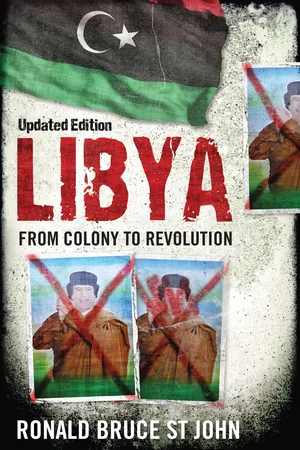
Since Qaddafi's ousting in 2011, Libya has been beset by instability and conflict. To understand the tumultuous state of the country today, one must look to its past. With great clarity and precision, renowned regional expert Ronald Bruce St John examines Libya's long struggle to establish its political and economic identity amidst the interference of external actors keen to exploit the country's strategic importance.This authoritative history spans the time of the early Phoenician and Greek settlements, colonization by Mussolini's Italy, Qaddafi's four decades of rule and, in this updated edition, the internal rivalries that have dominated the country in the aftermath of the Arab Spring. Essential reading for those seeking a greater understanding of this complex North African state, Libya: From Colony to Revolution is an insightful history, rich in detail and analysis.
Frequently asked questions

Yes, you can cancel anytime from the Subscription tab in your account settings on the Perlego website. Your subscription will stay active until the end of your current billing period. Learn how to cancel your subscription.
No, books cannot be downloaded as external files, such as PDFs, for use outside of Perlego. However, you can download books within the Perlego app for offline reading on mobile or tablet. Learn more here.
Perlego offers two plans: Essential and Complete
  • Essential is ideal for learners and professionals who enjoy exploring a wide range of subjects. Access the Essential Library with 800,000+ trusted titles and best-sellers across business, personal growth, and the humanities. Includes unlimited reading time and Standard Read Aloud voice.
  • Complete: Perfect for advanced learners and researchers needing full, unrestricted access. Unlock 1.4M+ books across hundreds of subjects, including academic and specialized titles. The Complete Plan also includes advanced features like Premium Read Aloud and Research Assistant.
Both plans are available with monthly, semester, or annual billing cycles.
We are an online textbook subscription service, where you can get access to an entire online library for less than the price of a single book per month. With over 1 million books across 1000+ topics, we’ve got you covered! Learn more here.
Look out for the read-aloud symbol on your next book to see if you can listen to it. The read-aloud tool reads text aloud for you, highlighting the text as it is being read. You can pause it, speed it up and slow it down. Learn more here.
Yes! You can use the Perlego app on both iOS or Android devices to read anytime, anywhere β€” even offline. Perfect for commutes or when you’re on the go.
Please note we cannot support devices running on iOS 13 and Android 7 or earlier. Learn more about using the app.
Yes, you can access Libya by Ronald Bruce St John in PDF and/or ePUB format, as well as other popular books in History & African History. We have over one million books available in our catalogue for you to explore.

Information

Year
2017
eBook ISBN
9781786072412
Edition
3
MAPS_01.webp
Map 1 Β Libya
Β 
1
EARLY HISTORY
Much of the history of north-west Africa is the history of foreigners. Its civilizations have been imposed on its indigenous people largely from outside, and it was usually conquered from outside. Yet they have endured with considerable vigour.
Susan Raven, Rome in Africa, 1993
In Libya, you are made aware the whole time of the abandonment of things, the material leftovers of receding cultures.
Anthony Thwaite, The Deserts of Hesperides, 1969
Because Libya rests on the periphery of three worlds – Arab, African, and Mediterranean, geography has been an important influence on the historical development of its principal regions. The Gulf of Sirte, also known as the Gulf of Sidra, is centered on the country’s Mediterranean coastline, forming a deep but irregular salient on its headlands. The desolate Sirte Basin, a remote desert tract known as Sirtica, extends three hundred miles along the Libyan coast below the Gulf of Sirte, dividing the country into two parts.
Formidable sea and land barriers, combined with vast deserts in the southeast and southwest of the country, resulted in the early delineation of Libya into three regions, Cyrenaica in the east, Tripolitania in the west, and Fezzan in the southwest. Historically, Cyrenaica tended to look eastward toward the Mashriq or eastern Islamic world while Tripolitania looked westward toward the Maghrib or western Islamic world. With southern Libya extending well into the Sahara Desert and sharing selected socioeconomic features with neighboring African states, Fezzan naturally looked south to central and western Africa.
The very word β€œLibya,” which derives from the name of a single Berber tribe known to the early Egyptians, embodies a misconception. The Greeks applied the term to most of North Africa and the name Libyan to its Berber inhabitants. It was later applied to former Ottoman provinces by Italy in 1911 as an integral part of an imperialist policy aimed at justifying colonialism by linking it to the Roman Empire and then adopted by the United Nations in 1951 to refer to the newly created United Kingdom of Libya. No European, Ottoman, or indigenous authority used the term β€œLibya” before the beginning of the last century. And it was not formally adopted as the name of Italy’s colony in North Africa until 1929 when the separately administered provinces of Cyrenaica, Tripolitania, and Fezzan were joined under a single Italian governor. We will speak of Libyan history for reasons of convenience, but it is important to remember that Libya as an integrated administrative, economic, and political reality, is less than sixty years old.
HISTORICAL SETTING
The prehistory of Libya is shrouded in mystery, with the available archeological evidence both complex and controversial. In addition, it should be recognized at the outset that the early history of Libya is known to us only through Greco-Latin literature. The early peoples of the region, from Berbers to Vandals, had no written language. Therefore, while they were described by Greek and Roman officials, geographers, and other travelers, the knowledge we have of them is indirect, through the eyes of others, and has nothing to do with the ancient peoples themselves.
The coastal plain of Libya from at least 7000 bce shared in a Neolithic culture, skilled in the cultivation of crops and the domestication of cattle, which was common to the Mediterranean littoral. In the south of the country in what is now the Sahara Desert, nomadic herdsmen and hunters roamed large, well-watered grasslands, abounding in game. The savanna people flourished until worsening climatic conditions around 2000 bce caused the region to desiccate. Fleeing the encroaching desert, they either migrated to the Sudan or were absorbed by local Berbers.
We also know very little about the origins of the Berber people. Egyptian inscriptions dating from the Old Kingdom (ca. 2700–2200 bce) are the first recorded testimony of Berber migrations and the earliest written documentation of Libyan history. At least as early as this time, Berber tribes, one of which was known to the Egyptians as the Lebu or Libyans, were raiding eastward as far as the Nile Delta. During the Middle Kingdom (ca. 2200–1700 bce), the Egyptians succeeded in establishing some dominance over these eastern Berbers and extracting tribute from them. Around 950 bce, a Berber is thought to have seized control of Egypt and ruled as pharaoh under the name Shishonk I. His successors, the so-called Libyan dynasties, are also believed to have been Berbers.
It remains unclear when the Berber peoples reached modern-day Libya, but they were known to the writers of classical Greece and Rome who applied the name Libyan to all of them. The Greek historian, Herodotus, who visited North Africa in 450 bce, described their social and political organization in some detail. Gaius Sallustius Crispus, the Roman historian known as Sallust, described their life in the first century bce in a detailed account, many of whose particulars remain accurate today. Berber speakers are now a minority in the Maghrib in general and Libya in particular; nevertheless, the area in which they are found remains immense, testifying to the size of the original population. Small clusters are found at Siwa, in the western desert of Egypt, and in Fezzan in southern Libya. From the Jebel Nefousa in northwestern Libya, a large Berber-speaking area stretches southwest into southern Algeria, eastern Mali, and western Niger. Numerous Berber speakers also exist in northern Algeria and throughout Morocco.
The Garamantes were a tribal confederation of Saharan people living in what is now Fezzan. Little is known about them, including what they called themselves. Garamantes was a Greek name which the Romans later adopted. A local power between 500 bce and ce 500, the Garamantes first appeared in written record in The Histories by Herodotus. The political power of the Garamantes was limited to a chain of oases some 250 miles long in the Wadi Ajal. However, because the Garamantes occupied the oases on the most direct route from the Mediterranean Sea to central Africa, the so-called Garamantean Road, they controlled trans-Saharan trade from Ghadames south to the Niger River, east to Egypt, and west to Mauritania. The valleys of Fezzan are rich in archeological sites; part of Germa (Garama), the capital of the Garamantes, was excavated in the 1960s.
PHOENICIAN SETTLEMENTS IN TRIPOLITANIA
The Phoenicians, or Punics, were an eastern Mediterranean people whose homeland included the coastal regions of contemporary Syria, Lebanon, and northern Israel. Skillful navigators and accomplished merchants, the Phoenicians were active throughout the Mediterranean Basin before the twelfth century bce, founding commercial outposts based on an enterprising maritime trading culture. Carthage, founded in the ninth century bce along the Mediterranean coast of what is now Tunisia, was among the most successful of the Punic colonies.
The region of Tripolitania was settled by the Phoenicians as part of an effort to extend the influence of Carthage throughout the west coast of North Africa. The Punics established permanent settlements, building three large coastal cities, Oea (Tripoli), Labdah (later Leptis Magna), and Sabratha, known collectively as Tripolis (three cities). By the fifth century bce, Carthage, the greatest of the overseas Punic colonies, had extended its hegemony across much of North Africa.
MAPS_02.webp
Map 2 Punic Settlement in Libya
From its coastal location a few miles northeast of modern-day Tunis, Carthage exerted an especially strong influence on surrounding Berber populations. Essentially a maritime power, the Punics in Tripolitania, unlike the Greeks in Cyrenaica, also established and cultivated excellent relations with the Berbers, trading with them as well as teaching and learning from them. As a result, the Berbers eventually became somewhat Punicized in language and custom although the full extent of Punic influence on the Berbers remains a subject of historical debate. What is clear is that Carthage, together with Tripolis, later drew support from Berber tribes during both the first Punic War (264–241 bce) and second Punic War (218–202 bce).
The early Punic Wars doomed Carthage, ending its former glory. The Romans later sacked the city at the conclusion of the third Punic War (149–146 bce) to forestall a Carthaginian revival. Nevertheless, the influence of Punic civilization on the North African region remained strong. Displaying a remarkable gift for cultural assimilation, the Berbers readily synthesized Punic cults into their folk religion. In the late Roman period, the Punic language was still spoken in the towns of Tripolitania as well as by Berber farmers in the coastal countryside.
GREEK INFLUENCE IN CYRENAICA
The region of Cyrenaica, occupying the eastern half of Libya, derives its name from Cyrene, the first Greek city in North Africa, founded in 632 bce. Within two centuries, four more cities had been founded on the North African shore, thereby bringing the entire littoral of Cyrenaica under Greek influence. The four new cities were Barce (Al Marj), Euesperides (later Berenice, present-day Benghazi), Teuchira (later Arsinoe, present-day Tukrah), and Apollonia (later Susa, the port of Cyrene). Collectively, these five cities, all of which eventually became republics and experimented with a variety of democratic institutions, came to be known as the Pentapolis, a federation of five cities that traded together and shared a common coinage. Often in competition, they found it difficult to cooperate even when faced with a common enemy.
The early history of Cyrene, built approximately nine miles from the sea with a population at its peak of some three hundred thousand, is shrouded in legend. The first settlers are believed to have come from the island of Thera (present-day Santorini), possibly because the population had become too large for the limited economic resources of a small island. Whatever its origins, the city flourished; by the fifth century bce, it was one of the largest cities in Africa. Today, Cyrene generally is considered, after Leptis Magna, the second most important archeological site in Libya. It is the most splendidly preserved of the five Greek cities of the Pentapolis, with buildings originally modeled after those at Delphi. Archeological highlights from the Greek era include the Agora, Sanctuary of Apollo, and the Temple of Zeus. Apart from the ruins themselves, the location of the ancient city of Cyrene is noteworthy as it sits on a bluff overlooking the sea. Cyrene covers a large area and is still not completely excavated.
MAPS_03.webp
Map 3 Greek Settlement in Libya
The old city of Apollonia, founded at the same time as Cyrene, was named after the principal god of the city. Built to provide a port for Cyrene, it was i...

Table of contents

  1. Cover
  2. Praise for Libya
  3. About the author
  4. Title page
  5. Dedication
  6. Contents
  7. Preface to Third Edition
  8. Preface to Second Edition
  9. Preface to First Edition
  10. Maps and Illustrations
  11. Note on Transliteration
  12. Select Chronology of Libyan History
  13. Map 1 Libya
  14. 1. Early History
  15. 2. Ottoman Occupation, 1551–1911
  16. 3. Italian Colonial Era, 1911–43
  17. 4. Struggle for Independence, 1943–51
  18. 5. United Kingdom of Libya, 1951–69
  19. 6. One September Revolution, 1969–73
  20. 7. Revolution on the Move, 1973–86
  21. 8. Consolidation and Reform, 1986–98
  22. 9. Libya Resurgent, 1998–2007
  23. 10. A New Day Dawns, 2008–11
  24. 11. Post-Qaddafi Libya
  25. Further Reading
  26. Notes
  27. Copyright