Sophie Scholl and the White Rose
eBook - ePub

Sophie Scholl and the White Rose

  1. 256 pages
  2. English
  3. ePUB (mobile friendly)
  4. Available on iOS & Android
eBook - ePub

Sophie Scholl and the White Rose

About this book

A SPECIAL ANNIVERSARY EDITION TO COMMEMORATE 80 YEARS SINCE THE EXTRAORDINARY EVENTS OF 1943

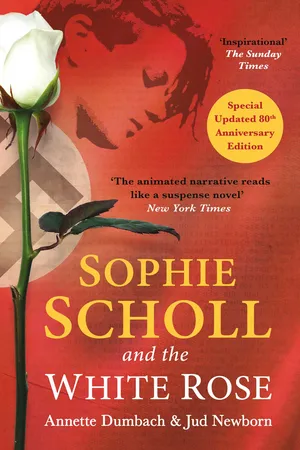
Sophie Scholl and the White Rose tells the gripping true story of five Munich university students who set up an underground resistance movement in World War II.

The thrilling story of their courage and defiance, brought to life in the Oscar-nominated film Sophie Scholl - The Final Days, is beautifully told in this special 80th anniversary edition of Annette Dumbach & Jud Newborn's critically acclaimed work.

Acclaim for Sophie Scholl and the White Rose:

'The animated narrative reads like a suspense novel.' New York Times


'Powerful and compelling... Among the indispensable literature of modern political culture.' Hans-Wolf von Wietersheim, Das Parlament

'A dramatic story of courage during the darkest period of the 20th Century... And it's a story with new chapters unfolding. This book is a fundamental resource and a memorable read.' Toby Axelrod, author and reporter
Frequently asked questions

Yes, you can cancel anytime from the Subscription tab in your account settings on the Perlego website. Your subscription will stay active until the end of your current billing period. Learn how to cancel your subscription.
At the moment all of our mobile-responsive ePub books are available to download via the app. Most of our PDFs are also available to download and we're working on making the final remaining ones downloadable now. Learn more here.
Perlego offers two plans: Essential and Complete
  • Essential is ideal for learners and professionals who enjoy exploring a wide range of subjects. Access the Essential Library with 800,000+ trusted titles and best-sellers across business, personal growth, and the humanities. Includes unlimited reading time and Standard Read Aloud voice.
  • Complete: Perfect for advanced learners and researchers needing full, unrestricted access. Unlock 1.4M+ books across hundreds of subjects, including academic and specialized titles. The Complete Plan also includes advanced features like Premium Read Aloud and Research Assistant.
Both plans are available with monthly, semester, or annual billing cycles.
We are an online textbook subscription service, where you can get access to an entire online library for less than the price of a single book per month. With over 1 million books across 1000+ topics, we’ve got you covered! Learn more here.
Look out for the read-aloud symbol on your next book to see if you can listen to it. The read-aloud tool reads text aloud for you, highlighting the text as it is being read. You can pause it, speed it up and slow it down. Learn more here.
Yes! You can use the Perlego app on both iOS or Android devices to read anytime, anywhere — even offline. Perfect for commutes or when you’re on the go.
Please note we cannot support devices running on iOS 13 and Android 7 or earlier. Learn more about using the app.
Yes, you can access Sophie Scholl and the White Rose by Annette Dumbach,Jud Newborn in PDF and/or ePUB format, as well as other popular books in History & Historical Biographies. We have over one million books available in our catalogue for you to explore.

Information

APPENDIX 1: LEAFLETS
Leaflets of the White Rose
The First Leaflet*
Nothing is so unworthy of a civilized nation as to allow itself to be “governed” without any opposition by an irresponsible clique that has yielded to basest instincts. It is certainly the case today that every honest German is ashamed of his government. Who among us has any conception of the enormous shame that we and our children will feel when eventually the veil drops from our eyes and the most horrible of crimes—crimes that eclipse all atrocities throughout history—are exposed to the full light of day? If the German people are already so corrupted and spiritually crushed that they do not raise a hand, unquestioningly trusting in the dubious legitimacy of historical order; if they surrender man’s highest principle, that which raises him above all of God’s creatures: his free will; if they abandon the will to take decisive action and turn the wheel of history and thus subject it to their own rational decision; if they are so devoid of all individuality, have already gone so far along the road toward becoming aspiritless and cowardly mass—then, yes, they deserve their downfall.
Goethe speaks of the Germans as a tragic people, like the Jews and the Greeks, but today they seem to be rather a spineless, weak-willed herd of hangers-on, who now—the marrow sucked out of their bones, robbed of their center of stability—are waiting to be hounded to their destruction. So it seems—but it is not so. Rather, by means of gradual, treacherous, systematic abuse, the system has put every man into a spiritual prison. Only now, finding himself lying in fetters, has he become aware of his fate. Only a few recognized the threat of ruin, and the reward for their heroic warning was death. We will have more to say about the fate of these people.
If everyone waits for someone else to make a start, the messengers of avenging Nemesis will come steadily closer, until even the last victim has been cast senselessly into the maw of the insatiable demon. Therefore every individual has to consciously accept his responsibility as a member of Western and Christian civilization in this last hour; to arm himself as best he can to work against the scourges of humanity, against fascism and every other form of the absolute state. Adopt passive resistance—resistance—wherever you are, and block the functioning of this atheistic war machine before it is too late, before the last city is a heap of rubble, like Cologne, and before the last youth of our nation bleeds to death on some battlefield because of the hubris of a sub-human. Don’t forget that every people gets the government it deserves!
From Friedrich Schiller’s “The Lawgiving of Lycurgus and Solon”:
Viewed in relation to its purposes, of Lycurgus’ code of law is a masterpiece of political science and knowledge of human nature. He desired a powerful, unassailable state, firmly based on self-created principles. Political effectiveness and permanence were the goals toward which he strove, and he attained these goals to the fullest extent possible under the circumstances. But if one compares the purpose Lycurgus had in mind with the purposes of mankind, then a deep abhorrence takes the place of the approbation we felt at first glance. Anything may be sacrificed for the good of the state except that end for which the State serves as a means. The state is never an end in itself; it is important only as a condition under which the purpose of mankind can be attained, and this purpose is none other than the development of all the abilities that man possesses. If a state prevents the development of the capacities which reside in man, if it hinders the progress of the spirit, then it is reprehensible and corrosive, no matter how excellently devised, how perfect in its own way. Its very permanence in that case amounts more to a reproach than to a basis for fame; it becomes a prolonged evil, and the longer it exists, the more corrosive it is. . . .
At the price of all moral feeling a political system was set up, and the resources of the state were mobilized to that end. In Sparta there was no conjugal love, no mother love, no filial devotion, no friendship; all men were merely citizens, and all virtue was civic virtue.
A law of the state made it the duty of Spartans to be inhumane to their slaves; in these unhappy victims of war humanity itself was insulted and mistreated. In the Spartan code of law the dangerous principle was promulgated that men are to be looked upon as means and not as ends—and the foundations of natural law and of morality were destroyed by that law. . . .
What an admirable sight it is, in contrast, to see the rough soldier Gaius Marcius in his camp before Rome, when he renounced vengeance and victory because he could not endure the sight of a mother’s tears! . . .
The state [of Lycurgus] could endure only under the one condition: that the spirit of the people remained quiescent. Hence it could be maintained only if it failed to achieve the highest, the sole purpose of a state.
From Goethe’s The Awakening of Epimenides, Act II, Scene 4.
Spirits:
Though he who has boldly ...

Table of contents

  1. Cover
  2. Praise for the book
  3. Title
  4. Contents
  5. Dedication
  6. Preface
  7. Foreword
  8. Sophie Scholl and the White Rose
  9. Appendix 1- The First Leaflet
  10. The Second Leaflet
  11. The Third Leaflet
  12. The Fourth Leaflet
  13. The Fifth Leaflet
  14. The Sixth Leaflet
  15. The Seventh Leaflet
  16. Appendix 2
  17. Appendix 3
  18. Appendix 4
  19. Appendix 5
  20. Appendix 6
  21. Appendix 7
  22. Appendix 8
  23. List of illustrations
  24. Illustrations
  25. Acknowledgments
  26. Sources
  27. Copyright