The Autism Job Club
eBook - ePub

The Autism Job Club

The Neurodiverse Workforce in the New Normal of Employment

  1. 272 pages
  2. English
  3. ePUB (mobile friendly)
  4. Available on iOS & Android
eBook - ePub

The Autism Job Club

The Neurodiverse Workforce in the New Normal of Employment

About this book

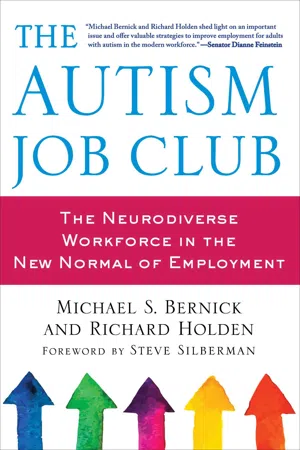
The Autism Job Club is a groundbreaking book for bringing adults with autism and other neuro-diverse conditions into the work world.
This second edition of The Autism Job Club includes a new Foreword by Steve Silberman, author of the best-selling NeuroTribes, along with an Afterword by the authors. The Afterword covers the many employment initiatives for adults on the autism spectrum launched just in the three years since the book was originally published.
The book has its basis in the autism job club that the authors have been part of in the San Francisco Bay Area, the job-creation and job-placement efforts the club has undertaken, and similar efforts throughout the United States.
The authors review the high unemployment rates among adults with autism and other neuro- diverse conditions more than two decades after the ADA. Bernick and Holden also outline and explain six strategies that, taken together, will reshape employment for adults with autism: the art of the autism job coach; the autism advantage in technology employment; autism employment and the internet economy; autism employment and the practical/craft economy; autism and extra-governmental job networks; autism and public service employment.
The Autism Job Club is a vital resource for adults with autism, their families, and advocates who are committed to neuro-diverse employment, not unemployment. But it also speaks to a far broader audience interested in how to carve out a place for themselves or others in an increasingly competitive job world.
Frequently asked questions

Yes, you can cancel anytime from the Subscription tab in your account settings on the Perlego website. Your subscription will stay active until the end of your current billing period. Learn how to cancel your subscription.
At the moment all of our mobile-responsive ePub books are available to download via the app. Most of our PDFs are also available to download and we're working on making the final remaining ones downloadable now. Learn more here.
Perlego offers two plans: Essential and Complete
  • Essential is ideal for learners and professionals who enjoy exploring a wide range of subjects. Access the Essential Library with 800,000+ trusted titles and best-sellers across business, personal growth, and the humanities. Includes unlimited reading time and Standard Read Aloud voice.
  • Complete: Perfect for advanced learners and researchers needing full, unrestricted access. Unlock 1.4M+ books across hundreds of subjects, including academic and specialized titles. The Complete Plan also includes advanced features like Premium Read Aloud and Research Assistant.
Both plans are available with monthly, semester, or annual billing cycles.
We are an online textbook subscription service, where you can get access to an entire online library for less than the price of a single book per month. With over 1 million books across 1000+ topics, we’ve got you covered! Learn more here.
Look out for the read-aloud symbol on your next book to see if you can listen to it. The read-aloud tool reads text aloud for you, highlighting the text as it is being read. You can pause it, speed it up and slow it down. Learn more here.
Yes! You can use the Perlego app on both iOS or Android devices to read anytime, anywhere — even offline. Perfect for commutes or when you’re on the go.
Please note we cannot support devices running on iOS 13 and Android 7 or earlier. Learn more about using the app.
Yes, you can access The Autism Job Club by Michael Bernick,Richard Holden in PDF and/or ePUB format, as well as other popular books in Medicine & Careers. We have over one million books available in our catalogue for you to explore.

Information

Publisher
Skyhorse
Year
2018
Print ISBN
9781510728295
eBook ISBN
9781510728301
Subtopic
Careers
Part I
The Six Autism Employment Strategies
1
WE COME TOGETHER AS THE AUTISM JOB CLUB: INTRODUCING SIX AUTISM EMPLOYMENT STRATEGIES
The Laughing Vanguard
ON THE FIRST Saturday of each month, the Bay Area Autism Job Club gathers at the ARC building, located at 11th and Howard in San Francisco’s South of Market area. Fifteen or so adults with autism are in attendance, ranging in age from early twenties to fifties, and even one member, James Ullrey, age seventy-two.
It is not easy to see the Autism Job Club as the vanguard of change for workers with autism. At the meetings, club members will laugh inappropriately or talk to themselves, go off topic, stare into space, wander around. Though many of the members have at least some college education—and a significant number have college degrees—they all are on the employment margins. Some are unemployed; most have part-time or contingent lower wage employment. The club meetings focus on relatively basic job search skills, rĂ©sumĂ© skills, and interviewing skills.
Yet, the Autism Job Club, and hundreds of other local groups across the United States, are experimenting with new employment projects and structures for workers with autism and other neurodiverse conditions—cerebral palsy, dyslexia, learning disabilities. It is an effort pushed forward by the unsustainable rise in costs of government disability programs, changing social views, and most of all, the fierce energy and extra-governmental efforts of families and friends of workers with neurodiverse conditions.
Autism: A True Spectrum
“If you’ve met one person with autism, you’ve met one person with autism,” Temple Grandin responds when asked about the characteristics of persons with autism. Ms. Grandin, a professor of animal science and inventor who was diagnosed with autism as a child, has been a presence in the autism community nationwide since the early 1980s, with separate memoirs published in 1986 (Emergence: Labeled Autistic) and 1996 (Thinking in Pictures). She became known to a wider population in 2010 through the movie, Temple Grandin, in which she was portrayed by actress Claire Danes.
Adults with autism span a wide range of skills, abilities, education levels, and interests. Much of the conventional wisdom regarding work skills and deficiencies of persons on the spectrum is wrong. Adults on the spectrum, for example, do not all excel in areas of math or science (most don’t) or are “little geniuses.” At the same time, adults on the spectrum are not all plagued by social isolation or difficulties/a lack of interest in workplace relations (many are very social).
So it is with the diversity of skills and abilities in our autism job club, as is clear from our first meetings. In early November 2011, the Autism Asperger Syndrome Coalition for Education Networking and Development (AASCEND), the volunteer group of adults with autism and their friends and families, posted a note to its members regarding the formation of a job club. At the first meeting, on Saturday, November 19, forty of us gathered in a small classroom at the City College campus in downtown San Francisco. As we went around the room, the participants described their job status and job searches, which varied widely. Here is how each participant described himself or herself at the time:
1. Paul, fifty-four, has a handyman business in Stockton that he has been trying to build up. He has a BA degree in geography from Fresno State and has held a few jobs in the field that didn’t last long. This led him to self-employment.
2. Andrew, thirty-two, completed two years of college and is working part-time with a recycling company while pursuing his sculpturing and design work.
3. Alex, thirty-one, has a BA degree in child/adolescent education from San Francisco State University. His job history includes short-term stints as a courtesy clerk at a large supermarket, a busman at a coffee shop chain, and a four-month position in the technology department of a major hotel. He currently is volunteering at the ARC while he looks for a job.
4. Gabriel, twenty-eight, has some college credits and is doing short-term transcription gigs he finds through family contacts while he seeks a full-time job.
5. Mark, early forties, worked in the information technology field for fifteen years as a consultant. His business partner, who was responsible for business development, passed away four years ago, the company fell apart, and Mark has not worked steadily since.
6. Martha, late twenties, has a masters degree, but has been able only to find work twelve hours a week as a clerk in a small legal office. She seeks more steady work, perhaps in a job related to her library science degree.
7. Jim, seventy-two, is the senior member of the group. He has college degrees in physics and chemistry and worked for Apple on a project basis a few years back. Mainly, though, he has worked in non-technology jobs: delivering pizza, doing yard work, supervising an after-school program for youth. He is not working now, but at seventy-two, still in the market for work.
The Autism Job Club Comes Together and Branches Out
Since that first meeting in November 2011, a number of the original participants have stopped coming. Some have found jobs, others have drifted out. Meanwhile new members have joined the group. The club is a fluid one; members come for as long or short a time as they find value. Some participants are employed or in school but come to improve their job search skills for future employment.
We rely mainly on volunteers—counselors, parents, graduate students. Cindy Zoeller is a workforce career coach in Sacramento who heard about the job club and drove ninety miles to the organizational meeting. She volunteers as the club facilitator, preparing the agenda and handouts and leading each session. She is joined by John Comegys, a job coach from Dixon who comes to volunteer, along with four graduate students from San Francisco State University.
The meetings start with an update on our job searches and a sharing of job leads. Each meeting then focuses on a specific job-search technique: using job boards, interviewing, preparing a résumé, getting in the door through part-time or contingent work, resolving issues that arise on the job. In between meeting dates, Ms. Zoeller keeps in touch with individual members to discuss their specific job situations and job searches.
Beyond the job placement activities, the club soon branched out in 2012 and early 2013 with other employment strategies. Brian Jacobs, a venture capitalist and job club volunteer, launched a LinkedIn site, Spectrum Employment Community by AASCEND. The site is an online discussion board for job club members, as well as an online job board and an online reference for employers. It is also a reference for parents and advocates seeking to keep up with latest information on employment for workers with autism.
In 2012, two club members, Luby and Andy Aczel, started a combination business/training agency, The Specialists Guild (Guild). The Guild is aimed at training persons with autism for employment in software testing—an occupation which the Aczels believe can be uniquely suited to persons with autism. The Aczels and other club members also built an autism technology employment network to promote hiring with Bay Area technology firms.
Laura Shumaker started a popular autism blog for the San Francisco Chronicle. She volunteered to research and report on autism employment efforts elsewhere in California.
The Six Strategies for Autism Employment
In this book, we draw on the experiences of our club members and club activities. We also draw on the experiences of other autism employment projects throughout the United States. The field is a very active one, with adults with autism, parents, and advocates coming together and new projects being launched regularly.
The following chapters are structured around two main lines of argument arising from these experiences. The first is that an improved autism employment system will be a series of strategies. Just as there is no “right” industry sector or occupation for all adults with autism, there is not a single strategy for our collective employment efforts. The technology sector will offer employment opportunities for adults with autism. So too will the Internet economy—some jobs directly in Internet economy firms, more jobs in the Internet economic activity of the share economy and social mission economy. The greatest number of jobs will be in the practical economy, of health aides, retail clerks, bakers, and repair persons. Job placement will involve multiple sectors as well as strategies of autism job coaches, on-going skills gains, supported work, and workplace culture.
We also explore the roles and limits of government programs. Government programs for adults with autism have continued to expand over the past twenty-five years since the passage of the Americans with Disabilities Act. Yet, the unemployment rate of adults with autism has not significantly declined. Why is this so, since, while placement performance is uneven among programs, most of the programs do place participants into jobs? Even if doubled in size, though, the programs would only reach a small part of the population. Government programs alone can never be the answer. A broad employment network outside of government is needed. Such a network is slowly emerging and its expansion has to be a priority.
In the first section of this book (Chapters 2–6), we discuss the Autism Job Club and the adult autism community in the United States today and its employment status. We start in the next chapter by saying more about the ways that club members have come together to protect each other as well as to seek collective approaches to housing, social networks, and employment futures.
In Chapter 3 we turn to the explosion in autism numbers in the United States and autism presence in public consciousness. Three decades ago, autism was a condition little known and little covered. Today it is difficult to pick up a newspaper or magazine or turn on the television without seeing a reference to autism.
Despite this sea change in autism’s role in American society, the employment of workers has not changed much in the past three decades and more, as set out in chapter 4. An estimated 60 to 70 percent of persons with autism are unemployed. Many sustain themselves financially through government benefit rolls, especially through the Supplemental Security Income (SSI) and Social Security Disability Insurance (SSDI) programs—the latter which has skyrocketed in numbers in the past few decades. In Chapter 5, we examine the background and employment journey of one adult with autism, illustrating in some detail the employment obstacles. In Chapter 6, we examine the backgrounds and employment journeys of several other club members, illustrating the variety of employment histories.
In the second section of the book (Chapters 7–19), we build on the first section and on our examination of autism employment initiatives which have been undertaken in recent years. Our findings lead us to six strategies that, taken together, can begin to reshape the nature of employment for adults with autism. These strategies are: (i) the art of the autism job coach, (ii) autism and technology advantage, (iii) autism and the emerging Internet economy, (iv) autism and the practical/craft economy, (v) autism and supported employment, and (vi) autism, lifelong learning, and workplace culture.
Our Collective Journey
As we shall see in the pages ahead, the employment journeys of our job-club members, especially those of the older members, have been difficult ones. For them, getting a job rarely leads to employment stability. Our members may be slower than others to pick up tasks, behave in inappropriate manners, not appear on time, or lose jobs in the largely unforgiving job world.
Some job placement projects for adults with autism focus today on interviewing skills and improving eye contact, and making a positive presentation. All of these are valuable skills and our Autism Job Club seeks to teach them. Cindy Zoeller has sessions to videotape mock interviews and review them with our members.
Yet, the obstacles facing our members usually go way beyond eye contract. These obstacles may involve major cognitive gaps and information processing gaps. They may involve major gaps in judgment. They may involve a lack of executive skills—including knowing what to do and being able to act effectively if a job is lost.2
The building of a better employment system for adults with autism will take the active efforts of all of us. It will involve pilot projects, experiments, and missteps. It will mean building on thousands of different efforts across the United States by adults with autism, parents, and advocates coming together.
The FRED conference in Los Angeles for “special needs adults” is one of the main annual national conferences involving the autism community. In March 2014, the panel on employment was the featured panel, and the conference lead, Ms. Mari-Anne Kehler, opened by stating, “Nothing says purpose and living with meaning like employment.” Then followed several references by the panel moderator, an attorney in the San Gabriel Valley, to the “incredible” skills of our young adults with disabilities and the “amazing” employment projects they were involved in, that were paving the way to fuller employment.
The employment opportunities that the participants described, though, were very modest: a job at a small restaurant in Albuquerque; a micro-business in animation started by a college student with autism in Southern California; a series of small ventures in laundry service, premium candles, and office services by a non-profit autism agency in Chapel Hill. Looked at one way, the number of jobs generated was miniscule; the claims of fuller employment exaggerated.
Yet looked at another way, something unusual and noteworthy was going on in the conference room. The presenters and audience were not whining or complaining or presenting themselves as victims. Nor were they waiting for government to do something. Against all odds, they were trying to generate employment for themselves and others, to engage in mutual support, to work with government, but also outside of government.
The autism community’s efforts toward a better employment system are still in their very early stages. We are in a wilderness that we only partly understand, and on a road that is not clearly marked. We have much to discover.
Come join our collective journey in the next chapters as we examine who we are, what we have learned so far, and strategies for advancing on this journey.
2
THE AUTISM JOB CLUB AS VOLUNTARY ASSOCIATION AND MUTUAL SUPPORT
THE EXTRA-GOVERNMENTAL NETWORK—THE voluntary association of adults with autism, parents, and advocates—is at the center of autism employment efforts.
It will be valuable at this starting point to say a little about one su...

Table of contents

  1. Cover
  2. Title Page
  3. Dedication
  4. Copyright
  5. Contents
  6. Foreword
  7. Introduction Creating a Place in the Emerging Job World
  8. Part I The Six Autism Employment Strategies
  9. Part II The Adult Autism Community in the United States Today and Its Employment Status
  10. Part III The Art of the Autism Job Coach
  11. Part IV Autism, Technology, and the Growing Internet Economy Employment
  12. Part V Autism and the Practical Economy
  13. Part VI Autism and Employment for the More Severely Impacted
  14. Part VII Lifelong Learning, Workplace Culture, and the Future of the Autism Job Club
  15. Afterword Recent Developments in Autism Employment
  16. Notes
  17. Acknowledgments
  18. About the Authors
  19. Index