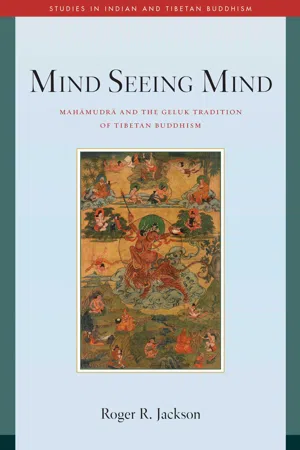
A definitive study of one of the most important practices in Tibetan Buddhism, with translations of a number of its key texts. Mahamudra, the "great seal, " refers to the ultimate nature of mind and reality, to a meditative practice for realizing that ultimate reality, and to the final fruition of buddhahood. It is especially prominent in the Kagyü tradition of Tibetan Buddhism, so it sometimes comes as a surprise that mahamudra has played an important role in the Geluk school, where it is part of a special transmission received in a vision by the tradition's founder, Tsongkhapa. Mahamudra is a significant component of Geluk ritual and meditative life, widely studied and taught by contemporary masters such as the Dalai Lama.
Roger Jackson's Mind Seeing Mind offers us both a definitive scholarly study of the history, texts, and doctrines of Geluk mahamudra and masterful translations of its seminal texts. It provides a skillful survey of the Indian sources of the teaching, illuminates the place of mahamudra among Tibetan Buddhist schools, and details the history and major textual sources of Geluk mahamudra. Jackson also addresses critical questions, such as the relation between Geluk and Kagyü mahamudra, and places mahamudra in the context of contemporary religious studies. The translation portion of Mind Seeing Mind includes ten texts on mahamudra history, ritual, and practice. Among these are the First Panchen Lama's root verses and autocommentary on mahamudra meditation, his ritual masterpiece Offering to the Guru, and a selection of his songs of spiritual experience.
Mind Seeing Mind adds considerably to our understanding of Tibetan Buddhist spirituality and shows how mahamudra came to be woven throughout the fabric of the Geluk tradition.
- 752 pages
- English
- ePUB (mobile friendly)
- Available on iOS & Android
eBook - ePub
About this book
Information
Topic
Theology & ReligionSubtopic
BuddhismTable of contents
- Cover Page
- Title Page
- Dedication
- Publisher’s Acknowledgment
- Contents
- Preface
- Permissions
- Technical Note
- Introduction
- Part 1. The Background to Geluk Mahāmudrā
- Part 2. Early Geluk Mahāmudrā
- Part 3. Later Geluk Mahāmudrā
- Part 4. Perspectives on Geluk Mahāmudrā
- Part 5. Translations
- Appendix A: The Geluk Mahāmudrā Uncommon Proximate Lineage
- Appendix B: The Geluk Mahāmudrā Uncommon Distant Lineage
- Appendix C: Keutsang Jamyang Mönlam’s Outline of Highway of the Conquerors
- Bibliography
- Index
- About the Author
- Copyright
Trusted by 375,005 students
Access to over 1.5 million titles for a fair monthly price.
Study more efficiently using our study tools.
Frequently asked questions
Yes, you can cancel anytime from the Subscription tab in your account settings on the Perlego website. Your subscription will stay active until the end of your current billing period. Learn how to cancel your subscription
No, books cannot be downloaded as external files, such as PDFs, for use outside of Perlego. However, you can download books within the Perlego app for offline reading on mobile or tablet. Learn how to download books offline
Perlego offers two plans: Essential and Complete
- Essential is ideal for learners and professionals who enjoy exploring a wide range of subjects. Access the Essential Library with 800,000+ trusted titles and best-sellers across business, personal growth, and the humanities. Includes unlimited reading time and Standard Read Aloud voice.
- Complete: Perfect for advanced learners and researchers needing full, unrestricted access. Unlock 1.5M+ books across hundreds of subjects, including academic and specialized titles. The Complete Plan also includes advanced features like Premium Read Aloud and Research Assistant.
We are an online textbook subscription service, where you can get access to an entire online library for less than the price of a single book per month. With over 1.5 million books across 990+ topics, we’ve got you covered! Learn about our mission
Look out for the read-aloud symbol on your next book to see if you can listen to it. The read-aloud tool reads text aloud for you, highlighting the text as it is being read. You can pause it, speed it up and slow it down. Learn more about Read Aloud
Yes! You can use the Perlego app on both iOS and Android devices to read anytime, anywhere — even offline. Perfect for commutes or when you’re on the go.
Please note we cannot support devices running on iOS 13 and Android 7 or earlier. Learn more about using the app
Please note we cannot support devices running on iOS 13 and Android 7 or earlier. Learn more about using the app
Yes, you can access Mind Seeing Mind by Roger R. Jackson in PDF and/or ePUB format, as well as other popular books in Theology & Religion & Buddhism. We have over 1.5 million books available in our catalogue for you to explore.