Mindfulness Yoga
eBook - ePub

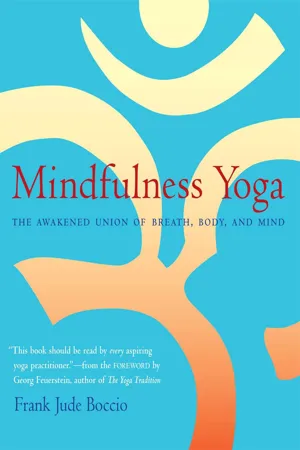
Mindfulness Yoga

The Awakened Union of Breath, Body, and Mind

  1. 368 pages
  2. English
  3. ePUB (mobile friendly)
  4. Available on iOS & Android
eBook - ePub

Mindfulness Yoga

The Awakened Union of Breath, Body, and Mind

About this book

Whether you have no background in meditation or yoga or have been practicing for years, Mindfulness Yoga is for you. This groundbreaking book introduces an entirely new form of yoga, Mindfulness Yoga, which seamlessly integrates the Buddha's teachings on the Four Foundations of Mindfulness with traditional asana yoga practice.Mindfulness Yoga emphasizes the spiritual side of yoga practice, an aspect often overlooked in a culture that tends to fixate solely on the physical benefits of yoga. Unlike any other Buddhism-meets-yoga book, Mindfulness Yoga presents the two disciplines as a single practice that brings health to the body and liberates the mind and spirit, awakening compassion and fostering equanimity and joy. Mindfulness Yoga will appeal to the many people who have an interest in yoga, Buddhism, and meditation, but who may not have been able to find a teacher who could bring these practices together in a meaningful, practical way.In the first part of the book, author Frank Jude Boccio offers a superb and lively introduction to the Buddha's teachings and locates them within the larger context of the Indian spiritual traditions. Then, in the second half of the book, Boccio offers three complete Mindfulness Yoga sequences, including over 100 pictures, with detailed guidance for body, breath, and mind. Special lay-flat binding makes this book even more useful as a practice aid.
Frequently asked questions

Yes, you can cancel anytime from the Subscription tab in your account settings on the Perlego website. Your subscription will stay active until the end of your current billing period. Learn how to cancel your subscription.
No, books cannot be downloaded as external files, such as PDFs, for use outside of Perlego. However, you can download books within the Perlego app for offline reading on mobile or tablet. Learn more here.
Perlego offers two plans: Essential and Complete
  • Essential is ideal for learners and professionals who enjoy exploring a wide range of subjects. Access the Essential Library with 800,000+ trusted titles and best-sellers across business, personal growth, and the humanities. Includes unlimited reading time and Standard Read Aloud voice.
  • Complete: Perfect for advanced learners and researchers needing full, unrestricted access. Unlock 1.4M+ books across hundreds of subjects, including academic and specialized titles. The Complete Plan also includes advanced features like Premium Read Aloud and Research Assistant.
Both plans are available with monthly, semester, or annual billing cycles.
We are an online textbook subscription service, where you can get access to an entire online library for less than the price of a single book per month. With over 1 million books across 1000+ topics, we’ve got you covered! Learn more here.
Look out for the read-aloud symbol on your next book to see if you can listen to it. The read-aloud tool reads text aloud for you, highlighting the text as it is being read. You can pause it, speed it up and slow it down. Learn more here.
Yes! You can use the Perlego app on both iOS or Android devices to read anytime, anywhere — even offline. Perfect for commutes or when you’re on the go.
Please note we cannot support devices running on iOS 13 and Android 7 or earlier. Learn more about using the app.
Yes, you can access Mindfulness Yoga by Frank Jude Boccio in PDF and/or ePUB format, as well as other popular books in Biological Sciences & Sport & Exercise Science. We have over one million books available in our catalogue for you to explore.
PART ONE
PUTTING IT IN CONTEXT
dp n="35" folio="12" ?dp n="36" folio="13" ?
CHAPTER ONE
THE BUDDHA’S YOGA
THROUGH ARCHAEOLOGICAL EVIDENCE, we are now beginning to understand that the Indus/Sarasvati civilization, located in the northwest of the subcontinent of what is modern-day India, prospered as far back as 6500 B.C.E. and reached its maturity between 3100 B.C.E. and 1900 B.C.E. It was apparently a complex civilization: technically proficient, using wheeled carts and boats and a decimal-based measurement system which, among other things, has revealed a remarkable ability to accurately measure weights. Further, there were baths in most homes which were connected to a public drainage system having brick-lined sewers fitted with manholes. Only the Romans, over two thousand years later, had a comparable system. It has been conjectured, based upon the ordered geometric plan of the towns (all quite similar to each other although spread out over an area larger than the ancient civilizations of Sumer, Assyria and Egypt combined-over 300,000 square miles) that this Indic civilization was governed by a conservative priestly elite.
Cultural artifacts left behind by this great civilization—including terracotta seals depicting a variety of figures reminiscent of later Hinduism—suggest that they already practiced a rudimentary form of what we now know as yoga. One featuring a male divinity surrounded by animals, has been thought to be an early depiction of Lord Shiva, the archetypal yogin known as the Lord of the Beasts. They also apparently worshipped a Great Mother or earth goddess figure, as indicated by a ceramic depicting a female from whose womb is growing a plant. Other objects depict images relating to the male and female generative symbols still utilized in tantric practices. Certain trees and animals were sacred to them. One such tree had particular importance: the pipal tree, which many years later would be revered by others as the Bodhi Tree, the tree under which Siddhartha Gautama would sit when he achieved enlightenment, becoming the Buddha.
The religious and philosophical teachings of this civilization were recorded orally as the Vedas (which literally means the “knowledges”), which are still considered by devout Hindus as revealed scripture. Recent research suggests that the earliest of the Vedas date from between the fifth and fourth millennia B.C.E.
By 1900 B.C.E. the great Sarasvati River had dried up and many of the cities along its banks were abandoned. The center of the Vedic civilization shifted east to the fertile banks of the Ganges. This disruption and dislocation led to great social changes, including the arising of a professional priestly class. These Brahmins and their commentaries on the Vedas, which are called the Brahmanas (a name also used for the Brahmins themselves), gave rise to a religion referred to as, perhaps not surprisingly, Brahmanism.
In what may have been an attempt to solidify their superior position in society, a caste system evolved with Brahmin priests occupying the top of the social hierarchy, along with senior officials and counselors to kings. Next were the Kshatriyas, the ruling and warrior class, followed below them by the Vaisyas, the emerging merchant class. The lowest class, the Sudras, consisted of common laborers akin to serfs. A group considered so low that they were outside the caste system, or “outcastes,” were the Panchamas.
This caste system, along with the ever more particular and ritualized practice of the Brahmins, had the effect of removing the Brahmanic faith from the lived experience of the majority at the bottom of the social ladder. From as early as 1500 to 1000 B.C.E., others began to expand and develop the ideas of Brahmanism from an outwardly focused ritualized system based upon the fire ceremony, and even animal sacrifice, into a more internalized form of spiritual practice. From this movement arose the earliest of the Upanishads.
The word upanishad means “sitting near” (as one does to one’s teacher) and refers to the fact that Upanishadic teachings were delivered directly from teacher to disciple by word of mouth. While they are quite diverse in their teachings, as Georg Feuerstein notes in his wonderful text, The Yoga Tradition, we can see the prominence of four closely related themes: (1) that the transcendental core of one’s being, the Atman, is identical with the transcendent ground of being itself, Brahman; (2) the doctrine of reincarnation, sometimes called “repeated embodiment” (punar-janman) or, in the earlier Upanishads, “repeated death” (punar-mrityu); (3) the doctrine of karma, which means “action” and refers to the moral force of one’s acts, intentions, and words; it is a doctrine of moral causality that sees causal retribution as akin to what modern science would call a law of nature; and (4) the idea that the law of karma is not fatalistic: karma can be transcended, and reincarnation ended, through spiritual practices such as renunciation and meditation. By the time of the Yoga-Upanishads, written after Patanjali, many of them as late as the fourteenth and fifteenth centuries of the common era, the practical approach to liberation became synonymous with yoga.
By the time of the Buddha’s birth, most often given as 563 B.C.E., the Brahmin priesthood had become a rigid, often quite corrupt, and exclusivist society. For example, while the original castes were not hereditary, by the time of the Buddha’s birth they had acquired a sacred significance and justification. They were seen to mirror the order of the cosmos, and thus had become immutable. No longer was there the possibility of social mobility. Those at the bottom of the social ladder, who no doubt yearned for a spiritual teaching that would speak to them, were denied instruction in Brahmanism and kept apart from the higher castes, and in this way the Brahmanic faith was entirely removed from their lived experience. At the same time, the ideas expressed in the Upanishads were filtering out into the wider intellectual community. A movement of wandering ascetics arose as an alternative to the strict ritualism of the Brahmanas. Some of these wanderers were even of Brahmin origin and were called paribbajakas, meaning “wanderers” whether or not their practice was orthodox (based upon the Vedas). But an even larger group, the shramanas (samanas in Pali) meaning “strivers,” made up of members from the other castes, followed a wide variety of heterodox practices.
Living ascetic lives, these shramanas moved from town to town, village to village, subsisting on alms and free from family ties, in order to practice contemplation, expound their theories, and investigate through questioning and debate among themselves and others. The Jains, a still extant religion in India, originated as a shramana group. Another, even larger and more popular religion worldwide also had its start as a shramana group: Buddhism.


Siddhartha Gautama was born into the Kshatriya class, the son of a raja, a king, and as such, he enjoyed a privileged position. Despite his luxurious lifestyle, the young Siddhartha felt discontented. Knowing that life was ephemeral, that he was subject to old age, sickness, and death, he could not rest easy in his mind. Finally, it was the sight of a shramana one day that inspired Siddhartha to pursue the spiritual path. Seeing how calm, quiet, and peaceful the shramana seemed, the young prince thought to himself, “Maybe he knows. Maybe this is the way. Maybe in this way I shall find an answer to the problems that are tormenting me.”
Spurred on by this insight, Siddhartha made what has come to be called the Great Renunciation, leaving behind his family and the luxuries of the palace to enter upon the homeless life. The Bodhisattva (as the Buddha is referred to before his enlightenment), eager to seek liberation, first went to study with the shramana sage Alara Kalama. An eager student, Siddhartha quickly grasped the intellectual doctrine espoused by Alara Kalama, but he was not content with this and so inquired after the meditational state on which the teachings were based. He was told that this was the “sphere of nothingness,” a deep state attained through yogic concentration in which the mind goes beyond any apparent object and dwells in the “thought” of nothingness. Soon enough, Siddhartha learned how to enter into this state, and Alara Kalama offered him joint leadership of his community; but he turned down the offer, feeling that, while he had attained a refined inner calmness, he had not reached the enlightenment he sought, he had not yet brought an end to suffering:
“I thought: ‘This teaching does not lead to dispassion, to fading of lust, to cessation, to peace, to direct knowledge, to enlightenment, to nibbana, but only to the base consisting of nothingness. I was not satisfied with that teaching. I left to pursue my search.’”
Gautama sought out another teacher, Uddaka Ramaputta, but his experience with this teacher was similarly disappointing, except that from Uddaka he learned the still higher yogic attainment of the “sphere of neither perception nor nonperception.” Of this state, he later said:
Even when one has reached the level of neither perception nor nonperception, although there is then liberation from form and from formlessness, there is still something left over—the thing that has been liberated from them, a watcher of “neither perception nor nonperception.” As long as such a watcher, which some call a soul, remains, though one may momentarily be secluded from the cycle of suffering, the watcher remains as a seed of rebirth. As soon as the situation changes, rebirth easily takes place again. This is just what happens now when I get up from meditating. No matter how profound my absorption, after a short time I get caught up again in the world of the senses. The basic causes and conditions for rebirth have not been extinguished! Complete liberation has not been achieved. Enlightenment must still be sought!
However elevated and subtle the state of consciousness became as a result of these meditations, these states could not be nirvana for at least two reasons. In coming out of the meditations, Siddhartha found himself still subject to craving, aversion, and delusion. He had not been permanently transformed by the meditative experience and had attained no lasting peace. Nirvana, by definition, was not temporary, but eternal.
He also questioned how any such altered state of consciousness could be equated with nirvana, “the unborn, the unconditioned, the uncreated,” when he was well aware that he had in fact created this experience, this altered state of consciousness, through his yogic prowess.
Reading these words of the Buddha, many have come to the conclusion that as a result of his experiences with these two teachers of what apparently was Samkhya yoga and Upanishadic thought, the Buddha rejected yoga and its means. Yet, in fact, he would incorporate these meditational states as well as other yogic methods into his own teachings, and he would use these yogic techniques for the rest of his life. As we see from the above passage, however, he could not accept his teachers’ metaphysical interpretation of his meditative experience. His integrity and honesty, as well as the skepticism about metaphysical doctrines that characterizes his teaching throughout his life, would not allow him to accept an interpretation not supported by his experience. So while we see that the Buddha may have rejected traditional yogic metaphysics, he can be seen as having been one of India’s greatest yoga practitioners in his unwavering commitment to direct realization.


When I first read about the Buddha’s dissatisfaction with the teachings he received, I instantly recognized the similarity to my own experience—how wonderfully calm and peaceful I felt after “yoga practice,” and yet how all too soon I fell back into the suffering of craving and aversion—lust and anger. And when I became a yoga teacher, I saw how many students seemed to have similar experiences. They would leave a class blissed out, but as soon as they got “caught up in the world of their senses,” they found themselves back amid their anxious lives—from blissed out to stressed out. So the question arises, How do we stop this apparently ceaseless cycle, this endless emotional and psychological roller coaster? In our very lives generally, and in our own practice of yoga specifically, we can see the process of samsara, the cyclic process of “birth and death” occur over and over, moment by moment! What to do about it?


Upon leaving Uddaka Ramaputta, Siddhartha set out upon the path of austerities, which some of the forest-dwelling mendicants believed could burn up all negative karma and lead to liberation. After practicing extreme forms of austerities for nearly six years, he found himself close to death but no closer to the liberation he sought. Also, despite the austerities and the mortification he practiced, his body clamored for attention, and he found himself still plagued by craving and aversion. In fact, such austerities seemed to fuel his obsession with the body, much as an anorexic is obsessed with the very body she is seeking to deny.
He began to ask himself if there might not be some other way. And in his pondering, he recalled an incident from his childhood when, as a nine-year-old, he spontaneously entered into meditation. It was during the ritual spring plowing festival, and the young Siddhartha watched how the oxen strained to pull the plow under the hot sun, how the plow, turning the soil, sliced up worms that squirmed and writhed, and how birds swooped down and took the worms in their beaks. With the seed of compassion watered in his heart, the young boy sat in the cool shade of a rose-apple tree, and “secluded from sensual desires and from unwholesome things,” entered upon and abode in the first meditation that is accompanied by thinking and exploring, “with the happiness and pleasure born of seclusion.”
All this, years later, Siddhartha recalled, and he thought to himself, “Might this be the way to enlightenment?” And then immediately an answer swelled up from deep inside that said “Yes! This is surely the way to enlightenment!”
This is good news for all of us: we needn’t torture ourselves into liberation, but nirvana is in fact natural to human beings. It is built into the very fabric of our humanity. As a child, untutored in meditation, Siddhartha was able to have intimations of nirvana spontaneously.


Take a moment now to close your eyes and recall the religion you practiced as a child. Not the religion you were tutored in, but the religion before religion, when the vast Heaven and the wondrous Earth were truly one. Perhaps it was while lying on your back looking up at the clouds, perhaps it was being enraptured by the waves rushing in and out from the shore, or perhaps it was looking deeply into the veins of a leaf. I can remember times when it rained, and I’d become absorbed in the wonder of a raindrop making its way down the windowpane. Or another time I observed a beetle make its way around a strawberry plant so intently that the beetle’s perspective became my own.
Can you remember what it was like to walk in the midst of a world of miracles? Can you remember ever traveling within a world of pure delight with a joy untainted by craving or aversion? What happened to that world? All yoga, including the Buddha’s yoga, is often called “the path of return”—a return to our true home, which we eventually come to see was never really lost.
What the Buddha saw in remembering his childhood experience is that by practicing a yoga of compassion and understanding we can cultivate the innate capacities we all share already, capacities that can lead us to ceto-vimutti, a term from the Pali canon meaning the “release of the mind” that is often used as a synonym for enlightenment. We...

Table of contents

  1. Cover
  2. PUBLISHER’S ACKNOWLEDGMENT
  3. Foreword
  4. Acknowledgements
  5. HOW TO USE THIS BOOK
  6. SOME WORDS ABOUT THE ASANAS
  7. A WORD ABOUT WORDS
  8. Introduction
  9. INTERLUDE
  10. PART ONE - PUTTING IT IN CONTEXT
  11. PART TWO - CULTIVATING MINDFULNESS: REMEMBERING THE PRESENT
  12. PART THREE - THE PRACTICE OF MINDFULNESS YOGA
  13. APPENDIX A: - THE SEVEN FACTORS OF AWAKENING
  14. APPENDIX B: - TEXT OF SUTRA ON THE FULL AWARENESS OF BREATHING
  15. APPENDIX C: - ESTABLISHING YOUR SEAT
  16. APPENDIX D: - ALPHABETICAL LIST OF POSES
  17. NOTES
  18. SUGGESTED RESOURCES
  19. INDEX
  20. ABOUT WISDOM
  21. Copyright Page