This book is available to read until 4th December, 2025
- 272 pages
- English
- ePUB (mobile friendly)
- Available on iOS & Android
eBook - ePub
Available until 4 Dec |Learn more
About this book
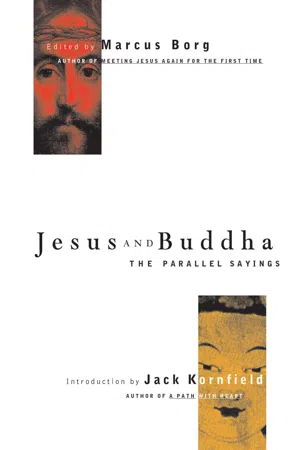
Jesus and Buddha were separated by five hundred years, three thousand miles, and two drastically different cultures. Yet this trade paper edition of the highly acclaimed hardback juxtaposes passages from the New Testament and ancient Buddhist scriptures to illuminate the striking similarity between their lives, deeds, and teachings.
Frequently asked questions
Yes, you can cancel anytime from the Subscription tab in your account settings on the Perlego website. Your subscription will stay active until the end of your current billing period. Learn how to cancel your subscription.
No, books cannot be downloaded as external files, such as PDFs, for use outside of Perlego. However, you can download books within the Perlego app for offline reading on mobile or tablet. Learn more here.
Perlego offers two plans: Essential and Complete
- Essential is ideal for learners and professionals who enjoy exploring a wide range of subjects. Access the Essential Library with 800,000+ trusted titles and best-sellers across business, personal growth, and the humanities. Includes unlimited reading time and Standard Read Aloud voice.
- Complete: Perfect for advanced learners and researchers needing full, unrestricted access. Unlock 1.4M+ books across hundreds of subjects, including academic and specialized titles. The Complete Plan also includes advanced features like Premium Read Aloud and Research Assistant.
We are an online textbook subscription service, where you can get access to an entire online library for less than the price of a single book per month. With over 1 million books across 1000+ topics, we’ve got you covered! Learn more here.
Look out for the read-aloud symbol on your next book to see if you can listen to it. The read-aloud tool reads text aloud for you, highlighting the text as it is being read. You can pause it, speed it up and slow it down. Learn more here.
Yes! You can use the Perlego app on both iOS or Android devices to read anytime, anywhere — even offline. Perfect for commutes or when you’re on the go.
Please note we cannot support devices running on iOS 13 and Android 7 or earlier. Learn more about using the app.
Please note we cannot support devices running on iOS 13 and Android 7 or earlier. Learn more about using the app.
Yes, you can access Jesus and Buddha by Marcus Borg in PDF and/or ePUB format, as well as other popular books in Theology & Religion & Biblical Reference. We have over one million books available in our catalogue for you to explore.
Information
The Parallel Sayings
dp n="28" folio="" ? dp n="29" folio="3" ? PARALLEL SAYINGS, PARALLEL LIVES
“Do to others as you would have them do to you.”
“Consider others as yourself.”
The ideas—spoken by teachers separated by five hundred years, three thousand miles, and two drastically different cultures—are identical.
“Give to anyone who requests it.”
“Give when you are asked.”
Over and over again in the New Testament and ancient Buddhist scriptures, we discover that the lives, deeds and teachings of Jesus and Buddha are strikingly similar.
The correspondences in their life stories begin even before they are born. In the Gospel of Luke, the Angel Gabriel acts as God’s messenger, proclaiming that Mary will bear a child “who will be called the Son of the Most High.” Buddha’s birth, according to the second-century-B. C. Digha Nikaya, is attended by devas who say to Queen Maya, “Rejoice, a mighty son has been born to you.”
Here are two cultures as diametrically opposed as the Orient and the Occident, and yet as we delve deeper into the traditional biographies of Jesus and Buddha, the birth parallels, rather than appearing quaintly coincidental, become increasingly specific. Each is born while the mother is on a journey, and neither birth occurs in a house. Heralds are present on both occasions, and they do very similar things, singing praises and announcing that a great event has occurred, identifying the parents and prophesying the child’s glorious future.
The correlations among these ancient texts are almost eerie. As will become immediately evident in the collections of parallel sayings that follow, Jesus’ and Buddha’s later teachings are as alike as their early biographies. Whether speaking of love, material wealth, temptation or salvation, they were two masters with one message.
It shouldn’t be surprising, then, that the philosophies they developed drew them into parallel experiences during their adult years. Neither began his spiritual quest until he was about thirty years old, but both soon encountered trouble with the ruling aristocracy. Buddha, a fifth-century-B. C. prince who was heir to a throne in northern India, flouted social convention by consorting with thieves and murderers. Though he was a peasant in first-century Palestine, an obscure province of the Roman Empire, Jesus was fiercely attacked for eating with sinners and whores.
dp n="31" folio="5" ? They taught that what is inside a person matters, not his or her outward appearance, and they punctuated their beliefs with actions, revolutionizing the religions of their day. Gautama helped to reform Brahmanical rituals harmful to people and animals; Jesus attacked many temple traditions. Both created religions that minimized class distinctions and eliminated animal sacrifice.
The irony in this seems overwhelming when you realize that the new religions they initiated became the defining points for the greatest cultural schism in world history. “East is East, and West is West,” Rudyard Kipling explained, “And never the twain shall meet.” Buddha created a religion that had no God. Jesus was the very son of God. To Christians, Buddhism was a pagan religion; and for Buddhists, Christianity was a web of false hopes and dangerous myths.
In fact, it wasn’t until around Kipling’s time that anyone noticed how similar Jesus and Buddha really were. For over eighteen hundred years, from the birth of Christianity until just over a century ago, the mirrorlike nature of their images remained buried in the ancient texts of each religion. Then, in the 1880s, with the escalation of European rule in Asia and growing interest in Buddhism, scholars comparing these holy books began to notice remarkable patterns.
dp n="32" folio="6" ? One of the first of these spiritual explorers, a Dutch writer named Ernest de Bunsen, equated the Asian concept of an “angel messiah” with Christ. In his fanciful 1880 book, The Angel-Messiah of Buddhists, Essenes, and Christians, he told of exiled Jews from the East re-entering Palestine, carrying in their caravans not only rare spices but a revolutionary idea as well. The angel myth was picked up by the Essenes, a Jewish sect living in the desert during the first century, who applied it to Jesus. But Jesus, de Bunsen claimed, refuted the Essenes and tried to hide the fact that he was the Messiah. De Bunsen’s theory, difficult to believe in any era, was completely discredited with the 1947 discovery of the Dead Sea Scrolls, which are attributed to the Essenes. To date, the remains of about 870 scrolls have been discovered; not one mentions either Jesus or an “angel messiah.”
Soon afterward, a German writer named R. Seydel began uncovering strong resemblances between the infancy stories in the Gospels of Matthew and Luke and the Lalitavistara biography of Buddha. But it was a British civil servant assigned to duty in India who fully revealed these parallels. During his off hours, Arthur Lillie developed a fascination with Indian religion and began probing the ancient texts. Around 1909, he published Buddhism in Christianity and India in Primitive Christianity. Unfortunately, Lillie drew upon Buddhist texts from such divergent places as Sri Lanka and China, and from canonical and apocryphal Gospels alike, failing to take into consideration where or when the texts were written. It was difficult for historians to take the King’s civil servant seriously when he cited as evidence for Buddhist influence on Christianity texts written several centuries after Jesus.
An American scholar named Albert J. Edmunds, working around the same time, elevated the study to an objective and professional level. Unlike Lillie and his predecessors, who often placed personal religious beliefs before historical accuracy, Edmunds was rigorous...
Table of contents
- Title Page
- Introduction
- EDITOR’S PREFACE
- The Parallel Sayings
- BIBLIOGRAPHY
- Copyright page continued
- OTHER ULYSSES PRESS TITLES
- Copyright Page