eBook - ePub
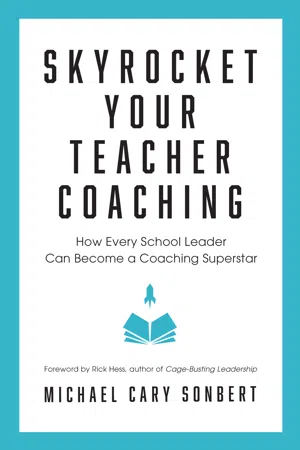
Skyrocket Your Teacher Coaching
How Every School Leader Can Become a Coaching Superstar
- English
- ePUB (mobile friendly)
- Available on iOS & Android
eBook - ePub
Skyrocket Your Teacher Coaching
How Every School Leader Can Become a Coaching Superstar
About this book
In Skyrocket Your Teacher Coaching, Michael Cary Sonbert offers a rocket-fueled, no-nonsense approach to helping school leaders launch high-impact instructional coaching in their schools. The book pinpoints problematic trends in current instructional coaching frameworks and approaches and outlines a simple, step-by-step process that emphasizes providing precise and direct feedback, actionable steps for teachers, practice and real-time coaching, mutual accountability, and most importantly, a focus on students and student outcomes.
Trusted by 375,005 students
Access to over 1.5 million titles for a fair monthly price.
Study more efficiently using our study tools.
Information
Topic
EducationSubtopic
Education Administration1
BIG Ideas
We are what we repeatedly do.
Excellence, then, is not an act, but a habit.
—Aristotle
Imagine you decide, after years of wanting to learn how to play the piano, to hire a piano teacher and begin lessons. You start slowly, one key at a time, following your teacher’s lead. She hits a note. Then you hit the same one. She does it again. So do you. Soon you’re playing the easiest of all piano songs, “Chopsticks.” You’re slow, but you’re getting it, building confidence along the way. You’re thinking, I can do this. I’m playing piano. And then your teacher looks at you and says, “Now let’s work on some Tchaikovsky.”
Likely, this would shock you. Or frustrate you. Confuse, anger, or disinvest you. If your teacher told you to play Tchaikovsky without first modeling what it looks like to play Tchaikovsky at a high level, that would likely disinvest you further. If her feedback felt random, not specific enough, or not actionable, or if it was absent altogether, you might want to give up. You might even think, I’ll tolerate the time I spend with this person, but really, I can’t wait for them to leave so I can go back to doing things my own way.
Here’s the thing: it’s just not possible to become proficient at “Chopsticks” and Tchaikovsky at the same time, the same way it’s not possible to become proficient at giving clear directions and checking for understanding at the same time. It’s too much, and these tasks are too different.
This is why the core belief behind the Skyrocket approach is that teachers should be coached where they are and not where you want them to be. That can be a challenge for school leaders who feel the urgency to “fix” everything at once, and it’s going to be a theme throughout this book.
Our approach is a long-game approach. It’s about building foundational skills, and layering on top of them more and more advanced skills. This means no more training a teacher on writing objectives when they can’t get their students to stop talking, because even the most effective lesson, in the hands of a teacher who can’t get students’ attention, will fall flat. Also, the teacher will likely feel disheartened and may lose faith in their coach and, potentially, the students. A coach in this situation might even start to doubt themselves. And lower coach confidence often results in less directive and more general coaching—the same type of suggestion-based coaching I provided to teachers early in my career.
Coaching teachers where they are does not mean we lower the bar. Certainly not. In fact, I’d argue Skyrocket is one of the most—if not the most—intense coaching models in education today, and the intensity and precision of our model will become evident as you read on. We train school leaders to land on a teacher’s highest-lever teacher action to increase student outcomes. After that, the leader designs and executes a practice session that will move the teacher forward immediately. Then the leader provides real-time coaching and follow-up support to ensure the teacher action sticks. (This three-step process—Ignition, Launch, and Orbit—has ample time dedicated to it in this book.)
If you have designs on running a marathon, I wouldn’t train you by having you run an entire marathon on your first day. We’d have to build to that. That might be your end goal, but trying to do that on day one or in week one would be a formula for failure, just like asking the first-week piano student to play “Chopsticks” and Tchaikovsky in the same lesson. Without adequate support, success is even more difficult. That’s why leaders often find themselves having the same conversations with teachers in March that they were having in September. It’s too hard to provide feedback on, collect data on, or design practice for too many skills at once.
I was in a school recently that had a schoolwide initiative around higher-order questioning. This seems like a reasonable thing for a school to be working on. We want students to engage with harder and harder material, and higher-order questioning is a great way to help get there. But as I began sitting in on coaching meetings and talking to teachers, many were so far away from being able to create the space for a higher-order question to even land with their students that it was largely a waste of time to provide them training on it. I shared this data and the school leaders agreed. They then decided to coach only a few teachers on higher-order questioning (as it was a logical next step for them), while coaching everyone else exactly where they were.
What I’m suggesting is that, even if a schoolwide instructional focus is present, individual teachers are still coached—in the finite amount of time a coach has with a teacher—on the skill they personally need to work on to most increase student outcomes in their room.
Right now, you may be thinking, how do we land on that thing? And how do we train on it? How do we ensure the teacher gets good and stays good at it? Our three-step process provides the answers for these three questions. But before we get there, I want to reiterate that core belief: Teachers should be coached where they are and not where you want them to be. Because to get them to where you want them to be, you need them to get really good where they are now.
Now that we’ve discussed this core distinction in our approach, I think it’s important to make another distinction, between what we at Skyrocket consider coaching and what many schools, networks, districts, and consultants consider coaching. What most people in education consider coaching is what we consider support. It’s important to name this, because you’re likely reading this and reflecting on your own teacher development program, which is great. But I’d like to ask you to think about coaching and support in the following ways throughout this book: for the sake of uniformity, for the sake of clarity, and for the sake of simplicity.
Support, as we see it, is discussing a lesson, maybe sharing some materials, or talking about a student discipline issue. It’s a conversation about the teacher’s class. It’s not terribly structured, no skill is modeled, no practice occurs, and there aren’t any deadlines or deliverables set at the end of it. It’s talking about how to get James to stop sleeping in class. It’s helping a teacher organize a lunch meeting with some students he’s struggling to build relationships with. It’s telling a teacher to use popsicle sticks to ensure more students are called on (this one happens a lot). It’s showing the teacher the worksheet you use...
Table of contents
- praise
- halftitle
- title
- copyright
- dedication
- foreword
- introduction
- partone
- 1
- 2
- 3
- parttwo
- 4
- 5
- 6
- partthree
- 7
- 8
- 9
- 10
- partfour
- 11
- 12
- partfive
- 13
- 14
- skyrocket
- abouttheauthor
- acknowledgments
- morefrom
Frequently asked questions
Yes, you can cancel anytime from the Subscription tab in your account settings on the Perlego website. Your subscription will stay active until the end of your current billing period. Learn how to cancel your subscription
No, books cannot be downloaded as external files, such as PDFs, for use outside of Perlego. However, you can download books within the Perlego app for offline reading on mobile or tablet. Learn how to download books offline
Perlego offers two plans: Essential and Complete
- Essential is ideal for learners and professionals who enjoy exploring a wide range of subjects. Access the Essential Library with 800,000+ trusted titles and best-sellers across business, personal growth, and the humanities. Includes unlimited reading time and Standard Read Aloud voice.
- Complete: Perfect for advanced learners and researchers needing full, unrestricted access. Unlock 1.5M+ books across hundreds of subjects, including academic and specialized titles. The Complete Plan also includes advanced features like Premium Read Aloud and Research Assistant.
We are an online textbook subscription service, where you can get access to an entire online library for less than the price of a single book per month. With over 1.5 million books across 990+ topics, we’ve got you covered! Learn about our mission
Look out for the read-aloud symbol on your next book to see if you can listen to it. The read-aloud tool reads text aloud for you, highlighting the text as it is being read. You can pause it, speed it up and slow it down. Learn more about Read Aloud
Yes! You can use the Perlego app on both iOS and Android devices to read anytime, anywhere — even offline. Perfect for commutes or when you’re on the go.
Please note we cannot support devices running on iOS 13 and Android 7 or earlier. Learn more about using the app
Please note we cannot support devices running on iOS 13 and Android 7 or earlier. Learn more about using the app
Yes, you can access Skyrocket Your Teacher Coaching by Michael Cary Sonbert in PDF and/or ePUB format, as well as other popular books in Education & Education Administration. We have over 1.5 million books available in our catalogue for you to explore.