- English
- ePUB (mobile friendly)
- Available on iOS & Android
eBook - ePub
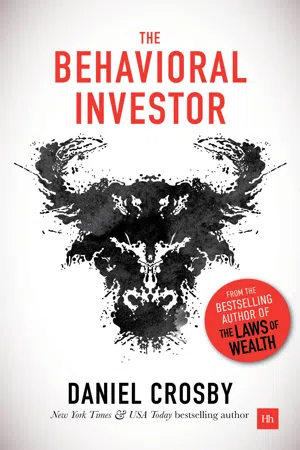
The Behavioral Investor
About this book
From the New York Times bestselling author of the book named the best investment book of 2017 comes The Behavioral Investor, an applied look at how psychology ought to inform the art and science of investment management.
In The Behavioral Investor, psychologist and asset manager Dr. Daniel Crosby examines the sociological, neurological and psychological factors that influence our investment decisions and sets forth practical solutions for improving both returns and behavior. Readers will be treated to the most comprehensive examination of investor behavior to date and will leave with concrete solutions for refining decision-making processes, increasing self-awareness and constraining the fatal flaws to which most investors are prone.
The Behavioral Investor takes a sweeping tour of human nature before arriving at the specifics of portfolio construction, rooted in the belief that it is only as we come to a deep understanding of "why" that we are left with any clue as to "how" we ought to invest. The book is comprised of three parts, which are as follows:
- Part One – An explication of the sociological, neurological and physiological impediments to sound investment decision-making. Readers will leave with an improved understanding of how externalities impact choices in nearly imperceptible ways and begin to understand the impact of these pressures on investment selection.
- Part Two – Coverage of the four primary psychological tendencies that impact investment behavior. Although human behavior is undoubtedly complex, in an investment context our choices are largely driven by one of the four factors discussed herein. Readers will emerge with an improved understanding of their own behavior, increased humility and a lens through which to vet decisions of all types.
- Part Three – Illuminates the "so what" of Parts One and Two and provides a framework for managing wealth in a manner consistent with the realities of our contextual and behavioral shortcomings. Readers will leave with a deeper understanding of the psychological underpinnings of popular investment approaches such as value and momentum and appreciate why all types of successful investing have psychology at their core.
Wealth, truly considered, has at least as much to do with psychological as financial wellbeing. The Behavioral Investor aims to enrich readers in the most holistic sense of the word, leaving them with tools for compounding both wealth and knowledge.
Information
Part 1. The Behavioral Investor
Chapter 1. Sociology
“Why, sometimes I’ve believed as many as six impossible things before breakfast.”
— Lewis Carroll, Alice in Wonderland
Imagine for a moment that you are seated in the first class cabin of a luxury airliner, soon to wing your way toward Hawaii on a long overdue vacation. You have been working nonstop of late and you can actually feel the tension melting from your neck and shoulders as you settle in to your seat and accept the flight attendant’s offer of a celebratory glass of bubbly. Better still, you are seated next to an attractive individual who bypasses the usual airplane banter and immediately engages you in a conversation that makes the first part of the trip speed past.
One hour into your voyage the plane encounters some turbulence, not entirely unwelcome as it allows for a serendipitous meeting of hands between you and your seatmate as you both grasp for your armrests. A shared laugh dissipates the fear, but as the tumult persists, you begin to worry that this isn’t your average storm. Scanning the aircraft you sense similar concern on the faces of the flight attendants, who are now moving with a great deal of purpose. The wind and rain seem to intensify with every passing second and you feel more nauseated with every bump. The captain, who had previously addressed the plane with a certainty borne of experience, now speaks in a voice filled with fear. “Heads down! Brace for impact!” she shouts as you feel the plane start to list and shake.
As you regain consciousness you find yourself 100 yards from the charred remains of the plane and a quick survey of the scene reveals the worst – there are no other human survivors. Head in hands, your mind begins to race through a thousand scenarios, a convoluted mix of what might have been and “What comes next?” But you are soon interrupted by an unusual sound.
Scratch. Scraaaatch. BOOM.
Your eyes dart around your new environs until they land on the source of the racket, a mangled cage with a small sign, “Property of the Atlanta Zoo.” At length, the occupant of the cage makes itself known – an Angolan Colobus monkey.
Man versus wild
Assume for the sake of our thought experiment that it will take 18 months for a search party to discover the uninhabited island where you have crashed and that you and the monkey – the lone survivors of the ill-fated flight – will be left to fend for yourselves until that time. When the rescue party arrives, whom do you think will be in better shape, you or the monkey? If you are honest with yourself, I think you will agree the monkey has better prospects than you or I when dropped in the middle of nowhere and asked to survive. When the search party arrives they may well find your sun-bleached bones, whereas the monkey seems likely to be thriving, happy to be free of the taunts of school children on field trips.
Yuval Noah Harari asks us to consider a stranger, slightly less plausible variant of this experiment in his superb TED talk, ‘Bananas in heaven.’1 Imagine that your plane was filled with 1000 humans and 1000 monkeys, all of which survived and were forced to live on a remote island. Would the results be the same when the rescuers landed on the shore a year and a half later? Likely not. In the second scenario, the humans have the edge for a reason that sits at the heart of our ability to build both great societies and functioning capital markets: our ability to flexibly cooperate with one another.
Sure, Harari concedes, some animals like bees and ants are able to cooperate, but do so only in a very rigid, hierarchical way. As the historian quips, bees are unlikely to plot a coup against the queen bee and have her killed in an effort to form a bee republic. Bees and ants accomplish great things but are cognitively inflexible, which limits their ascension up the food chain. Monkeys, on the other hand, are highly intelligent and have complex social structures, but they are limited by the number of social interactions they can meaningfully process. Psychologists put this number at about 150 in humans; a useful yardstick for evaluating our primate brethren. After about 100 relationships, monkeys begin to lose the ability to know their peers well enough to make accurate judgments about their behavior, character and intentions, effectively capping the size and complexity of monkey civilizations.
If bees organize by innate mandate and chimps through tight-knit social interactions, the miracle of human ascendance in the animal kingdom owes to a penchant for behaving in accordance with social narratives. To put it bluntly, we make up stories about the world and then act as if they are real. As Harari writes in the magisterial Sapiens, “As far as we know, only Sapiens can talk about entire kinds of entities that they have never seen, touched or smelled.”2 A monkey can say, “There is a caribou by the river,” but could never communicate that, “The caribou by the river is the spiritual guardian of our city.”
This ability to communicate about the unreal allows us humans to create all manner of social structures that help bring about predictable human behavior and that reliably breed trust. The State of Alabama, the Catholic church, the Constitution of the United States of America, the inalienable civil rights of man: none of these things are real in the strictest sense, but our shared belief in them and behaving as though they are real brings about orderly civilizations steeped in mutual trust. This ability to form and buy in to collective fictions is why, “…Sapiens rule the world, whereas ants eat our leftovers and chimps are locked up in zoos.”3
If our dominance as a species is a function of our shared trust in fictions, there is one fiction in particular that reigns supreme: money. Harari pulls no punches: “Money is the most universal and most efficient system of mutual trust ever devised.”4 There is, of course, nothing inherently valuable about the pieces of paper for which we all spend our lives toiling, dreaming and fretting. Money and capital markets are shared hallucinations whose value is more psychological than physical. The human mind gave rise to financial markets and to seek to understand them without an appropriate understanding of their genesis is folly in the extreme. There is no understanding markets without understanding people.
A blessing and a curse
Whether it be the birth of a child and sleepless nights, or financial prosperity and covetous relatives, few things in life are unequivocally good. So too it goes with mankind’s greatest gift, for the same narrative cohesiveness that gives rise to stock markets can lead us to poor decisions in those very same markets! Hugo Mercier and Dan Sperber, authors of The Enigma of Reason, argue that human reason evolved not to be “correct” in the strictest sense of the word, but rather to privilege the stability of the shared beliefs that are the cornerstone of our species’ success.5
To more fully understand this concept, it may be useful to consider the example of belief testing in both animals and humans. A human may encounter an idea that runs contrary to a deeply held belief – for instance, that “members of my chosen political party are smart and kind” – and this may cause painful cognitive dissonance. The proof against this cherished notion may be convincing in objective terms – failed policies, incompetent leadership, scientific realities that contradict the party line – but political beliefs are often quite recalcitrant to change. Since shared communal beliefs are the glue that holds humankind together, breaking those bonds is no small task, even in the face of damning contraindications. A party zealot who experiences a change of mind does so at a great social cost...
Table of contents
- Contents
- About the author
- Also by Daniel Crosby
- Foreword by Noreen D. Beaman
- Preface
- Part 1. The Behavioral Investor
- Chapter 1. Sociology
- Chapter 2. Investing on the Brain
- Chapter 3. Physiology
- Part Two. Investor Psychology
- Chapter 4. Ego
- Chapter 5. Conservatism
- Chapter 6. Attention
- Chapter 7. Emotion
- Part Three. Becoming a Behavioral Investor
- Chapter 8. The Behavioral Investor Overcomes Ego
- Chapter 9. The Behavioral Investor Conquers Conservatism
- Chapter 10. The Behavioral Investor Hones Attention
- Chapter 11. The Behavioral Investor Manages Emotion
- Part Four. Building Behavioral Portfolios
- Chapter 12. Investing a Third Way
- Chapter 13. Behavioral Investing is Rules-Based
- Chapter 14. Behavioral Investing is Risk First Investing
- Chapter 15. Behavioral Investing has No Masters of the Universe
- Chapter 16. Sample Behavioral Investment Factors
- Epilogue. Endure to the End
Trusted by 375,005 students
Access to over 1.5 million titles for a fair monthly price.
Study more efficiently using our study tools.
Frequently asked questions
Yes, you can cancel anytime from the Subscription tab in your account settings on the Perlego website. Your subscription will stay active until the end of your current billing period. Learn how to cancel your subscription
No, books cannot be downloaded as external files, such as PDFs, for use outside of Perlego. However, you can download books within the Perlego app for offline reading on mobile or tablet. Learn how to download books offline
Perlego offers two plans: Essential and Complete
- Essential is ideal for learners and professionals who enjoy exploring a wide range of subjects. Access the Essential Library with 800,000+ trusted titles and best-sellers across business, personal growth, and the humanities. Includes unlimited reading time and Standard Read Aloud voice.
- Complete: Perfect for advanced learners and researchers needing full, unrestricted access. Unlock 1.5M+ books across hundreds of subjects, including academic and specialized titles. The Complete Plan also includes advanced features like Premium Read Aloud and Research Assistant.
We are an online textbook subscription service, where you can get access to an entire online library for less than the price of a single book per month. With over 1.5 million books across 990+ topics, we’ve got you covered! Learn about our mission
Look out for the read-aloud symbol on your next book to see if you can listen to it. The read-aloud tool reads text aloud for you, highlighting the text as it is being read. You can pause it, speed it up and slow it down. Learn more about Read Aloud
Yes! You can use the Perlego app on both iOS and Android devices to read anytime, anywhere — even offline. Perfect for commutes or when you’re on the go.
Please note we cannot support devices running on iOS 13 and Android 7 or earlier. Learn more about using the app
Please note we cannot support devices running on iOS 13 and Android 7 or earlier. Learn more about using the app
Yes, you can access The Behavioral Investor by Daniel Crosby in PDF and/or ePUB format, as well as other popular books in Business & Financial Accounting. We have over 1.5 million books available in our catalogue for you to explore.