eBook - ePub
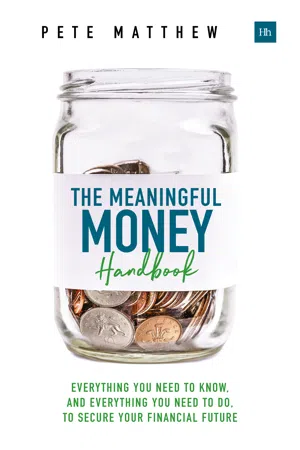
The Meaningful Money Handbook
Everything you need to KNOW and everything you need to DO to secure your financial future
- English
- ePUB (mobile friendly)
- Available on iOS & Android
eBook - ePub
The Meaningful Money Handbook
Everything you need to KNOW and everything you need to DO to secure your financial future
About this book
In The Meaningful Money Handbook, personal finance expert and podcaster extraordinaire Pete Matthew guides you through everything you need to KNOW and everything you need to DO to build a secure financial future for yourself and your family.
This is achievable for everyone by following three simple steps:
1. Spend less than you earn and clear debt.
2. Insure against disaster.
3. Build up your savings and invest wisely.
You will learn:
• How to get out of debt as quickly as possible.
• Techniques for good financial control, so you can avoid getting into debt again.
• The importance of insurance for laying down a foundation on which to build a solid financial plan, which isn't washed away by an unexpected disaster.
• How to save and invest simply and efficiently so that you can work your way towards future financial freedom.
No matter your starting position, or your existing level of comfort with dealing with your money, Pete Matthew's calm, straightforward and jargon-free approach will appeal to you and help you to set out on the right path.
The Meaningful Money Handbook is a practical guide to succeeding with money by cutting out the stuff you don't need to know, and clarifying the essential things you need to do, to make a real difference to your life.
Don't put it off any longer – pick up this book and start to take a meaningful approach to your money today.
Information
Topic
Personal DevelopmentSubtopic
Personal FinanceStep 1: Spend Less Than You Earn
Spending less than you earn is the first of our three steps, and is the foundation for everything else. If you get this step right, much of the rest will fall into place for you.
In this section of the book, I firstly cover why you should bother to budget, and the benefits you’ll get from learning how to do so.
Then I give you my tried and tested system for spending less than you earn each and every month, including some simple hacks that I use to make the process as painless as possible.
For many of us, debt is an issue that we battle with daily. Wouldn’t it be great not to owe anything to anybody? I want to show you a step-by-step method called the debt snowball, which will help you clear your debt as quickly and painlessly as possible.
When money is tight, it can seem like everyone else is getting a slice of your money before you get to enjoy any of it. The taxman, your landlord, your electricity provider, mobile phone company and your supermarket all get the benefit of your money – but what about you?
A fundamental principle of good financial management is to pay yourself first. You’ll learn what that means in practice, and how to apply it consistently so you get the benefit of your hard-earned money before anyone else.
And finally I help you learn how to deal with the inevitable setbacks that could derail your progress along the way.
This section is really about helping you build good habits. The great thing about habits is that pretty soon they become second nature.
Let’s begin.
Chapter 1: Why Bother to Budget?
If there’s one word which is likely to strike, if not fear, then certainly boredom into people, it’s budget.
Like so many words in finance it can have several meanings. One is the Chancellor of the Exchequer holding up a red box outside 11 Downing Street on a certain Wednesday each November. Another makes us think of local authority budget cuts – our hospital might have fewer beds or close down altogether.
But the meaning I assign to the word in this book is the setting of a spending plan each month, so that you know where your money is going.
It’s fair to say that most people don’t bother to budget. They might have a sense of how much money they have left until they next get paid, and they’ll eke things out until then, but that’s not budgeting.
Budgeting isn’t tracking your spending either, though that can be a part of the process.
Budgeting is about telling each pound that comes through your hands where it should go, and how it should be used. In other words, budgeting is forward-looking. It’s about deploying your resources in the best way possible, like an army general planning the deployment of troops.
Some pounds will be used to buy electricity, water or internet data. Others will go to paying down debt, some will be used for fun, like hobbies or eating out, and still others will be used to save for your future.
But why should you bother? Why not just wing it and try to save whatever’s left at the end of the month?
Simple answer: because unless you plan, there probably won’t be anything left at the end of the month.
Control your money or it’ll control you
One of the immutable laws of personal finance is that expenditure rises to meet income. In other words, there will never be any money left at the end of the month unless you plan for that to be the case.
You might start the month with good intentions. Perhaps you had a bit more pay last month and there are no big bills on the horizon. Great news – this month you’ll be able to save a bit, or pay a bit more off your credit card balance. But unless you do that straightaway, you’ll find that the extra money will simply disappear over the course of the month.
Maybe you’ll have an extra night out, buy a couple more things from Amazon than you planned, or enjoy a couple of extra skinny lattes. Whichever, the strong likelihood is that the extra money will be gone by the time payday rolls around again.
Money can, however, be forced to do your bidding. You can control it, and you must. If you don’t, you will always be just a passive observer, feeling increasingly frustrated as your financial situation never gets any better.
If you grab your money by the scruff of the neck and force it to do what you want, it will serve you very well for the rest of your life.
Having a budget is the first step.
You’ll get to know yourself
Successful budgeting requires you to get to know yourself. If you’re intentional about being self-aware, it will help you massively in the area of financial control, and also in other areas of your life.
I’ve yo-yo dieted for years, but am only now beginning to become aware of the triggers which make me want to reach for a Star Bar. It’s a very similar response to the desire to press the Buy It Now button on eBay for something I don’t need.
I’ve learned that if I’m feeling tired, upset or overwhelmed, then my defences are down. I try to avoid these states as much as I can, and also to be aware that when I am feeling those things, I’m vulnerable.
When it comes to your budget, you’ll learn to watch for similar unhelpful triggers which might end up with you spending money on stuff you don’t need. You’ll become aware of the best time for you to sit down and create a budget, and whether or not it’s smart to have a glass of wine while you do it.
Knowing yourself is always the first step to improving yourself, and that’s a goal we all share, right?
Financial control is a mark of adulthood. The problem is, many of us never get taught this stuff at school or at home. We’re lucky if we get the birds and the bees talk, but I bet more kids have to endure the awkwardness of that particular conversation, than are taught about managing spending and saving.
So, it’s ...
Table of contents
- Contents
- Praise for The Meaningful Money Handbook
- About the author
- Acknowledgements
- Foreword by Justin Urquhart Stewart
- Prologue
- Preface
- Introduction
- The Money Mindset
- The Three Steps to Financial Success
- Step 1: Spend Less Than You Earn
- Chapter 1: Why Bother to Budget?
- Chapter 2: Spend Less than You Earn
- Chapter 3: Getting Out of Debt
- Chapter 4: Pay Yourself First
- Chapter 5: Dealing with Setbacks and Challenges
- Step 2: Protect Against Disaster
- Chapter 6: Lay a Solid Foundation
- Chapter 7: Life Insurance
- Chapter 8: Critical Illness Insurance
- Chapter 9: Income Protection Insurance
- Chapter 10: Building a Protection Programme
- Chapter 11: Wills, Trusts and Powers of Attorney
- Step 3: Invest Wisely
- Chapter 12: Saving and Investing
- Chapter 13: Risk, Timescale and Reward
- Chapter 14: Asset Classes
- Chapter 15: Funds
- Chapter 16: Wrappers
- Chapter 17: Platforms
- Chapter 18: A Word About Tax
- Chapter 19: Practical Investing
- Staying the Course
- When and How to Use a Financial Adviser
- Over to You
Trusted by 375,005 students
Access to over 1.5 million titles for a fair monthly price.
Study more efficiently using our study tools.
Frequently asked questions
Yes, you can cancel anytime from the Subscription tab in your account settings on the Perlego website. Your subscription will stay active until the end of your current billing period. Learn how to cancel your subscription
No, books cannot be downloaded as external files, such as PDFs, for use outside of Perlego. However, you can download books within the Perlego app for offline reading on mobile or tablet. Learn how to download books offline
Perlego offers two plans: Essential and Complete
- Essential is ideal for learners and professionals who enjoy exploring a wide range of subjects. Access the Essential Library with 800,000+ trusted titles and best-sellers across business, personal growth, and the humanities. Includes unlimited reading time and Standard Read Aloud voice.
- Complete: Perfect for advanced learners and researchers needing full, unrestricted access. Unlock 1.5M+ books across hundreds of subjects, including academic and specialized titles. The Complete Plan also includes advanced features like Premium Read Aloud and Research Assistant.
We are an online textbook subscription service, where you can get access to an entire online library for less than the price of a single book per month. With over 1.5 million books across 990+ topics, we’ve got you covered! Learn about our mission
Look out for the read-aloud symbol on your next book to see if you can listen to it. The read-aloud tool reads text aloud for you, highlighting the text as it is being read. You can pause it, speed it up and slow it down. Learn more about Read Aloud
Yes! You can use the Perlego app on both iOS and Android devices to read anytime, anywhere — even offline. Perfect for commutes or when you’re on the go.
Please note we cannot support devices running on iOS 13 and Android 7 or earlier. Learn more about using the app
Please note we cannot support devices running on iOS 13 and Android 7 or earlier. Learn more about using the app
Yes, you can access The Meaningful Money Handbook by Pete Matthew in PDF and/or ePUB format, as well as other popular books in Personal Development & Personal Finance. We have over 1.5 million books available in our catalogue for you to explore.