eBook - ePub
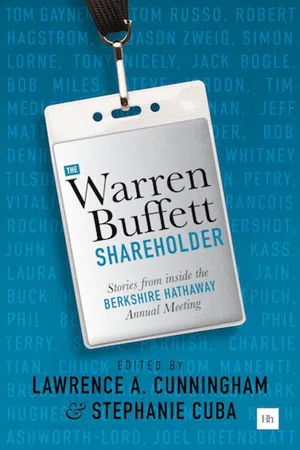
The Warren Buffett Shareholder
Stories from inside the Berkshire Hathaway Annual Meeting
- English
- ePUB (mobile friendly)
- Available on iOS & Android
eBook - ePub
The Warren Buffett Shareholder
Stories from inside the Berkshire Hathaway Annual Meeting
About this book
In this engaging collection of stories, 43 veterans of the Berkshire Hathaway Annual Shareholders Meeting explain why throngs attend year after year. Beyond the famous Q&A with Warren Buffett and Charlie Munger, these experts reveal the Berkshire Meeting as a community gathering of fun, fellowship and learning.
The contributors whisk readers through the exciting schedule of surrounding events--book signings, panel discussions and social gatherings--and share the pulse of this distinctive corporate culture. Spanning decades, the book offers glimpses of the past and ideas of what lies ahead. To learn about what makes Buffett's shareholders tick and all the happenings at the Berkshire Meeting, and to reminisce about past Meetings, make this delightful book your companion.
Includes work by these bestselling authors:
- Robert Hagstrom
- Robert Miles
- Jason Zweig
- Joel Greenblatt
- Vitaliy Katsenelson
- Jeff Matthews
- Charlie Tian
- Whitney Tilson
- Prem Jain
- Karen Linder
Information
Topic
Desarrollo personalSubtopic
Negocios internacionalesChapter One: Writers
Jason Zweig – You’re Not Alone
When my flight came slanting down into Omaha on a drizzly night in April, a ceiling of rain cloud was clamped over the city like a thick pewter plate. But directly above downtown, the reflected light of Omaha’s skyscrapers reached a mile into the air to burnish the underside of the dark clouds with a dazzling silvery-white circle. Suddenly the ceiling of clouds looked like a floor—the floor of heaven. “My God,” a passenger gasped in the back of the plane, “Warren really does have a halo!”
Why do Berkshire Hathaway investors nearly worship Chairman Warren Buffett and hang on his every word as if he were a religious prophet? What makes tens of thousands of people descend on Omaha from every state in the union and dozens of foreign countries?
Buffett’s astounding investment record—bolstered by the astute advice of his business partner, Berkshire Vice Chairman Charles Munger—is one reason people flock to Omaha to listen to him. But it is far from the only one.
Each year for decades, Buffett and Munger have urged shareholders to come to the Annual Meeting and speak out about whatever is on their minds. At the Annual Meeting, as dozens of Berkshire investors step up to microphones throughout Omaha’s giant Qwest Center auditorium, Buffett and Munger field questions for nearly six hours.
At most companies, the Annual Meeting offers about as much give-and-take as a session of the Supreme People’s Assembly of North Korea. So why does Buffett throw open the floor to all at Berkshire’s meeting? “Even though Ben Graham [Buffett’s mentor] had everything he needed in life, he still wanted to give something back by teaching,” Buffett tells me after the Meeting. “So just as we got it from somebody else, we don’t want it to stop with us. We want to pass it along too.”
Sure, plenty of shareholders ask for Buffett and Munger’s views on stock and bond prices and a host of other investing issues. But others have broader questions: What’s the best book you’ve read lately? What was your worst mistake? How can I keep learning? Is mathematics “the language of God”?
When Justin Fong, a 14-year-old shareholder from California, asks for advice on succeeding in life, Buffett and Munger don’t mince words. “Hang out with people whose behavior is better than yours, and then you’ll drift in the right direction,” says Buffett. “If this gives you a little temporary unpopularity with your peer group,” adds Munger dryly, “the hell with ’em.”
This is what Berkshire’s shareholders say they love most: the interchanges that show what Buffett and Munger are made of. David Lin, 35, a Nashville radiologist, has come to the Meeting seven of the previous eight years. “It helps me refocus,” says Lin. “I’ve learned what things Warren thinks are important. Things like friendship, morality, developing good habits, how to live a happy life—and it’s not just about money.”
Alex Rubalcava, 24, a venture capitalist in Los Angeles, says, “Warren and Charlie talk constantly about how you don’t have to do anything just for the sake of doing something. They’ve taught me the importance of saying no to things in investing and in life.”
“You wouldn’t believe what a good feeling you get when you listen to Warren and Charlie,” says Mike Loisel, 56, a retired electrical contractor from Minneapolis. Adds his wife Connie, 55: “You feel like you’re part of a group of people who share the same values—solid, honest people, hard workers.”
Buffett has thought a lot about why so many people come to his meetings. “First, they come to have a good time,” he tells me afterward. “Second, they come to learn. And they really feel as if they’re partners in the enterprise.”
Why do so few investment firms educate and treat their clients this way? “It’s a joke, isn’t it?” answers Buffett, adding that fund managers and brokers “don’t judge their success by investment results. They judge it by how much they can gather in assets. So they don’t want the shareholders to think of themselves as owners. They want them to think of themselves as customers.”
Most pundits talk about how important value is to Buffett as an investor. What they miss is that values are even more important to him. Buffett understands the heart of the matter for all of us: Money is not just pieces of paper or electronic blips with prices attached. It is far more: our fondest hopes, our most fervent dreams, our worst nightmares, all balled up into an explosively emotional package. Investing can be exhilarating—or terrifying.
Consider, too, that the English word “invest” derives from a Latin root that means to dress, clothe, wrap in robes, surround or envelop. To invest means, literally, to wrap yourself in a financial asset and hold it close. No wonder investing arouses such intimate and elemental emotions as fear and greed, surprise and pain, hope and pride.
As Peter L. Bernstein, the financial historian and investment consultant, once wrote: “Believe me, when people have told you about their money, they have told you the most important fact about themselves. Their sex lives, problems with their children, their political views, are all secondary.”
How profoundly odd it is, then, for the investment-management industry to take it for granted that clients should be willing to send their money off to a faceless, often even nameless, stranger—or a group of them.
It is ironic—if not downright outrageous—that mutual-fund companies refer to their menus of offerings as “fund families.” What kind of family consists of people who have never met, and never will, so long as they live?
The most basic act in the relationship between a client and a portfolio manager—committing your capital—requires you to consign your financial future into the hands of someone whose hand you cannot shake, who will not hold your hand, whom you can never look in the eye.
In a stock market that feels like a madhouse at best and a war zone at worst, investing is a lonely, alienating, often frightening task. Fund “families” are far too impersonal to offer any solace, and the typical financial adviser is often too harried to be able to comfort every client. All too many investors have to settle for a chirpy email, a hasty phone call, or even just a few moments of watching their fund manager pontificating on CNBC.
Few things make humans feel worse than being alone. Buffett knows that no one wants to face the uncertainties of investing all by our lonesome. We want to be comforted and feel we’re part of a community. That’s the greatest gift he gives his investors: not massive wealth or brilliant insights, but the deep-rooted solace of knowing that they belong, that they are in this together with others, that they are not alone.
About Jason Zweig
Jason Zweig writes the Intelligent Investor column for the Wall Street Journal. He is the editor of the contemporary edition of Benjamin Graham’s classic book, The Intelligent Investor.
Steve Jordon – He’s Just Like Us
It’s twilight in late April. An Alpine horn sounds its somber note across Ponca Hills, the rolling-landscape region north of Omaha named for an American Indian tribe, but home to fox hunts, gracious acreages and mysterious hollows.
While the crowd bustles at Borsheims, a half-hour and light years away, the Omaha Lounge Suit Society’s (LSS) two dozen members are beginning their membership ceremony, as steeped in tradition as Warren Buffett’s Annual Meeting of Berkshire Hathaway shareholders.
Coming to the Berkshire Meeting, says New York investment manager Christopher C. Stavrou, a member of the society “started as a learning experience, but it’s evolved into a part of the fabric of one’s life.” He sips an iced tea, lightly sweetened, as fellow members of the LSS (the name came from the first invitation, which suggested “lounge suits” as appropriate dress) gather to exchange the clever Latin and Greek phrases that codify their position on the official roster.
“Nunc est Bibendum!” they conclude, loosely translated as “Break out the champagne!”
The Lounge Suit Society’s membership ceremony is part of the background for Berkshire’s Meeting, which is not just six hours of Q&A with stockholders, journalists and analysts, but an entire community ecosystem.
True, Buffett’s objective is to fulfill his duty to his million or so partners, via stock ownership, in his real-life experiment in rational investing. It is still educational. “You learn more here in a weekend than you do all year in New York,” says Manhattan attorney and CPA Michael Assael. He and his wife, Eiko, used to buy new personalized license plates each time Berkshire’s stock gained another $10,000 (“BRK 60000,” it read in 2000).
But the price outgrew the license plates, and now they come to see people who have become friends, who visit each other in the non-Berkshire days of the calendar. Assael thinks Charlie Munger’s writings and discussions are at least as enlightening as Plato’s. The Assaels actually went to Borsheims, where the shareholders enjoyed free food and wine for hours, and some bought things like Christmas ornaments shaped like stock cer...
Table of contents
- Contents
- Preface
- Chapter One: Writers
- Chapter Two: Partners
- Chapter Three: Readers
- Chapter Four: Speakers
- Chapter Five: Professors
- Chapter Six: Pioneers
- Chapter Seven: Managers
- Chapter Eight: Scholars
- Chapter Nine: Patrons
- Chapter Ten: Legends
- Epilogue
- Contributors
- Editors
- Acknowledgements
Trusted by 375,005 students
Access to over 1.5 million titles for a fair monthly price.
Study more efficiently using our study tools.
Frequently asked questions
Yes, you can cancel anytime from the Subscription tab in your account settings on the Perlego website. Your subscription will stay active until the end of your current billing period. Learn how to cancel your subscription
No, books cannot be downloaded as external files, such as PDFs, for use outside of Perlego. However, you can download books within the Perlego app for offline reading on mobile or tablet. Learn how to download books offline
Perlego offers two plans: Essential and Complete
- Essential is ideal for learners and professionals who enjoy exploring a wide range of subjects. Access the Essential Library with 800,000+ trusted titles and best-sellers across business, personal growth, and the humanities. Includes unlimited reading time and Standard Read Aloud voice.
- Complete: Perfect for advanced learners and researchers needing full, unrestricted access. Unlock 1.5M+ books across hundreds of subjects, including academic and specialized titles. The Complete Plan also includes advanced features like Premium Read Aloud and Research Assistant.
We are an online textbook subscription service, where you can get access to an entire online library for less than the price of a single book per month. With over 1.5 million books across 990+ topics, we’ve got you covered! Learn about our mission
Look out for the read-aloud symbol on your next book to see if you can listen to it. The read-aloud tool reads text aloud for you, highlighting the text as it is being read. You can pause it, speed it up and slow it down. Learn more about Read Aloud
Yes! You can use the Perlego app on both iOS and Android devices to read anytime, anywhere — even offline. Perfect for commutes or when you’re on the go.
Please note we cannot support devices running on iOS 13 and Android 7 or earlier. Learn more about using the app
Please note we cannot support devices running on iOS 13 and Android 7 or earlier. Learn more about using the app
Yes, you can access The Warren Buffett Shareholder by Lawrence A. Cunningham,Stephanie Cuba in PDF and/or ePUB format, as well as other popular books in Desarrollo personal & Negocios internacionales. We have over 1.5 million books available in our catalogue for you to explore.