• How is the human brain wired for two distinct experiences of happiness? And why can money "buy" one but not the other? • What are the touchstones of a meaningful life, and are they affordable? • Why is market savvy among the least important sources of wealth but self-awareness is among the most? • How does one strike a balance between striving for more while being content with enough?
This journey memorably contours along three basic shapes: A circle, triangle and square help us to visualize how we adapt to evolving circumstances, set clear priorities, and find empowerment in simplicity. In this accessible and entertaining book, Portnoy reveals that true wealth is achievable for many - including those who despair it is out of reach - but only in the context of a life in which purpose and practice are thoughtfully calibrated.
- English
- ePUB (mobile friendly)
- Available on iOS & Android
eBook - ePub
About this book
How does money figure into a happy life?
In The Geometry of Wealth, behavioral finance expert Brian Portnoy delivers an inspired answer, building on the critical distinction between being rich and being wealthy. While one is an unsatisfying treadmill, the other is the ability to underwrite a meaningful life, however one chooses to define that. Truly viewed, wealth is funded contentment.
At the heart of this groundbreaking perspective, Portnoy takes readers on a journey toward wealth, informed by disciplines ranging from ancient history to modern neuroscience. He contends that tackling the big questions about a joyful life and tending to financial decisions are complementary, not separate, tasks.
These big questions include:
Information
Topic
Personal DevelopmentSubtopic
International Business1. Alone Together
“For many of us—we silent sufferers who cannot speak about our financial tribulations—it is our lives, not just our bank accounts, that are at risk.”
– Neal Gabler
“Nothing is so bitter that a calm mind cannot find comfort in it.”
– Seneca
Money life
Money courses through both daily decisions and grand contemplations. It acts as the oil in the engine of everyday life, without which metal grinds metal. With it, the engine operates, which isn’t to say it drives in the right direction.
Money life, a term I’ll use many times, has four dimensions: Earning, spending, saving, and investing.
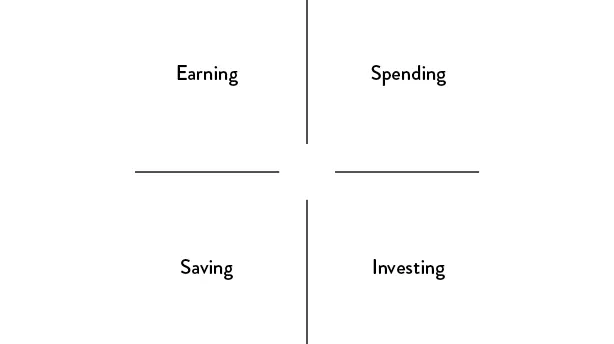
It starts with a paycheck. The phrase “Making a living” is heavily loaded with the gravity of holding a job whose first but not sole purpose is to sustain ourselves and our families. Absent the ability to earn, the future is dim. Paycheck in hand, we then must figure out how to navigate a vast array of decisions. The first and largest batch of decisions relates to spending. Beyond the monthly bills, there are consumption choices that have grown more and more plentiful. The remainder of unspent earnings, if any, creates the opportunity to save. Lastly, there is investing, the process of putting our financial capital at risk to grow it at a higher rate than what it would make sitting in cash. Regardless of income level or inherited riches, the matrix of our money lives is complex and stressful.
While we all share similar concerns and pose similar questions, we don’t figure it out collectively. Money is an isolated—and isolating—affair. We figure it out on our own.
What are we all up against? I see three broad challenges currently:
- We have more control over our own finances.
- We are wired to make bad money decisions.
- We have less room for error.
I’ll address each of these in turn.
The first challenge: You’re in charge—like it or not
The zeitgeist of modern times is defined by a deluge of information and choice, a thinning of deep social ties despite unprecedented digital connectedness, and a do-it-yourself approach to just about everything. In our world of lonesome crowds, we harbor great discretion and responsibility.1 Through technology, we now have it in our grasp (or so we think) to be media moguls, culinary experts, travel agents, medical practitioners, meteorologists, instant scholars of ________ (choose a Wiki page), and, yes, market experts and portfolio managers. We have more autonomy across more domains than ever before. We live in an age of information. We live in an age of anxiety.
In the domain of money, we’re being put to the test in unprecedented ways. The burden of managing your long-term financial health has shifted over recent generations. In particular, the nature of retirement is changing, in no small part due to the steady demise of the traditional pension plan. There are few more powerful structural forces driving the “democratizing” of our money lives and investing specifically.
Keep in mind that “retirement” wasn’t really a thing all that long ago. Modern civilization is several thousand years old, so the idea to voluntarily stop working at some point and live off of savings and investments is relatively new. The reason for this is simple: Through most of history, people worked until they died. And those who outlived their human capital relied on traditional family structures for support. In Willy Wonka and the Chocolate Factory, bedridden Grandpa Joe and Grandma Josephine weren’t pensioners, nor did they have Social Security or some other government largesse to rely upon; they were the wards of Charlie Bucket’s mom.
Starting in 19th century Europe and then later spreading to America, governments set up social safety nets for aging populations, while employers arranged benefits packages aimed at sustaining their workers in old age. In the United States, for example, a large percentage of the American private and public workforce participated in defined benefit plans for a good portion of the post-World War II era. In practical terms, that translated to a paycheck for life during retirement.
Over the past few decades, however, these collective retirement plans have been frozen or shut down altogether. They’ve largely been replaced by do-it-yourself investment programs, such as the 401(k). Since the 1980s, for example, workers with pension fund coverage shrunk from 62% to 17%, while those who had access only to 401(k) plans grew from 12% to 71%.2 As we’re now mostly all responsible for our own retirement investing, experts have concluded that the golden age of retirement security is over.
Our collective confidence in being able to enjoy a comfortable retirement is low. In 2017, only 18% of workers were “very confident” about having enough money after they stopped working. About one-fourth of Americans are not confident in a financially secure future, and the balance are somewhere in between.3 The questionable future of government benefits further undermines confidence. Though never designed or intended to be the sole paycheck in retirement, Social Security has become just that for millions.
As the social safety net weathers into a frayed hammock, the lack of retirement confidence is justified. The data on retirement preparedness are troubling. Nearly 40% of American workers have not saved for retirement. Let me repeat: Tens of millions of Americans do not h...
Table of contents
- Contents
- About the author
- Introduction: A Story About Three Shapes
- Taking Shape
- 1. Alone Together
- 2. Adaptive Simplicity
- Purpose
- 3. The Places You Might Go
- 4. What Matters
- 5. Yes, Not Really, It Depends
- Priorities
- 6. Setting Priorities
- 7. Making Decisions
- Tactics
- 8. Gray Matter
- 9. Four Corners
- Shapeless
- 10. You Are Here
- The Geometry of Wealth: Recap
- Acknowledgements
Trusted by 375,005 students
Access to over 1.5 million titles for a fair monthly price.
Study more efficiently using our study tools.
Frequently asked questions
Yes, you can cancel anytime from the Subscription tab in your account settings on the Perlego website. Your subscription will stay active until the end of your current billing period. Learn how to cancel your subscription
No, books cannot be downloaded as external files, such as PDFs, for use outside of Perlego. However, you can download books within the Perlego app for offline reading on mobile or tablet. Learn how to download books offline
Perlego offers two plans: Essential and Complete
- Essential is ideal for learners and professionals who enjoy exploring a wide range of subjects. Access the Essential Library with 800,000+ trusted titles and best-sellers across business, personal growth, and the humanities. Includes unlimited reading time and Standard Read Aloud voice.
- Complete: Perfect for advanced learners and researchers needing full, unrestricted access. Unlock 1.5M+ books across hundreds of subjects, including academic and specialized titles. The Complete Plan also includes advanced features like Premium Read Aloud and Research Assistant.
We are an online textbook subscription service, where you can get access to an entire online library for less than the price of a single book per month. With over 1.5 million books across 990+ topics, we’ve got you covered! Learn about our mission
Look out for the read-aloud symbol on your next book to see if you can listen to it. The read-aloud tool reads text aloud for you, highlighting the text as it is being read. You can pause it, speed it up and slow it down. Learn more about Read Aloud
Yes! You can use the Perlego app on both iOS and Android devices to read anytime, anywhere — even offline. Perfect for commutes or when you’re on the go.
Please note we cannot support devices running on iOS 13 and Android 7 or earlier. Learn more about using the app
Please note we cannot support devices running on iOS 13 and Android 7 or earlier. Learn more about using the app
Yes, you can access The Geometry of Wealth by Brian Portnoy in PDF and/or ePUB format, as well as other popular books in Personal Development & International Business. We have over 1.5 million books available in our catalogue for you to explore.