- English
- ePUB (mobile friendly)
- Available on iOS & Android
eBook - ePub
About this book
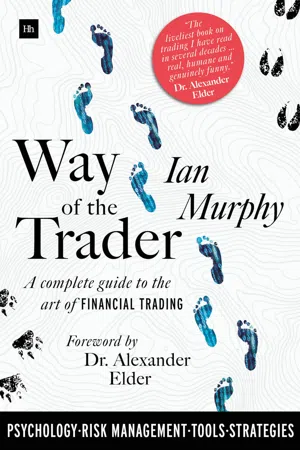
Way of the Trader offers a fresh perspective on a mysterious art - trading the financial markets. Over 15 compelling chapters, Ian Murphy unpacks the world of a private trader, providing a wealth of practical tools for those wishing to make a living from the markets.
In Part A he examines the job of a trader and their relationship with the market - and how to survive where so many others have failed.
In Part B he reveals the habits of serious professionals. These include essential procedures such as the Eight Checks and the Nine Filters which should be employed by all traders before a single penny is placed in the market. Most important of all, Ian explains how the Five Limits of Risk allow us to embrace the dangers at the heart of trading, so we can face the market with confidence and clarity.
In the Six Edges chapter, psychology - the key to trading success - is closely examined and we see how the concept of a trading edge is overrated and misunderstood. We also learn how Buddhist techniques for working with the mind can be profitably employed in the market.
In Part C the author shares three consistently profitable trading strategies which expose opportunities inherent in the market and demonstrates how to leverage those opportunities. These strategies are explained in great detail with the aid of annotated charts and backtested results.
Way of the Trader is a must read for anyone thinking of trying their hand at trading. It's also an indispensable tool for experienced traders who are unable to remain profitable over the long run and need to introduce order and structure to their daily routine.
Murphy doesn't claim to be another market guru or promise to make you millions. He's the guy up the street who figured out how to become profitable after years of frustration and confusion. Based on his own experience and that of other professional traders, he systematically demonstrates how patience and perseverance, when coupled with an open mind and hard work, offer a path to a lifestyle which is financially independent and free.
If you have the courage to take that path, this book is the first step on the way.
Information
Five Stages
The Path of a Successful Trader’s Career
There is a clear and well-trodden road which successful traders follow. When we break the journey down into its five stages, it’s not as daunting as it first appears.
1. Reckless
In the 80s, I frequented a nightclub which used the catchphrase, ‘Where love stories begin.’ When the receivers entered the building a few years later, they had a different story in mind. The love affair of a new trader with the market inevitably begins with romantic recklessness. It certainly did in my case, and the rose of romance had some sharp thorns.
When I started to trade, I was constantly jumping from one market to another, trading different instruments in my quest to make a quick fortune. I switched from one style to the next and tried four different trading platforms. I was always on edge and constantly checking my open positions. The manic hosts on financial news channels played more havoc with my emotions than any young thing in legwarmers ever did.
Looking back on those days, the only thing that kept me out of trouble was my preference for equities and an instinct for frugality. Thankfully, I wasn’t one for ‘Hail Mary’ trades, where a trader goes all in on a hunch and a prayer. This type of trading leads to disastrous losses which wipe out many beginners.
Losing money
It’s important we lose money when we start trading. In fact, it’s an essential job requirement. Losses are the entrance fee to the profession and the more we lose the better the interview went. Dealing with loss is the apprenticeship of trading, the tough grind we all have to endure when we start a new career.
Our acceptance and understanding of loss is the bedrock on which our future success will be built. Regrettably many traders fail to understand the significance of this early learning opportunity.
When a beginner makes money, it can have worse consequences. If he makes a month’s wages in a few trades, he begins to lose interest in his day job and considers taking up trading full time. The warm feeling he experiences as he counts his winnings is not the glow of success, it’s the breeze of the bullet which just passed his head. Flush with cash, he starts increasing his position size and risk. All the while, turning his account into a bigger target, ensuring the professionals won’t miss next time.
2. Recognition
When I met other traders, the story was the same all over. The honest beginners were losing money, the rest were either too embarrassed to admit it or too lazy to change. It was fascinating to see the diversity of cultural and educational backgrounds, yet in spite of our different approaches to the market we all ended up in the same hole.
The first thing a paramedic does when he arrives at the scene of an accident is to stop the bleeding. Likewise, once we recognize we have been trading recklessly, we need to stop the cash bleeding from our account. To do this we need to stop trading.
Excessive trading is one of the leading causes of mortality among newly opened trading accounts. What’s worse, traders don’t ‘lose’ money – it is taken from them. Their losses don’t flow down a drain in Wall Street, they flow into the accounts of other traders. Every day billions of dollars change hands, flowing from thousands of accounts held by amateurs into hundreds of accounts held by professionals. When losers stop trading, winners stop taking.
A bad trader is like a bad negotiator, every time he sits down at the table he gets a worse deal.
For beginners, this is where things start to get difficult because they need to accept they are out of their depth. This can be a bitter pill to swallow for mature and intelligent people.
The Dunning-Kruger effect30
In 1999, two American social psychologists, Justin Kruger and David Dunning, conducted a series of tests on 65 undergraduate students at Cornell University. The students were tested on humor, logical reasoning and English grammar, and were then asked to assess their own ability in the tests. The study concluded that when people think they are good at something, but are not, they fail to recognize their own ineptitude.
In their final report, Dunning and Kruger state:
“We propose that those with limited knowledge in a domain suffer a dual burden: Not only do they reach mistaken conclusions and make regrettable errors, but their incompetence robs them of the ability to realize it.”
If ever there was a definition of reckless trading, that is it.
3. Revival
Once a losing trader has stopped trading, they need to take some time out and make a decision. They can embark on the road to revival, which will involve effort and patience, or they can give up trading altogether. These are the only two choices which will preserve the capital left in their account.
Should they choose revival, they need to do the following:
(a) Realistically assess their ability to trade.
(b) Accept a reasonable return on investment.
(c) Identify the market they will trade.
(d) Find a trading style which suits their personality, lifestyle and resources.
(e) Learn a trading strategy with a proven profitable outcome.
(f) Constantly apply risk management tools.
(g) Keep good records.
(h) Stay humble and keep an open mind.
As they start trading again with their new rules and records, their account balance will stop falling, but it probably won’t start rising either – at least not straightaway. This is common and is actually a very good sign. It is the first indication they are making progress. They are trading but not losing as much as before – their risk management tools are working.
Things get a little more challenging as the revival continues, because the transition to profitability requires experience and skill. It’s not just a case of flapping their trading wings, they have to learn how to fly. Listed below, in no particular order, are some of the flying lessons I attended:
(a) Elbow grease
When we cook a roast or wash our clothes, we don’t actually ‘cook’ or ‘wash’ anything. We arrange the infrastructure and create the circumstances which allow it to happen. The properties of the heat do the cooking and the composition of the water does the washing, we just facilitate the event.
In the same way, we don’t...
Table of contents
- Contents
- The Foreword by Dr. Alexander Elder
- The Introduction
- Part A
- The Job
- The Relationship
- Part B
- One Rule
- Two Choices
- Three Styles
- Four Legs
- Five Stages
- Six Edges
- Seven Records
- Eight Checks
- Nine Filters
- Ten Tools
- Part C
- The Strategies
- The Tidal Strategy
- The Wilde Strategy
- The Help-Up Strategy
- The Beginning
- The Acknowledgements
- The Author
- Publishing details
Trusted by 375,005 students
Access to over 1.5 million titles for a fair monthly price.
Study more efficiently using our study tools.
Frequently asked questions
Yes, you can cancel anytime from the Subscription tab in your account settings on the Perlego website. Your subscription will stay active until the end of your current billing period. Learn how to cancel your subscription
No, books cannot be downloaded as external files, such as PDFs, for use outside of Perlego. However, you can download books within the Perlego app for offline reading on mobile or tablet. Learn how to download books offline
Perlego offers two plans: Essential and Complete
- Essential is ideal for learners and professionals who enjoy exploring a wide range of subjects. Access the Essential Library with 800,000+ trusted titles and best-sellers across business, personal growth, and the humanities. Includes unlimited reading time and Standard Read Aloud voice.
- Complete: Perfect for advanced learners and researchers needing full, unrestricted access. Unlock 1.5M+ books across hundreds of subjects, including academic and specialized titles. The Complete Plan also includes advanced features like Premium Read Aloud and Research Assistant.
We are an online textbook subscription service, where you can get access to an entire online library for less than the price of a single book per month. With over 1.5 million books across 990+ topics, we’ve got you covered! Learn about our mission
Look out for the read-aloud symbol on your next book to see if you can listen to it. The read-aloud tool reads text aloud for you, highlighting the text as it is being read. You can pause it, speed it up and slow it down. Learn more about Read Aloud
Yes! You can use the Perlego app on both iOS and Android devices to read anytime, anywhere — even offline. Perfect for commutes or when you’re on the go.
Please note we cannot support devices running on iOS 13 and Android 7 or earlier. Learn more about using the app
Please note we cannot support devices running on iOS 13 and Android 7 or earlier. Learn more about using the app
Yes, you can access Way of the Trader by Ian Murphy in PDF and/or ePUB format, as well as other popular books in Business & Financial Accounting. We have over 1.5 million books available in our catalogue for you to explore.