eBook - ePub
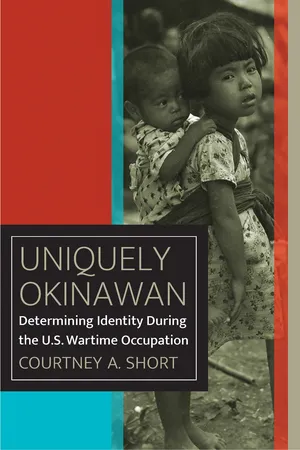
Uniquely Okinawan
Determining Identity During the U.S. Wartime Occupation
- 272 pages
- English
- ePUB (mobile friendly)
- Available on iOS & Android
eBook - ePub
About this book
Uniquely Okinawan explores how American soldiers, sailors, and Marines considered race, ethnicity, and identity in the planning and execution of the wartime occupation of Okinawa, during and immediately after the Battle of Okinawa, 1945–46.
Information
Publisher
Fordham University PressYear
2020Print ISBN
9780823287727
9780823288380
Edition
1eBook ISBN
9780823288397
1
Identifying the Enemy
US Army Wartime Occupation Policy
On May 31, 1945, two American soldiers sat cross-legged on the floor of a small hut in the gutted village of Nodake on the island of Okinawa. Their hostess, a middle-aged Okinawan woman, stooped over them as she poured hot tea into small round clay cups. Many different families shared the hut with the woman, and some of them crowded into the main room to join in the tea ceremony with the Americans.1 Bombings, begun in October 1944 preparatory to the American invasion, had destroyed numerous homes in the village. Under the direction of the US Army, several families now lived together in the homes that survived.
Military Government Detachment B-5 had operated Camp Nodake for two months. Outside its perimeter, the Battle of Okinawa, which had begun with the invasion of the Kerama Islands in March 1945, still raged. The Japanese were preparing to fall back to their second line of defense, and the Americans had seized Shuri Castle, the headquarters of the Japanese 32nd Army.2
In the quiet hut, over a steaming cup of traditional tea, the mood felt welcoming and congenial; the Okinawans and Americans exchanged peaceful gestures and expressed kinship.3 Months before, during the planning of Operation Iceberg, the Americans had not foreseen such a friendly exchange. Planning efforts had considered the possibility that the Okinawan population could act with hostility toward the invading forces. The commanders and planners who devised the US Army’s military government strategy based their work on an overriding commitment to successfully securing the island of Okinawa with the smallest number of American casualties possible. Grappling with the heavy challenge of transporting food and supplies across an ocean and the pivotal importance of the security of both sensitive information and soldiers, consideration of the population entered the planning mindset as a factor related to the protection of American soldiers and the mission. The large size of the population meant that the Okinawans could have a dramatic effect on the outcome of the battle. Analyzing the complicated relationship between Okinawa and Japan, planners recognized that they had to gauge the reaction of the Okinawan population to a foreign force invading their land. Assessing the civilian temperament related directly to the practical military planning considerations of provisions and security yet also required the planners to define the level of allegiance that the Okinawans felt toward Japan. The Americans, therefore, made determinations about the Okinawans’ identity that influenced the construction of military government policy.
The American planners who devised military government policy and the commanders and soldiers who executed that policy carefully considered practical military matters in their decision making; however, contemplation of the complex ethnic and political situation of Okinawa as a prefecture of Japan stood as a paramount element of policy construction.
On January 6, 1945, Lieutenant General Simon Bolivar Buckner Jr. sat at a desk in Washington, DC, reviewing the final version of his “Operational Directive #7 from the Commanding General of Tenth Army” (GOPER).4 For the past three years, the United States had been engaged in world war in numerous theaters of operation. American troops invaded North Africa and Sicily, destroyed German submarines in the Atlantic Ocean, liberated France, combated subversion in Latin America, sent supplies to the Soviets through the North Pacific and the Middle East, provided limited mortars and artillery to the Chinese, and committed over $50 billion to Great Britain for war materials through the Lend-Lease Act. In the Pacific, American forces proved victorious in battles fought from aircraft carriers at sea and amphibious landings on various islands, drawing ever closer to Japan for the inevitable invasion, seizing islands including Guadalcanal, Tarawa, Kwajalein, Saipan, Leyte, and part of New Guinea along the way.
In June 1944, Buckner traveled to Washington to take command of the Tenth Army and participate in the planning for the unit’s first mission. Originally identified as the seizure of Taiwan, the objective shifted to the island of Okinawa in October. As American military progress in the Pacific moved closer to Japan’s home islands, military planners viewed Operation Iceberg as a crucial preliminary step in the plan to invade mainland Japan. Admiral Chester W. Nimitz, Admiral Raymond A. Spruance, and Vice Admiral Richmond Kelly Turner believed the successful capture of Okinawa would prevent the war from lasting another year.5 Located 360 nautical miles from Kyushu and equally as close to Formosa and China, Okinawa sat in a militarily advantageous position in relation to Japan, its occupied lands, and its deployed troops. Capture of Okinawa would jeopar dize Japan’s ability to send supplies to Southeast Asia and allow the Allies to launch missions against multiple Japanese possessions.6 As a staging ground for the proposed attack on Japan, Okinawa offered airstrips, harbors, and troop-staging areas. The island could also operate as a supply depot and help alleviate the increasingly difficult task of transporting resources from the United States to the western Pacific.
Buckner spent months in Washington planning the details of the upcoming Okinawa mission with top military leaders from both the US Army and Navy, while Brigadier General William E. Crist, his deputy commander for military government, worked from Schofield Barracks in Oahu, Hawaii, with the rest of Buckner’s staff.7 Admiral Nimitz, Admiral Spruance, General of the Army George C. Marshall, Lieutenant General Robert C. Richardson, and Rear Admiral Forrest P. Sherman all participated in the planning of Operation Iceberg. The planners, from the beginning, recognized the mission as a joint operation of the Army, Navy, and Marines that would include amphibious landings, heavy shelling from ground-based artillery, warships and carriers, and an aggressive infantry landing force. Buckner offered his combat plans for Admiral Spruance’s review on the morning of November 1, 1944. Buckner had only one voice in the joint planning. On January 8, 1945, he submitted alternative combat plans to Vice Admiral Turner that were then accepted. Separated from his staff in Hawaii, all his plans—combat plans, military government plans, and operational annexes—were written at separate intervals, submitted, revised, and approved at different times.
The GOPER, approved on January 6, was the plan for handling the large civilian population on Okinawa through the use of military government units attached to Marine and Army combat divisions. Based on training manuals used in the US Army’s Civil Affairs schools and CINCPACCINCPOA Bulletin #161-44, produced from intelligence summaries, the plan provided a general outline of the initial tasks of the military government units.8 It began with the mission of military government: to “assist military operations by maintaining order, promoting security, preventing interference, reducing active and passive sabotage, relieving combat troops of local administration, and mobilizing local resources in the aid of military objective.”9 The GOPER explained the structure and function of the military government units. It also gave general directions on the proper conduct of the units under the immediate conditions of battle. Primarily, the document established short-term policies aimed at providing the units with just enough information to establish rudimentary camps immediately upon landing.
In the appendices, Buckner and his staff detailed the composition, including personnel and equipment, of the military government units. During the combat phase, he specified that the units would fall under the combat commander and divisions to which they were attached.10 The headquarters element for all military government activities on the island lay at the Tenth Army level. The separate military government units attached to the combat divisions each consisted of four detachments with different individual missions. “A” detachments were to move forward with the combat units and seek out dislocated civilians for evacuation. The civilians would then move away from the frontlines toward the “B” detachments, which were to follow closely behind the “A” detachments and establish temporary camps that processed civilians. Further back, the “C” detachments were to build more stable camp environments that had the capacity to sustain a large civilian population for an extended period of time. The “D” detachments would process even larger populations—sixty thousand to one hundred thousand people—and potentially would build permanent settlements.11 The basic concept funneled civilians gradually from the dangerous battlefront to the relatively safe rear areas through a series of detachments and camps that increasingly became more established and larger in size.
Buckner gave little guidance about the personal conduct of his troops toward civilians.12 He only addressed their relationship in one statement. Under the title of “Degree of Control,” he ordered the commanders to “demand and enforce obedience,” thus directing that civilians could earn back their freedom only by following the instructions of the occupiers. He delegated to his subordinate commanders the “powers of government as international law and military necessity may require.” The GOPER was a flexible document that allowed for interpretation by subordinate commanders as conditions warranted. As the battle changed, commanders on all levels had the freedom to decide based on their own judgment. With language like “to the extent required” and “take necessary action,” Buckner made the GOPER as useable a document as subordinate commanders could desire. It clearly stated, however, that “rigid control of civilians will be exercised.”13
Policies for the immediate occupation outlined in the GOPER addressed supply, medical needs, and civilian labor forces for use both within camps and with tactical units. An initial supply of food for the civilian population would arrive with the assault divisions. The plan calculated rations of foods typical of an Okinawan diet, such as rice, beans, and fish, per individual and per thousand civilians. After the depletion of the initial supplies brought ashore by the Americans, policy called for soldiers to use procured local island resources. Policies for clothing and transportation followed similar guidelines—an initial stock would land with the assault, and resupply became the responsibility of military government by means of reconnaissance and recovery of local items. The policy forbade the issuing of US military rations except in cases of undefined emergency. The GOPER emphasized the ingenuity of the soldiers to procure the necessary supplies while at the same time planning for an adequate initial stock. The policy designated the requirements of food and clothing as those “minim[ally] essential.”14
Medical policy involved treating casualties, containing contagious disease, and creating a sanitary environment. The guidance directed American military medical personnel to dispense care only “to the extent required to prevent interference with military operations and meet humanitarian needs.”15 Guidance dictated that medical personnel transport the urgently sick or wounded patients to hospitals, quarantine those with contagious ailments, and maintain strict supervision over conditions to ensure proper cleanliness. The order also stated that Okinawan medical doctors and nurses, local facilities, and local equipment should be used only for civilian patients.16
Buckner and his staff viewed the Okinawans as a potential source of labor that the combat units could use as long as the population received food, water, and transportation as they worked. Civilians would not receive pay. The policy also directed the combat units to guard civilians as they labored. The responsibility of organizing and coordinating the work force fell to the military government commander of each camp, who handled the labor assignments.17 Civilians would not have a choice about participating in the labor program.
The GOPER included a section that briefly mentioned locally run government as an eventual goal but an impractical reality for the initial occupation. The majority of the government section dealt with censorship and Okinawan cultural institutions. Civilians residing in camps could not communicate with those outside the camp. The policy denied the use and/or creation of a postal service and empowered military government personnel to “take necessary action to prevent communication with enemy civilians.” Policies ordered the protection of cultural arts and monuments and suggested instituting educational programs for civilians.18
Buckner thus laid a base for military government operations. Naturally, his policy emphasized the primacy of the tactical military mission over the comfort of the civilians and thus set the standard for the needs of the civilians at the lowest level possible to meet the minimal essential requirements for sustaining life. Despite its varied guidance on numerous aspects of military government, the GOPER neglected any significant discussion of interaction between soldiers and civilians. The GOPER laid out broad expectations of programs but did not address the conduct of American soldiers.
As the commanding general of the Tenth Army, General Buckner wanted first to secure the island in order to sever Japanese supply lines, then organize and launch the final attack on the home islands. In the GOPER, the mission of the military government included a statement about “preventing interference with military operations.”19 He ordered the military government to remove civilians from the battlefield because their presence could jeopardize the tactical mission; he did not order their evacuation out of a concern for their safety. “As for the civilians, the main idea is to keep them out of the way,” he told an interviewer on March 21, 1945, “and to minimize difficulties for our own forces.”20 While he and his staff worked on the GOPER, he also worked simultaneously on the invasion plans. The men focused on balance of fire through the combined use of artillery and infantry, decided where to land, and analyzed intelligence reports and maps in an attempt to identify the location of the Japanese forces. Buckner based his decisions related to military government on an assessment of the potential combat situation and how that situation could produce an American victory. The GOPER did not in actuality focus on the conduct of military government. Instead, it focused on how to minimize the impact of civilians on the battle.
Buckner’s command emphasis on the battle shaped mi...
Table of contents
- Cover
- Title Page
- Copyright
- Contents
- Introduction
- 1 Identifying the Enemy: US Army Wartime Occupation Policy
- 2 US Marine Discipline: Strict Directives in Wartime Marine Military Government
- 3 “Japanese” Warriors? Okinawan Preparation for Battle
- 4 The US Fights Overseas: Americans Charge toward the Battlefield
- 5 Having a Say: Okinawan Constructions of Identity
- 6 Policy into Action: The US Army Hits the Shore
- 7 Benevolent Captors? Okinawans Encounter the Americans
- 8 No Initiative: Unbending Policy, Rigid US Marine Action
- 9 The US Navy Period: Navigating the Transition to Peace
- 10 New Visions, New Interpretations of Identity:The Expansion of US Navy Military Government
- Conclusion
- Acknowledgments
- Notes
- Bibliography
- Index
- Photographs
Trusted by 375,005 students
Access to over 1.5 million titles for a fair monthly price.
Study more efficiently using our study tools.
Frequently asked questions
Yes, you can cancel anytime from the Subscription tab in your account settings on the Perlego website. Your subscription will stay active until the end of your current billing period. Learn how to cancel your subscription
No, books cannot be downloaded as external files, such as PDFs, for use outside of Perlego. However, you can download books within the Perlego app for offline reading on mobile or tablet. Learn how to download books offline
Perlego offers two plans: Essential and Complete
- Essential is ideal for learners and professionals who enjoy exploring a wide range of subjects. Access the Essential Library with 800,000+ trusted titles and best-sellers across business, personal growth, and the humanities. Includes unlimited reading time and Standard Read Aloud voice.
- Complete: Perfect for advanced learners and researchers needing full, unrestricted access. Unlock 1.5M+ books across hundreds of subjects, including academic and specialized titles. The Complete Plan also includes advanced features like Premium Read Aloud and Research Assistant.
We are an online textbook subscription service, where you can get access to an entire online library for less than the price of a single book per month. With over 1.5 million books across 990+ topics, we’ve got you covered! Learn about our mission
Look out for the read-aloud symbol on your next book to see if you can listen to it. The read-aloud tool reads text aloud for you, highlighting the text as it is being read. You can pause it, speed it up and slow it down. Learn more about Read Aloud
Yes! You can use the Perlego app on both iOS and Android devices to read anytime, anywhere — even offline. Perfect for commutes or when you’re on the go.
Please note we cannot support devices running on iOS 13 and Android 7 or earlier. Learn more about using the app
Please note we cannot support devices running on iOS 13 and Android 7 or earlier. Learn more about using the app
Yes, you can access Uniquely Okinawan by Courtney A. Short in PDF and/or ePUB format, as well as other popular books in History & World War II. We have over 1.5 million books available in our catalogue for you to explore.