- 437 pages
- English
- PDF
- Available on iOS & Android
eBook - PDF
Mechanical Behavior of Materials
About this book
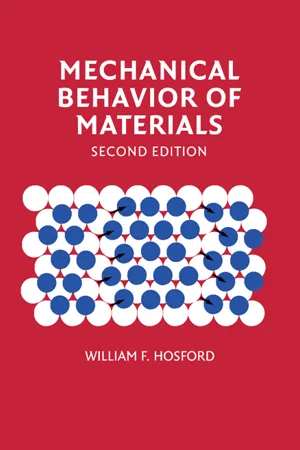
This textbook fits courses on mechanical behavior of materials in mechanical engineering and materials science and includes numerous examples and problems. It emphasizes quantitative problem solving. This text differs from others because the treatment of plasticity emphasizes the interrelationship of the flow, effective strain, and effective stress and their use in conjunction with yield criteria to solve problems. The treatment of defects is new, as is the analysis of particulate composites. Schmid's law is generalized for complex stress states. Its use with strains allows for prediction of R-values for textures. Of note is the treatment of lattice rotations related to deformation textures. The chapter on fracture mechanics includes coverage of Gurney's approach. Among the highlights in this new edition are the treatment of the effects of texture on properties and microstructure in Chapter 7, a new chapter (12) on discontinuous and inhomogeneous deformation, and the treatment of foams in Chapter 21.
Information
Table of contents
- Cover
- Half-title
- Title
- Copyright
- Contents
- Preface
- 1 Stress and Strain
- 2 Elasticity
- 3 Mechanical Testing
- 4 Strain Hardening of Metals
- 5 Plasticity Theory
- 6 Strain Rate and Temperature Dependence of Flow Stress
- 7 Slip and Crystallographic Textures
- 8 Dislocation Geometry and Energy
- 9 Dislocation Mechanics
- 10 Mechanical Twinning and Martenitic Shear
- 11 Hardening Mechanisms in Metals
- 12 Discontinuous and Inhomogeneous Deformation
- 13 Ductility and Fracture
- 14 Fracture Mechanics
- 15 Viscoelasticity
- 16 Creep and Stress Rupture
- 17 Fatigue
- 18 Residual Stresses
- 19 Ceramics and Glasses
- 20 Polymers
- 21 Composites
- 22 Mechanical Working
- Appendix I: Miller Indices
- Appendix II: Stereographic Representation of Orientations
- Index
Trusted by 375,005 students
Access to over 1.5 million titles for a fair monthly price.
Study more efficiently using our study tools.
Frequently asked questions
Yes, you can cancel anytime from the Subscription tab in your account settings on the Perlego website. Your subscription will stay active until the end of your current billing period. Learn how to cancel your subscription
No, books cannot be downloaded as external files, such as PDFs, for use outside of Perlego. However, you can download books within the Perlego app for offline reading on mobile or tablet. Learn how to download books offline
Perlego offers two plans: Essential and Complete
- Essential is ideal for learners and professionals who enjoy exploring a wide range of subjects. Access the Essential Library with 800,000+ trusted titles and best-sellers across business, personal growth, and the humanities. Includes unlimited reading time and Standard Read Aloud voice.
- Complete: Perfect for advanced learners and researchers needing full, unrestricted access. Unlock 1.5M+ books across hundreds of subjects, including academic and specialized titles. The Complete Plan also includes advanced features like Premium Read Aloud and Research Assistant.
We are an online textbook subscription service, where you can get access to an entire online library for less than the price of a single book per month. With over 1.5 million books across 990+ topics, we’ve got you covered! Learn about our mission
Look out for the read-aloud symbol on your next book to see if you can listen to it. The read-aloud tool reads text aloud for you, highlighting the text as it is being read. You can pause it, speed it up and slow it down. Learn more about Read Aloud
Yes! You can use the Perlego app on both iOS and Android devices to read anytime, anywhere — even offline. Perfect for commutes or when you’re on the go.
Please note we cannot support devices running on iOS 13 and Android 7 or earlier. Learn more about using the app
Please note we cannot support devices running on iOS 13 and Android 7 or earlier. Learn more about using the app
Yes, you can access Mechanical Behavior of Materials by William F. Hosford in PDF and/or ePUB format, as well as other popular books in Technology & Engineering & Materials Science. We have over 1.5 million books available in our catalogue for you to explore.