- 268 pages
- English
- PDF
- Available on iOS & Android
eBook - PDF
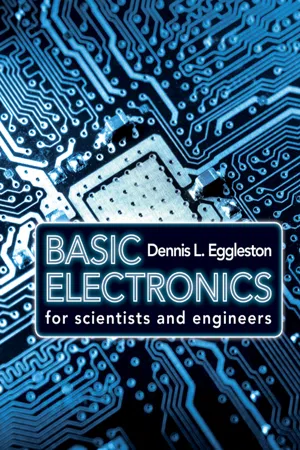
Basic Electronics for Scientists and Engineers
About this book
Ideal for a one-semester course, this concise textbook covers basic electronics for undergraduate students in science and engineering. Beginning with the basics of general circuit laws and resistor circuits to ease students into the subject, the textbook then covers a wide range of topics, from passive circuits through to semiconductor-based analog circuits and basic digital circuits. Using a balance of thorough analysis and insight, readers are shown how to work with electronic circuits and apply the techniques they have learnt. The textbook's structure makes it useful as a self-study introduction to the subject. All mathematics is kept to a suitable level, and there are several exercises throughout the book. Password-protected solutions for instructors, together with eight laboratory exercises that parallel the text, are available online at www.cambridge.org/Eggleston.
Information
Table of contents
- Cover
- Title Page
- Copyright
- Contents
- Preface
- 1 Basic concepts and resistor circuits
- 2 AC circuits
- 3 Band theory and diode circuits
- 4 Bipolar junction transistors
- 5 Field-effect transistors
- 6 Operational amplifiers
- 7 Oscillators
- 8 Digital circuits and devices
- Appendix A: Selected answers to exercises
- Appendix B: Solving a set of linear algebraic equations
- Appendix C: Inductively coupled circuits
- References
- Index
Trusted by 375,005 students
Access to over 1.5 million titles for a fair monthly price.
Study more efficiently using our study tools.
Frequently asked questions
Yes, you can cancel anytime from the Subscription tab in your account settings on the Perlego website. Your subscription will stay active until the end of your current billing period. Learn how to cancel your subscription
No, books cannot be downloaded as external files, such as PDFs, for use outside of Perlego. However, you can download books within the Perlego app for offline reading on mobile or tablet. Learn how to download books offline
We are an online textbook subscription service, where you can get access to an entire online library for less than the price of a single book per month. With over 1.5 million books across 990+ topics, we’ve got you covered! Learn about our mission
Look out for the read-aloud symbol on your next book to see if you can listen to it. The read-aloud tool reads text aloud for you, highlighting the text as it is being read. You can pause it, speed it up and slow it down. Learn more about Read Aloud
Yes! You can use the Perlego app on both iOS and Android devices to read anytime, anywhere — even offline. Perfect for commutes or when you’re on the go.
Please note we cannot support devices running on iOS 13 and Android 7 or earlier. Learn more about using the app
Please note we cannot support devices running on iOS 13 and Android 7 or earlier. Learn more about using the app
Yes, you can access Basic Electronics for Scientists and Engineers by Dennis L. Eggleston in PDF and/or ePUB format, as well as other popular books in Technology & Engineering & Electrical Engineering & Telecommunications. We have over 1.5 million books available in our catalogue for you to explore.