- 280 pages
- English
- PDF
- Available on iOS & Android
eBook - PDF
About this book
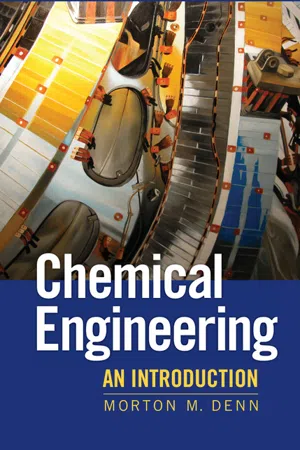
'Chemical engineering is the field of applied science that employs physical, chemical, and biological rate processes for the betterment of humanity'. This opening sentence of Chapter 1 has been the underlying paradigm of chemical engineering. Chemical Engineering: An Introduction is designed to enable the student to explore the activities in which a modern chemical engineer is involved by focusing on mass and energy balances in liquid-phase processes. Problems explored include the design of a feedback level controller, membrane separation, hemodialysis, optimal design of a process with chemical reaction and separation, washout in a bioreactor, kinetic and mass transfer limits in a two-phase reactor, and the use of the membrane reactor to overcome equilibrium limits on conversion. Mathematics is employed as a language at the most elementary level. Professor Morton M. Denn incorporates design meaningfully; the design and analysis problems are realistic in format and scope.
Information
Table of contents
- Cover
- Title
- Copyright
- Contents
- Preface
- 1 Chemical Engineering
- 2 Basic Concepts of Analysis
- 3 The Balance Equation
- 4 Component Mass Balances
- 5 Membrane Separation
- 6 Chemically Reacting Systems
- 7 Designing Reactors
- 8 Bioreactors and Nonlinear Systems
- 9 Overcoming Equilibrium
- 10 Two-Phase Systems and Interfacial Mass Transfer
- 11 Equilibrium Staged Processes
- 12 Energy Balances
- 13 Heat Exchange
- 14 Energy Balances for Multicomponent Systems
- 15 Energy Balances for Reacting Systems
- Postface
- Index
Trusted by 375,005 students
Access to over 1.5 million titles for a fair monthly price.
Study more efficiently using our study tools.
Frequently asked questions
Yes, you can cancel anytime from the Subscription tab in your account settings on the Perlego website. Your subscription will stay active until the end of your current billing period. Learn how to cancel your subscription
No, books cannot be downloaded as external files, such as PDFs, for use outside of Perlego. However, you can download books within the Perlego app for offline reading on mobile or tablet. Learn how to download books offline
We are an online textbook subscription service, where you can get access to an entire online library for less than the price of a single book per month. With over 1.5 million books across 990+ topics, we’ve got you covered! Learn about our mission
Look out for the read-aloud symbol on your next book to see if you can listen to it. The read-aloud tool reads text aloud for you, highlighting the text as it is being read. You can pause it, speed it up and slow it down. Learn more about Read Aloud
Yes! You can use the Perlego app on both iOS and Android devices to read anytime, anywhere — even offline. Perfect for commutes or when you’re on the go.
Please note we cannot support devices running on iOS 13 and Android 7 or earlier. Learn more about using the app
Please note we cannot support devices running on iOS 13 and Android 7 or earlier. Learn more about using the app
Yes, you can access Chemical Engineering by Morton Denn in PDF and/or ePUB format, as well as other popular books in Technology & Engineering & Chemical & Biochemical Engineering. We have over 1.5 million books available in our catalogue for you to explore.