Our Bodies, Ourselves: Menopause
eBook - ePub

Our Bodies, Ourselves: Menopause

  1. 368 pages
  2. English
  3. ePUB (mobile friendly)
  4. Available on iOS & Android
eBook - ePub

Our Bodies, Ourselves: Menopause

About this book

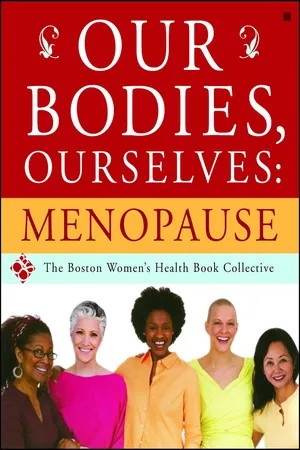
FROM THE EDITORS OF THE CLASSIC "BIBLE OF WOMEN'S HEALTH, " A TRUSTWORTHY, UP-TO-DATE GUIDE TO HELP EVERY WOMAN NAVIGATE THE MENOPAUSE TRANSITION For decades, millions of women have relied on Our Bodies, Ourselves to provide the most comprehensive, honest, and accurate information on women's health. Now, in Our Bodies, Ourselves: Menopause, the editors of the classic guide discuss the transition of menopause. With a preface by Vivian Pinn, M.D., the director of the Office of Research on Women's Health at the National Institutes of Health, Our Bodies, Ourselves: Menopause includes definitive information from the latest research and personal stories from a diverse group of women. Our Bodies, Ourselves: Menopause provides an in-depth look at subjects such as hormone therapy and sexuality as well as proven strategies for coping with challenges like hot flashes, mood swings, and night sweats. In clear, accessible language, the book dispels menopause myths and provides crucial information that women can use to take control of their own health and get the best care possible. Our Bodies, Ourselves: Menopause is an essential resource for women who are experiencing -- or expecting -- menopause.
Frequently asked questions

Yes, you can cancel anytime from the Subscription tab in your account settings on the Perlego website. Your subscription will stay active until the end of your current billing period. Learn how to cancel your subscription.
At the moment all of our mobile-responsive ePub books are available to download via the app. Most of our PDFs are also available to download and we're working on making the final remaining ones downloadable now. Learn more here.
Perlego offers two plans: Essential and Complete
  • Essential is ideal for learners and professionals who enjoy exploring a wide range of subjects. Access the Essential Library with 800,000+ trusted titles and best-sellers across business, personal growth, and the humanities. Includes unlimited reading time and Standard Read Aloud voice.
  • Complete: Perfect for advanced learners and researchers needing full, unrestricted access. Unlock 1.4M+ books across hundreds of subjects, including academic and specialized titles. The Complete Plan also includes advanced features like Premium Read Aloud and Research Assistant.
Both plans are available with monthly, semester, or annual billing cycles.
We are an online textbook subscription service, where you can get access to an entire online library for less than the price of a single book per month. With over 1 million books across 1000+ topics, we’ve got you covered! Learn more here.
Look out for the read-aloud symbol on your next book to see if you can listen to it. The read-aloud tool reads text aloud for you, highlighting the text as it is being read. You can pause it, speed it up and slow it down. Learn more here.
Yes! You can use the Perlego app on both iOS or Android devices to read anytime, anywhere — even offline. Perfect for commutes or when you’re on the go.
Please note we cannot support devices running on iOS 13 and Android 7 or earlier. Learn more about using the app.
Yes, you can access Our Bodies, Ourselves: Menopause by Judy Norsigian in PDF and/or ePUB format, as well as other popular books in Medicine & Health Care Delivery. We have over one million books available in our catalogue for you to explore.

Information

Approaching Menopause

CHAPTER 1
Understanding Our Menopause Experiences

When I was fifty-two, my youngest son had just started college, my mother had relocated to a continuing care community close to me, my husband was stressed at work, and I was trying to define my next career steps. In the midst of my life, my body took over and signs of menopause began: very heavy irregular bleeding due to fibroids, occasional night sweats, and some vaginal dryness. . . . I had to acknowledge I was aging and couldn’t take my body for granted. I needed to take care of it.
When I stopped having my periods, I was really happy about that. I realized that I could relax. I did n’t have to worry about getting pregnant. I’m looking forward to the times ahead. I have vaginal dryness, but I use a range of lubricants so it is not a huge problem. Sex has changed but not in a negative way. Sometimes I feel great joy, other times less joy. But that’s the way life is, isn’t it?
The younger women I knew all thought it was never going to happen to them (ha!). And all my older women friends insisted, “Oh, it’s nothing.” So I had no one to talk to. That was very hard on me. Late in the process I found an excellent online support group, but by then, I realized that I was in a better position to give advice than to receive it. I think more women need to talk about this.
Those of us who are approaching menopause may wonder how it will affect us physically, emotionally, and socially. Most of us have questions, whether we anticipate the end of our periods with excitement, anxiety, or a combination of the two. While talking about menopause used to be considered taboo, women today are sharing our experiences more openly, through discussions with friends and family, in support groups and online chat rooms, and in the media. Women’s health advocates have long pushed for better research on midlife and menopause and worked to raise awareness of the biological, social, and political factors that influence our menopause experiences. This book offers the information, resources, and support we need to make informed decisions and take care of ourselves as we approach and experience the menopause transition. When we learn more about menopause, we can proceed with increased confidence, the knowledge that we are not alone, and a critical perspective on the cultural messages that surround us.
For most women, menopause is a natural biological change that occurs at midlife. For others, menopause is the consequence of a health condition, medical treatment, or surgery, or it occurs naturally but earlier than usual. Because such a transition is earlier or more abrupt, it may pose different challenges. Our experiences as we go through the menopause transition vary greatly. For some women, the transition is quite rapid; for others, it is slow or intermittent. It is impossible to predict with certainty what changes our bodies will go through or precisely how they will affect us.
Most of us, if we have not already experienced sudden or early menopause, begin to undergo a number of physical changes when we are in our forties. We may wonder if these changes are normal and if they are associated with menopause. A forty-eight-year-old says,
I think I’m in the beginning of my menopause. I’ve noticed a change in my menstrual cycle. In the last two or three months my periods have been a bit irregular and my flow is a lot heavier than it used to be. I’m normally just like clockwork.
In addition to changes in our menstrual cycles, we may experience other signals of the menopause transition, including hot flashes, night sweats, vaginal dryness, and insomnia. Some of us also experience problems such as memory loss, mood swings, and reduced sexual desire, although evidence suggests that these problems are more likely correlated with the aging process, other medical conditions, or life stressors than with menopause. The only changes that are scientifically recognized as associated with menopause are the end of menstrual bleeding, hot flashes, night sweats, insomnia, and vaginal dryness.1
Menopause is not a disease that needs to be “fixed” or “cured” by physicians and drugs. For the majority of us, in fact, the transition to the postmenopausal years involves relatively minor discomforts that do not require medical intervention or treatment. Most signs of menopause are temporary. For example, the hot flashes and night sweats some of us experience are a response to changing hormone levels; when our hormone levels stabilize, the hot flashes usually stop within a few years. Knowing that these signs will end on their own may make them easier to tolerate or manage.
image
A minority of women experience problems associated with menopause that are severe enough to interfere with daily life.
I began having night sweats (I think I had them for a long time before I was really aware that it was night sweats and not just restless sleep). At work I would have sudden onsets of profuse sweating to the point of drenched hair and soaked shoes. . . . I am a registered nurse and always thought that I would sail right through menopause because I understood the physiological changes and did not fear it. Ha! . . . I know that few people have as severe a reaction to the hormonal changes of menopause as I did, but I think women and men should be more aware of the things that can happen.2
The Massachusetts Women’s Health Study, one of the largest and most comprehensive studies of midlife women and menopause, showed that the vast majority of women have positive or neutral attitudes toward menopause.3 Many of us find that the experience and symbolism of the menopause transition motivate us to take stock of our lives, think about what’s most important to us, become more attentive to our health needs, and make changes in how we take care of ourselves. In a 1998 Gallup survey sponsored by the North American Menopause Society, a majority of postmenopausal women said they were happier and more fulfilled than when they were younger. They reported improvements in their family and home lives, partner relationships, and friendships. In addition, approximately three-quarters of the women, who lived in the United States and ranged in age from fifty to sixty-five, said they had made some type of health-related lifestyle change, such as stopping smoking, at menopause/midlife.4
As we approach menopause, we may feel fearful because we have heard more about the small percentage of women who have very difficult menopausal transitions than we have about the majority, who have a relatively easy time of it.
It scared me at first because I felt I had no control. I sometimes went through three months of hot flashes and then I wouldn’t have anything for six months. Things were happening to me that I didn’t know if they were right or not. I couldn’t understand what was happening. . . . It was hard to talk to anybody, including my mother.
In popular media, menopause is often presented as a time of physical and mental degeneration that women dread. Women going through the transition are frequently portrayed as emotionally unstable and irrational—people who may break into tears for no reason, become angry without provocation, and seem “out of control” (all because of our hormones). In reality, studies have shown that emotional changes are not inevitably part of the menopause transition.5 The mood symptoms some women experience during the menopause transition do not appear to be caused by hormonal changes; they are far more likely to be linked to life stress, a history of depression, and health status at midlife.
Fears and anxieties about menopause can be created, exaggerated, or manipulated by drug companies, media pundits, and self-help gurus who focus attention on the potential problems associated with menopause (and the supposed solutions they are selling) rather than providing a balanced and accurate picture of women’s real experiences. As Aged by Culture author Margaret Morganroth Gullette puts it, “Women have less to fear from menopause than from menopause discourse.”6 When we have little information and few positive role models, we are left vulnerable to believing all the negative things we hear about menopause. Learning to recognize and resist these sometimes damaging influences can prepare us to better understand and cope with the menopause transition.
For most American women, the context within which we experience menopause includes ageism (negative stereotypes and institutionalized discrimination against older people), sexism (prejudice and discrimination against women), and medicalization (the notion that natural biological processes need medical supervision or intervention). These societal attitudes can undermine our confidence and encourage unnecessary reliance on hormone treatment, other medical interventions, or “expert” advice.
Our menopause experiences are also often affected by our cultural, racial, and ethnic heritage, our socioeconomic class, and our individual life histories and life circumstances. There is no single path that all women take to and through menopause.
AGEISM AND SEXISM
I had my first hot flash at age fifty-two, the same age my mother was when she started menopause. But she told me she remembered feeling old. I don’t. I feel like a younger older woman. I had my youngest daughter when I was forty-two. My sense of the life span has increased, with the expectation that I will have many active years, until my eighties, hopefully. There is so much I want to do.
Both women and men are living longer than we did in the past, for a wide variety of reasons: better sanitation, vaccinations, more control over reproduction, better understanding of the link between lifestyle and poor health, and better medical treatments and technology. A woman in the United States who reaches menopause today can expect to live approximately thirty more years, making her postmenopausal stage of life nearly as long as her reproductive years.7 In 2002, the 33 million women in the United States who were fifty-five or older made up nearly 23 percent of the female population.8 As more women reach midlife and change the demographics in our country, we have an opportunity to reframe the issues and construct a vision that will improve the health, well-being, and social status of women at midlife.
Unfortunately, entrenched negative stereotypes about “being old” can make it difficult for us to accept our natural aging process. We feel pressure, in overt and subtle ways, to live up to impossible ideals of eternal youth and beauty. Although society has changed somewhat, sexist attitudes linger and affect women as we age. A woman in her early forties says,
I don’t like the word “menopause.” . . . Whenever I heard that word when I was younger, I felt like it didn’t relate to me. And now when I hear other women talk about menopause, it’s all negative. . . . You’re viewed as getting old and you’re deteriorating.
In cultures where age is particularly venerated and respected, menopause is perceived very differently. In contexts where women look at aging in a positive light and are seen by others as sources of wisdom, menopause is likely to be less stressful.
We also may feel resistant to the idea that aging may bring with it a certain amount of discomfort, pain, and limitations to mobility. Such resistance is supported by our consumer culture, which promises us quick fixes for everything from menstrual cramps to acne, usually for a price.
image
Aging is separate from menopause, but it is part of it. I don’t feel old, but I’m getting aging spots on my hands and my face. My hair is turning white. I’m starting to get that “boxy” shape. I look at other women my age, and I think, Gee, they look old. They act “old.” But then, it’s like, Oh my God. Am I that old? Maybe I’m just deceiving myself. Maybe I’m old, too, but I just can’t see it. Maybe I need to go out and dye my hair and paint my toenails to feel good about myself. I don’t like the way it makes me view myself.
Aging is a natural part of life. We can resist the cultural messages that devalue older women by joining advocacy groups for midlife and older women and by reaching out and appreciating one another. Building friendships with older women can offer us alternative role models. A forty-four-year-old woman says,
I went to a women’s brunch where most of the women ranged from the mid-thirties to the mid-fifties. I was curious about one much older woman who turned out to be a sculptor in her seventies. She invited me to visit her at her studio near the shore. I drove down with a photographer friend, bringing a picnic lunch, and enjoyed a delightful afternoon viewing her recent work, each of us sharing her experiences as a woman trying to do creative work at different times in the life cycle.9
MEDICALIZATION
When I entered midlife, I experienced some of the same kinds of frustrations that I did as a woman giving birth. Once again, I found myself regarded by t...

Table of contents

  1. Cover
  2. Preface
  3. Introduction
  4. Part I: Approaching Menopause
  5. Part II: A Transition and Its Challenges
  6. Part III: Changing Selves, Changing Relationships
  7. Part IV: Taking Care of Ourselves
  8. Part V: Health Concerns
  9. Part VI: Knowledge is Power
  10. Resources
  11. Authorship and Acknowledgments
  12. About the Contributors
  13. Disclosures
  14. Index
  15. Copyright