Relaxation Revolution
eBook - ePub

Relaxation Revolution

The Science and Genetics of Mind Body Healing

  1. 288 pages
  2. English
  3. ePUB (mobile friendly)
  4. Available on iOS & Android
eBook - ePub

Relaxation Revolution

The Science and Genetics of Mind Body Healing

About this book

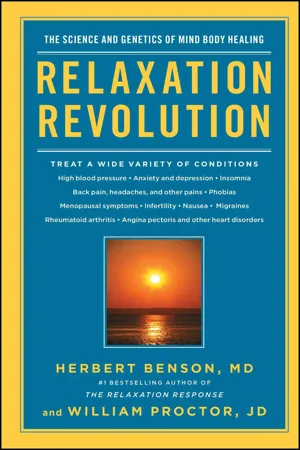
Recent scientific breakthroughs—demonstrating that mind body strategies can actually “switch off” or “switch on” gene activity associated with health and disease—have triggered a mind body revolution in the medical world.

In the 1970s, Dr. Herbert Benson of Harvard Medical School ushered in a new era of understanding in the field of mind body medicine. Coining the term “relaxation response,” Dr. Benson identified the body’s physiologic reaction that is the exact opposite of the stress (fight-or-flight) response. In the four decades since that initial discovery, Benson and his colleagues have established the first effective therapy to counteract the harmful effects of stress. They have explored how the relaxation response, the power of expectation and belief, and other mind body phenomena can produce healing in your own body.

A new era has dawned. Genetic research now shows conclusively that the mind can influence the body down to the genetic level. Your mind has the ability to change the way your body and your genes function.

We now have scientific proof that the mind can heal the body.

In Relaxation Revolution, Dr. Herbert Benson and William Proctor present the latest scientific endings, revealing that we have the ability to self-heal diseases, prevent life-threatening conditions, and supplement established drug and surgical procedures with mind body techniques. In a special “treatment” section, Benson and Proctor describe how these mind body techniques can be applied—and are being applied—to treat a wide variety of conditions, including:

• High blood pressure

• Anxiety and depression

• Infertility

• Insomnia

• Menopausal hot flashes

• Many pains, including backaches and headaches

• Phobias

• And much more

Relaxation Revolution details Dr. Benson’s recent work with colleagues in the field of genetics, which links mind body treatments to the healing of a steadily expanding number of medical conditions. Mind and body have become part of a scientific and medical whole; together they represent a complete approach to healing and maximal well-being. In clear, straightforward language, Benson and Proctor cite the experiences of real people to show how mind body techniques have the potential not only to enhance healing but also to reduce health costs to individuals and to society as a whole. Relaxation Revolution shines a light on the future of medicine.
Frequently asked questions

Yes, you can cancel anytime from the Subscription tab in your account settings on the Perlego website. Your subscription will stay active until the end of your current billing period. Learn how to cancel your subscription.
No, books cannot be downloaded as external files, such as PDFs, for use outside of Perlego. However, you can download books within the Perlego app for offline reading on mobile or tablet. Learn more here.
Perlego offers two plans: Essential and Complete
  • Essential is ideal for learners and professionals who enjoy exploring a wide range of subjects. Access the Essential Library with 800,000+ trusted titles and best-sellers across business, personal growth, and the humanities. Includes unlimited reading time and Standard Read Aloud voice.
  • Complete: Perfect for advanced learners and researchers needing full, unrestricted access. Unlock 1.4M+ books across hundreds of subjects, including academic and specialized titles. The Complete Plan also includes advanced features like Premium Read Aloud and Research Assistant.
Both plans are available with monthly, semester, or annual billing cycles.
We are an online textbook subscription service, where you can get access to an entire online library for less than the price of a single book per month. With over 1 million books across 1000+ topics, we’ve got you covered! Learn more here.
Look out for the read-aloud symbol on your next book to see if you can listen to it. The read-aloud tool reads text aloud for you, highlighting the text as it is being read. You can pause it, speed it up and slow it down. Learn more here.
Yes! You can use the Perlego app on both iOS or Android devices to read anytime, anywhere — even offline. Perfect for commutes or when you’re on the go.
Please note we cannot support devices running on iOS 13 and Android 7 or earlier. Learn more about using the app.
Yes, you can access Relaxation Revolution by Herbert Benson,William Proctor in PDF and/or ePUB format, as well as other popular books in Medicine & Alternative & Complementary Medicine. We have over one million books available in our catalogue for you to explore.

Information

Part I

The Science of
Mind Body Healing

1.
The Making of a Revolution

We now have scientific proof that the mind can heal the body.
This means that you have the innate ability to self-heal diseases, prevent life-threatening conditions, and supplement established drug and surgical procedures with mind body techniques that can improve your physiology, biochemistry, brain functioning, and genetic activity. Furthermore, these benefits have the potential to reduce individual health costs and the broader societal expenses of health care.
How can you take advantage of these revolutionary advances in medical science? The best way to answer this question is for us to introduce you to Caroline, a 47-year-old accountant and mother of three, who started out with some skepticism about mind body medicine. After she became my patient, she soon learned the tremendous personal benefits of this burgeoning field of medical treatment.
How Caroline Conquered Her Back Pain
Caroline, an experienced squash player, considered her forehand her best shot. But as she whipped forward into the ball, she felt something ā€œgiveā€ in her lower back. She thought nothing of the discomfort, which subsided as she continued to play. The morning after the match, however, she awoke with lower-back pain that hardly allowed her to stand.
Caroline decided that the pains were somehow related to her habit of bending her back excessively when she was serving. Because she had experienced lower-back pains before—and thought she knew how to deal with them—she immediately reached for an over-the-counter painkiller. Sure enough, after about 20 minutes the pain began to subside. But the discomfort didn’t completely disappear, and she went to bed that night struggling to find a position that would allow her to go to sleep.
The next morning, the pain was still present. Furthermore, when she made a seemingly innocuous movement to turn on the hot water in her bathroom, an excruciating back pain immobilized her. The attack began in the same general area, in the small of her back just above her buttocks, but now seemed to spread across her entire lower back.
After suffering the next day at work and finding she couldn’t concentrate, Caroline decided to make an emergency appointment with her physician. Her doctor, an internist, immediately prescribed a strong prescription painkiller, a narcotic-like opioid. But within a couple of days of taking the medication, Caroline began to experience side effects, including constipation, nausea, and intermittent stomach pains. Although the doctor switched her prescription to another painkiller that had fewer side effects, the new drug continued to upset her digestive system with occasional cramps.
More important, the second medication didn’t help as much with the back pain, which returned in force in a day or so. The fact that Caroline was not improving provided additional stress, triggering the ā€œfight-or-flight response.ā€ This physiologic condition, which comes into play when a person is subjected to stress, caused her body to put out excess adrenaline and noradrenaline, secretions that actually increased her sensitivity to pain. The end result was the creation of a vicious mind body cycle of escalating pain, discomfort, and anxiety.
Furthermore, the pain was spreading, moving down into her right leg. According to her physician-internist, this change might be a sign that she was dealing with sciatica. This tentative diagnosis, he explained, meant that the pains might involve her sciatic nerve, which runs from the lower back into the buttocks and the back of the upper leg.
Now at the end of his medical options, the internist sent Caroline to an orthopedic surgeon who specialized in diseases and health conditions related to the spine and back. The surgeon scheduled a magnetic resonance imaging examination, which required Caroline to undergo a nuclear scan of her spine in an enclosed, tubelike structure. The computerized MRI images revealed some herniation (abnormal bulging) of one of her disks and the beginnings of osteoarthritic bone buildup in her lower spine. (Osteoarthritis is a wear-and-tear form of bone and cartilage deterioration that occurs in all of us to one extent or another as we place stress on our bones and joints during the aging process.) But these findings weren’t necessarily conclusive about the cause of her pain.
ā€œA lot of people have MRIs that look like yours,ā€ the orthopedist explained. ā€œBut most aren’t experiencing the kind of pains you’re having. In fact, most aren’t in pain at all. They may have slightly stiff lower backs, but that’s about it.ā€
He also noted that he could find no tumor or other systemic problem that might be causing the pain. So, unable to identify the source of Caroline’s complaint but well aware of her distress, the orthopedist prescribed an even stronger narcotic painkiller. He also referred her to a physical therapist, who prescribed regular massages and an exercise plan. The new pain medication and the physical therapy helped enough to provide some temporary relief. But side effects from the new drug, including a tendency for Caroline to become drowsy at her desk, forced her to cut down on the dosage. As a result, by the end of the year, Caroline’s back pain had returned.
Another MRI and additional diagnostic procedures suggested some deterioration in the condition of the disk in her lower spine. These findings—along with Caroline’s reports that the time she was able to spend at work had steadily decreased—convinced the orthopedist that she was a candidate for back surgery. As a result, she underwent two operations over a two-year period to relieve pressure that the damaged disk might be exerting on nerves around her lower back.
Unfortunately, the surgeries seemed to make matters worse. During her recovery and afterward, Caroline found that she was rarely able to go in to work because of the pain she experienced while driving her car. When she did make it to the office, she couldn’t sit for any extended period in the chair at her desk. The only place she could operate in reasonable comfort was on a sofa in her office, but that wasn’t a location from which she could project proper authority when advising clients. Finally, Caroline elected to work entirely at home, a decision that effectively placed a cap on her client interactions and on her ability to bring in extra business to her firm—and added markedly to her already high stress levels.
She spent most hours during the day on her bed and found that her normal patterns of enjoyment in life had evaporated. Of course, she was unable to play squash: she had given that up even before the surgeries. But there were other issues. An accomplished cellist, she could no longer sit with the instrument for even a few minutes without being immobilized by pain. Finally, she was unable to interact effectively with her teenage children.
Fortunately, despite all the medical setbacks and the deterioration in her lifestyle, Caroline was not willing to give up on her treatment options. The surgeon had told her that her pains could be idiopathic—that is, they could not be linked to any identifiable cause.
ā€œWe’ve done all that’s medically possible for you,ā€ he said. ā€œWe’ve operated on your herniated disk, but you still experience pain. That may mean the pain is coming from some other source, some place that we just can’t identify, given our current medical knowledge.ā€
That conclusion might have been discouraging to some people, but it was actually encouraging to Caroline because she figured, ā€œIf he can’t find a cause, that doesn’t mean there isn’t one. Maybe he just doesn’t have the knowledge to find out what’s wrong and prescribe the right treatment.ā€
So she scheduled another meeting with her family physician, who now referred her to a psychiatrist. Although she was somewhat skeptical about the idea of employing any means other than drugs and surgery to treat her problem, she knew these approaches had not worked, and she was desperate to find some relief. As a result, Caroline was now ready to explore the possibility of an emotional component to her back problem.
The psychiatrist, suspecting that she might be wrestling with significant stress problems, referred her to our Institute. That marked the beginning of my relationship with Caroline and a breakthrough in her pain treatment.
In our first meeting, we reviewed her various tests, procedures, and prior diagnoses. ā€œWe always want to eliminate all physical possibilities,ā€ I explained, ā€œbecause if there is a physical cause, drugs or other standard procedures may work. But as you know too well, many diagnostic procedures have turned up no physical cause of your pain. Also, various medications, surgeries, and other medical procedures haven’t worked.ā€
I also explained the phenomenon of phantom limb pain. This refers to the well-documented perception by many who have lost arms or legs that somehow the missing limb is still there. They may even experience feelings in the absent limb, including pain. The reason for the pain perceptions is that sometimes, the pains have been there for such a long period before the loss of the limb that the brain has become restructured or ā€œrewiredā€ to communicate the painful sensation, which continues even after the limb is missing. The same process appears to work in other mind body situations, where the brain becomes wired for certain responses, including pain.
Caroline’s Third Treatment Option
Then I explained to Caroline that I was going to suggest a third treatment option—one that was as well established scientifically as drugs and surgery. It was also an option that carried no side effects and would cost nothing, once she learned how to use it.
ā€œI’m talking about the mind body treatment option,ā€ I explained, introducing her to what we have come to call mind body healing. ā€œBut before we get into the practical techniques, let me make the science behind this quite clear.ā€
At this point, I briefly described the various research studies that have established beyond any doubt that mind body approaches to treatment have a direct effect on beneficial physiologic and molecular changes in the body. I particularly emphasized those studies that dealt with the application of mind body strategies in treating pain.
I also went into some detail describing the nature of the relaxation response as the biological polar opposite of the fight-or-flight response. A major reason for my explaining the scientific foundation for mind body treatments was to engage one of the most important components of this type of therapy—Caroline’s belief and expectation that the therapy could have a positive, healing effect.* Because a proper understanding of the power of belief and expectancy is so important in mind body healing, I knew that it was essential for Caroline to be convinced that this new concept to which I was introducing her—the use of mind body healing to control her pain—was rooted in scientific fact. Many hundreds of scientific studies have shown that an inner conviction, which the medical community has linked to the phenomenon called ā€œthe placebo effect,ā€ can help produce healing for scores of diseases and medical complaints. The placebo effect is a mind body mechanism that may bring about healing through a person’s expectation and belief that a certain treatment will work.
To be certain that Caroline understood, I summed things up by emphasizing that effective mind body treatments must be grounded in two factors:
  • Techniques designed to elicit the relaxation response, and
  • a comprehensive set of inner beliefs and positive expectations.
ā€œFor you to experience relief from your back pains,ā€ I said, ā€œyou must incorporate these two factors into your mind body healing plan.ā€
When it became clear that Caroline was willing to accept what I was saying about the science behind the mind body approach, I introduced her to our two-phase Benson-Henry Protocol* for mind body healing: 1) the Phase One relaxation response trigger, and 2) Phase Two visualization or mental imagery. This two-phase protocol has been summarized in the accompanying box.
Caroline Learns the Relaxation Response
I told Caroline that, in my presence during this initial session, she should engage in a ā€œmind-openingā€ relaxation response exercise for about 12 to 15 minutes. ā€œThis exercise will prepare your mind to receive new positive impressions and information that can lead to healing,ā€ I said.
I also reminded her about the molecular, metabolic, respiratory, and brain changes that would occur in her body with this phase. With these facts bolstering her conviction that this unfamiliar approach to treatment might actually work, we moved to the heart of the mind body healing procedure.
ā€œIt’s essential for you to break the train of your everyday thoughts,ā€ I told her. ā€œThe usual way to do this is to repeat a word, prayer, sound, phrase, or movement that’s comforting or pleasant for you. What kind of focus word do you think you’d like to choose? It can be religious or secular.ā€
Caroline thought a moment and replied, ā€œPeace. That word should be just right for me.ā€
ā€œOkay,ā€ I said. ā€œN...

Table of contents

  1. Cover Page
  2. Title Page
  3. Acknowledgments
  4. Contents
  5. Preface
  6. Part I: The Science of Mind Body Healing
  7. Part II: Designing Your Personal Mind Body Treatment Plan
  8. Part III: The Possibilities of Mind Body Medicine
  9. Notes
  10. Index