
eBook - ePub
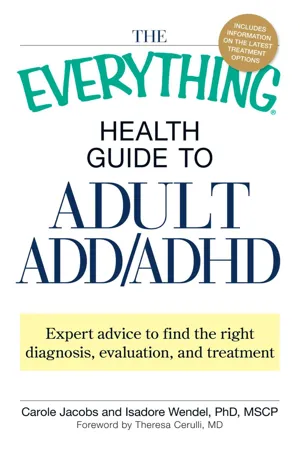
The Everything Health Guide to Adult ADD/ADHD
Expert advice to find the right diagnosis, evaluation and treatment
- 304 pages
- English
- ePUB (mobile friendly)
- Available on iOS & Android
eBook - ePub
The Everything Health Guide to Adult ADD/ADHD
Expert advice to find the right diagnosis, evaluation and treatment
About this book
People with undiagnosed Adult ADD/ADHD suffer highly chaotic lives--and often struggle with problems such as fatigue, depression, drug abuse, and learning disabilities. The good news is that treatment can go a long way toward getting this condition in check. But before anyone can manage the problem, they have to be able to identify it, starting with a thorough understanding of what it looks like in adults. This guide helps you:
- Understand telltale signs and symptoms
- Find the right specialist
- Choose the right treatment
- Decide whether talk therapy is right for you
- Learn how to lead a happier and more productive life
Frequently asked questions
Yes, you can cancel anytime from the Subscription tab in your account settings on the Perlego website. Your subscription will stay active until the end of your current billing period. Learn how to cancel your subscription.
No, books cannot be downloaded as external files, such as PDFs, for use outside of Perlego. However, you can download books within the Perlego app for offline reading on mobile or tablet. Learn more here.
Perlego offers two plans: Essential and Complete
- Essential is ideal for learners and professionals who enjoy exploring a wide range of subjects. Access the Essential Library with 800,000+ trusted titles and best-sellers across business, personal growth, and the humanities. Includes unlimited reading time and Standard Read Aloud voice.
- Complete: Perfect for advanced learners and researchers needing full, unrestricted access. Unlock 1.4M+ books across hundreds of subjects, including academic and specialized titles. The Complete Plan also includes advanced features like Premium Read Aloud and Research Assistant.
We are an online textbook subscription service, where you can get access to an entire online library for less than the price of a single book per month. With over 1 million books across 1000+ topics, weâve got you covered! Learn more here.
Look out for the read-aloud symbol on your next book to see if you can listen to it. The read-aloud tool reads text aloud for you, highlighting the text as it is being read. You can pause it, speed it up and slow it down. Learn more here.
Yes! You can use the Perlego app on both iOS or Android devices to read anytime, anywhere â even offline. Perfect for commutes or when youâre on the go.
Please note we cannot support devices running on iOS 13 and Android 7 or earlier. Learn more about using the app.
Yes, you can access The Everything Health Guide to Adult ADD/ADHD by Carole Jacobs,Isadore Wendel in PDF and/or ePUB format, as well as other popular books in Medicine & Diseases & Allergies. We have over one million books available in our catalogue for you to explore.
Information
CHAPTER 1
Learning the Basics
Learning the Basics
Not so long ago, attention deficit disorder (ADD), which is now called attention deficit hyperactivity disorder (ADHD), was a disorder experts believed was limited to children. The conventional wisdom was that kids grew out of the condition sometime during puberty and that symptoms did not continue into adulthood. Today, however, experts know that while ADHD begins in childhood, many people continue to have the disorder as adults. In fact, research now shows that 4 percent of the adult population suffers from ADHDâa total of more than 8 million people.
Origin and History
In 1902, Dr. G. F. Still, a researcher who worked with children with behavior disorders, theorized that the behavior problems were the result of neurological problems, not bad parenting. For the next six decades, researchers used neurological testing to search the brain for structural abnormalities that might explain the symptoms.
During the 1970s, researchers began looking more closely at symptoms of hyperactivity and concluded that the disorder appeared to be caused by cognitive disabilities of memory and attention problems. Around this time, scientists also discovered that attention problems could exist without hyperactivity and were likely to persist into adulthood.
The Mysterious Condition
Finally Gets a Name
Finally Gets a Name
In the mid-1970s, ADHD was finally classified as an official disorder. Studies around this time showed the condition appeared to be highly genetic. Many parents of children with ADHD also suffered from the telltale signs of ADHD, including inattention, impulsivity, and hyperactivity. But the adults were manifesting their ADHD symptoms differently.
Today, scientists agree that ADHD is a biological disorder of the nervous system that begins in children and often continues into adulthood. While the jury is still out on the exact cause of the condition, studies increasingly point to a chemical imbalance in three of the brainâs key neurotransmittersâdopamine, norepinephrine, and serotonin.
How ADD Became ADHD
To cover their bases, psychiatrists decided in 1980 to reclassify ADHD as two separate subsets. One was attention deficit disorder with hyperactivity, or ADD â H. The other was attention deficit disorder without hyperactivity, or ADD no H. On further study, researchers realized hyperactivity/impulsivity was actually a larger problem than inattention, and decided to change the name of the disorder to reflect their findings.
In 1987, the disorder was renamed attention deficit hyperactivity disorder, or ADHD, and reclassified as a disorder with not two, but three distinct subsets: inattentive, hyperactive/impulsive, and combination (people who display both inattentive and hyperactive/ impulsive symptoms). For the purpose of this book, the disorder will be called adult ADHD to comply with current psychiatric terminology.
Adult ADHD: A Silent Disorder
Getting a diagnosis for adult ADHD can be a difficult and time-consuming process. One reason is that the disorder has as many faces as people who suffer from it and so very few people fit into the tidy classic diagnosis established by the American Psychiatric Association. Often, a parent doesnât realize she has ADHD until her child is diagnosed with the condition and she realizes she has many of the same symptoms.

According to new genetic studies, one reason it may be so difficult to diagnose adult ADHD is that it is probably not just one disorder. Instead, itâs likely to be a cluster of slightly different disorders, each one of which may have its own causes, diagnoses, and treatments.
In addition, the manifestation of core symptoms of ADHD change dramatically as a person moves from childhood to adolescence to adulthood. For instance, perhaps both you and your child have trouble focusing and paying attention, or perhaps you and your child are both restless and at times reckless. In both cases, the two of you are likely to manifest your symptoms in much different ways. As you examine your past behavior, you may begin to see a common thread between your difficulties with playmates on the school playground and your problems relating to your colleagues at work.
The Hidden ADHD Epidemic in Females
Throughout the history of ADHD, research has focused almost exclusively on men. In fact, until the 1990s scientists believed ADHD was a rarity in females, affecting only one female for every nine males. Today, the ratio has been narrowed to one woman for every two men. Exciting new research is finally untangling the mysteries of how ADHD affects adult women, what causes it, what it looks like, how it differs from the condition in men, and why it has remained an invisible disorder until just recently.
In many cases, researchers failed to notice that many females were also suffering from ADHD simply because their symptoms did not manifest in the same ways. Boys and men with the disorder tend to be aggressive, hostile, and occasionally violent, exhibiting the sort of behavior that gets you put in the corner in grade school, in trouble with the law in your teens, and fired from a job as an adult.
On the other hand, girls and women with ADHD rarely manifest the loud, angry, hostile behavior exhibited by boys their age.
Instead, they tend to be shy and a little spacey, although those are just two of the many ways females manifest ADHD differently than men. Here are some of the major ADHD symptoms in girls and women.


The Accidental Diagnosis
Studies show that three out of four adults diagnosed with ADHD are also suffering from associated conditions like anxiety and depression. Many adults first learn they have adult ADHD when they seek medical help for depression or anxiety and learn that these conditions are the symptoms of a far more complicated disorder.
The Problem with Overlapping Conditions
Getting the right diagnosis can also be complicated by the overlap between the symptoms of adult ADHD and the symptoms of other common psychiatric conditions, such as clinical depression and anxiety. In addition, many undiagnosed adults have found ways to âlive withâ adult ADHD so it doesnât disrupt their lives. They learn how to mask the symptoms so well that their family physicians never suspect they have the disorder.
Differences Between Childhood and Adult ADHD
While few studies have tracked the progress of ADHD from childhood into adulthood, researchers do know that some basic symptoms of ADHD change as you age. Some symptoms, such as hyperactivity, restlessness, agitated behavior, and the need to move or make excessive noise, tend to fade. Others, such as chronic disorganization, the inability to plan or prioritize, and the inability to meet deadlines, tend to get worse.
Why ADHD Is More Serious in Adults
Adult ADHD impacts every area of an adultâs life, from his ability to make a living to his chances for a happy marriage and family. Because of the all-encompassing nature of the condition, experts believe it is far more serious and life-threatening than the childhood version of the disorder.

One hallmark symptom of adult ADHD is an inability to self-regulate. This affects a wide range of things, from your ability to perform tasks and jobs to your ability to organize and prioritize at work and at home so you can remember to get things done and plan for the future.
As a child, you might have engaged in such risky behavior as doing wheelies around the playground on your tricycle. But as an adult, your risky speed-demon habits could be potentially deadly to yourself and others. This is particularly true if they include such activities as flying down a black diamond slope at a ski resort before youâve mastered the snow plow. Racing through a project at work without reading the fine print, and getting fired as a result, is another way that reckless behavior can seriously impact an adult.
In a...
Table of contents
- Cover Page
- Title Page
- Copyright Page
- Contents
- Foreword
- Introduction
- 1: Learning the Basics
- 2: Understanding the Symptoms
- 3: Searching for Causes
- 4: The Many Faces of Adult ADHD
- 5: Understanding Diagnostic Challenges and Limitations
- 6: Meet the Screening Tests
- 7: How You Can Help Your Doctor
- 8: Choosing the Right Treatment
- 9: Treating with Medication
- 10: Exploring the Benefits of Talk Therapy
- 11: Weighing the Role of Behavioral Modification
- 12: Healing Through Neurofeedback
- 13: Weighing the Effects of Diet and Environment
- 14: Financial and Legal Issues
- 15: Making Necessary Lifestyle Changes
- 16: Coping with Adult ADHD in Social Settings
- 17: Harmony on the Home Front
- 18: Can This Relationship Be Saved?
- 19: Overcoming Workplace and Career Challenges
- 20: Finding the Silver Lining of Adult ADHD
- Appendix A: Symptoms Checklist
- Appendix B: Additional Resources