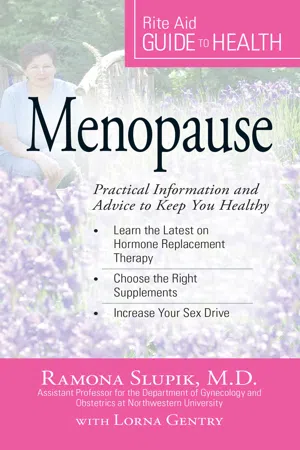
Your Guide to Health: Menopause
eBook - ePub

Your Guide to Health: Menopause

Practical Information and Advice to Keep You Healthy

  1. 224 pages
  2. English
  3. ePUB (mobile friendly)
  4. Available on iOS & Android
eBook - ePub

Your Guide to Health: Menopause

Practical Information and Advice to Keep You Healthy

About this book

Tired of those inconvenient hot flashes? Wish you could control constant mood swings? Curious about HRT and alternative treatments? Providing you with the information you'll need to understand and cope with your symptoms, Your Guide to Health - Menopause will help you decide on the best treatment for you.
Written by a health care expert with a technical review by a leading gynecologist, Your Guide to Health – Menopause, completely updated and revised, is chock full of new information on:

  • Hormone therapies, hormone replacement, and hormone delivery systems
  • Ways to address abnormal bleeding, hysterectomy, and removal of ovaries
  • Methods of coping with related health issues like decreased libido and depression
  • Up-to-date information on menopause and osteoporosis
  • Treatment options such as exercises emphasizing "core" routines like Pilates
  • Medicare, insurance/pharmaceutical plans, and more.


With this authoritative guide, you can live your life to the fullest-before, during, and throughout menopause.

Frequently asked questions

Yes, you can cancel anytime from the Subscription tab in your account settings on the Perlego website. Your subscription will stay active until the end of your current billing period. Learn how to cancel your subscription.
No, books cannot be downloaded as external files, such as PDFs, for use outside of Perlego. However, you can download books within the Perlego app for offline reading on mobile or tablet. Learn more here.
Perlego offers two plans: Essential and Complete
  • Essential is ideal for learners and professionals who enjoy exploring a wide range of subjects. Access the Essential Library with 800,000+ trusted titles and best-sellers across business, personal growth, and the humanities. Includes unlimited reading time and Standard Read Aloud voice.
  • Complete: Perfect for advanced learners and researchers needing full, unrestricted access. Unlock 1.4M+ books across hundreds of subjects, including academic and specialized titles. The Complete Plan also includes advanced features like Premium Read Aloud and Research Assistant.
Both plans are available with monthly, semester, or annual billing cycles.
We are an online textbook subscription service, where you can get access to an entire online library for less than the price of a single book per month. With over 1 million books across 1000+ topics, we’ve got you covered! Learn more here.
Look out for the read-aloud symbol on your next book to see if you can listen to it. The read-aloud tool reads text aloud for you, highlighting the text as it is being read. You can pause it, speed it up and slow it down. Learn more here.
Yes! You can use the Perlego app on both iOS or Android devices to read anytime, anywhere — even offline. Perfect for commutes or when you’re on the go.
Please note we cannot support devices running on iOS 13 and Android 7 or earlier. Learn more about using the app.
Yes, you can access Your Guide to Health: Menopause by Kate Bracy in PDF and/or ePUB format, as well as other popular books in Medicine & General Health. We have over one million books available in our catalogue for you to explore.

Information

Publisher
Everything
Year
2008
Print ISBN
9781593376932

Chapter 1
Everywoman’s Menopause … and Yours

As women reach middle age, their world isn’t neatly defined by their aging reproductive functions. This chapter helps you explore all of the changes that surround the menopausal experience to help you broaden your perspective of the challenges and opportunities menopause offers.

Just the Facts: What Menopause Is and Isn’t

Menopause becomes a reality for most women through a series of physical, mental, and emotional changes—some subtle, some more dramatic—that tend to emerge, evolve, intensify, and fade over a period of weeks, months, and years.
According to the Council of Affiliated Menopause Societies (CAMS), menopause is “The permanent cessation of menstruation resulting from the loss of ovarian follicular activity.”
To put it simply, when you have your last period, you go through menopause. Because your periods may become less regular and occur at greater intervals as you approach menopause, however, you don’t know you’ve gone through menopause until twelve months have passed since your last period.

What Menopause Means

According to the North American Menopause Society (NAM), the average age of natural
menopause in the Western world is fifty-one. Most American women born after 1950 can expect to live until their mid-eighties, meaning that the majority of menopausal women in the United States today have one-half to one-third of their lives to live after they’ve gone through menopause.
Everyone’s body is aging all of the time. In menopause, your body undergoes changes that require your attention. Your fluctuating hormones deplete your body’s calcium, resulting in bone loss. As you age, you may become more susceptible to heart disease, diabetes, and other illnesses. Menopause means you need to learn new ways to remain healthy, strong, and vital.
At the same time, menopause also means that you have an opportunity to enjoy new levels of freedom and self-awareness. You may find that you don’t miss the experience of menstruation at all. You no longer have to worry about becoming pregnant, so sex can take on new depths of pleasure. And menopause is a marker of your evolving life; its arrival may encourage you to focus new attention and energy inward, as you take this opportunity to evaluate who you are, what you’re doing, and where you want to go next.

What Causes Menopause?

The average woman has about 400 reproductive cycles during her lifetime. In every cycle, the woman’s pituitary gland produces follicle stimulating hormones (FSH) that trigger the follicle cells in the ovary that surround the developing eggs to produce estrogen, which in turn prepares an egg (usually just one) for fertilization. As the body’s level of estrogen increases, the pituitary gland stops producing FSH and starts producing a luteinizing hormone (LH), which causes the ovary to ovulate (release the egg) and produce progesterone, which prepares the uterine lining to accept the fertilized egg.
The mature egg is only one of several “candidates” available each month. Those that don’t mature (develop enough to be available for fertilization) are reabsorbed by the body. If the mature egg is unfertilized, it, too, is reabsorbed and the lining of the uterus is shed in the normal menstrual flow. The body’s level of estrogen dips, which then triggers the FSH production that starts the whole cycle again.
Every woman is born with a set number of eggs, ranging from 400,000 to 700,000. Half of those eggs deteriorate and are reabsorbed by each girl’s body before she reaches puberty. Scientists are still researching why this occurs. With each month’s ovulation, more of the egg supply is depleted. As you near menopause, your egg supply diminishes, your follicle cells stop responding to FSH, and you stop ovulating. As a result—over a period of years—you stop menstruating and your ovaries stop making estrogen and progesterone.
As the frequency of your ovulation decreases, the FSH levels in your bloodstream increase. Your doctor can test the level of FSH in your blood to determine whether you’re nearing menopause, which can be helpful if you’re trying to determine your fertility.

What Menopause Means for Your Hormones

Your body produces dozens of hormones, but only three of them play a major role in your reproductive cycle. Those three are estrogen, progesterone, and small quantities of androgens (testosterone, for example). Here’s what those hormones do:
Estrogen is a growth hormone that stimulates the development of adult sex organs during puberty; helps retain calcium in bones; regulates the balance of “good” and “bad” cholesterol in the bloodstream; and aids other body functions, such as blood sugar level, memory functions, and emotional balance.
Progesterone balances the effects of estrogen by aiding the maturation of body tissues and limiting their growth; stimulates the uterus, breasts, and fallopian tubes to secrete nutrients necessary for the body to prepare for growing an embryo and bearing a child; and raises body temperature and blood sugar levels.
Androgens are male hormones produced in small quantities by the ovaries and adrenal glands—with the greatest quantities occurring at the midpoint of a woman’s cycle—which contribute to a healthy libido by fostering a healthy desire for sex.
As your body’s supply of egg-producing follicles diminishes, the follicles that remain become less potent and produce lower amounts of estrogen. In perimenopause, cycles become less regular and some ovarian follicles don’t mature to ovulation; when that happens, the body’s level of progesterone drops.
When the pituitary gland senses that the ovaries aren’t producing normal levels of hormones, it produces higher levels of FSH, trying to nudge the ovaries into coughing up more estrogen. And, in the early stages of the perimenopause, that encouragement works; the follicles give up high doses of estrogen, but the body still isn’t producing the progesterone that normally rounds out the body’s reproductive hormone mix. As a result, a woman in perimenopause may experience widely fluctuating levels of estrogen for a number of years, until the ovaries shut down completely.
When estrogen levels become so low that the lining of the uterus is unable to grow, menstruation stops. The body’s FSH levels rise and remain high throughout the postmenopausal years. The body continues to produce small amounts of estrogen, but in levels too small to support the hormone’s age-defying functions in the body.

Understanding Perimenopause and
Its Symptoms

Perimenopause is the period of time preceding menopause in which your body’s reproductive system slowly winds down. Though perimenopause differs for every woman it generally marks a time of less-frequent ovulation and fluctuating levels of hormones, including estrogen, progesterone, and FSH. Perimenopause can last anywhere from two to ten years and usually begins sometime in a woman’s mid to late forties. Eventually, your ovaries completely stop all egg production and menstruation permanently ceases—that’s menopause.
Identifying when you enter perimenopause isn’t easy. If you start noticing obvious changes in the length of your periods, the intervals between them, or the heaviness of your flow, and you’re between the ages of thirty-five and sixty, you should start checking for other signs of perimenopause. But changes in your cycle may not be your first indicator that perimenopause is approaching. Many women report symptoms of perimenopause while their periods remain much the same. Though we all have our own perimenopausal profile, most women feel some or all of the following symptoms as their bodies prepare to stop ovulating. Note that your symptoms will probably not limit themselves to the following. These are simply a couple of the most common.
The most common symptoms of perimenopause include hot flashes, mood swings, decreased sexual drive, weight gain, difficulty concentrating, heart palpitations, migraine headaches, irregular and/or heavy periods, involuntary urine release and bladder urgency, insomnia, vaginal dryness and panic attacks.

Hot Flashes (Including Night Sweats)

Hot flashes are real, physiological responses to the body’s declining levels of estrogen. Nearly 75 percent of women who report perimenopausal symptoms list hot flashes among them. Hot flashes can come at any time of the day or night, but when they occur during sleep, they’re usually referred to as night sweats.
Hot flashes can be mild or severe, but in general, they involve a fast-spreading sensation of warmth in your neck, shoulders, and face that may last a few seconds or as long as thirty minutes or more. Hot flashes don’t have to limit themselves to your head and shoulders; many women have also reported flashes occurring across the breasts, below the breasts, or all over the body.
The flashes may be brief and cause only a slight flush on your face, neck, or shoulders; by the time you notice them occurring, they’re already beginning to fade. Or, hot flashes can result in dramatic temperature rises that produce profuse perspiration on your upper lip, neck, forehead—or even your entire body. During a severe hot flash, the skin on your face, neck, and scalp may become extremely red, and this flush may take longer to fade than the feeling of “heat” itself. Some women have reported a rapid heart rate immediately before and during their hot flashes; a few women have experienced nausea and/or chills following hot flashes.
Hot flashes may be accompanied by other feelings of physical discomfort, including tension, anxiety, or nervousness. And, if you suffer hot flashes at night, in what most women call night sweats, you may experience some loss of sleep. Many women sleep right through their nighttime hot flashes, and know of them only when they awake in the morning to find their bedding or clothes slightly damp. Severe night sweats can produce such severe heat and sweating that sleep becomes impossible. Extended sleep loss can lead to feelings of anxiety, tension, and even depression. But only a minority of women experiences this severe form of hot flashes.

Mood Swings

Mood swings can be minor “speed bumps” in your day—or they can leave you feeling totally down and out. The experiences are as individual as the women who have them, but mood swings tend to take the form of intensified emotional reactions. Sometimes, the swing can take you high, and you feel a particularly strong delight in everything around you. Other times, however, mood swings can take you on a wild roller-coaster ride of emotions, such as intense sorrow, despair, love, anger, anxiety, general depression, or fear. A typical anger response during a mood swing can leave your heart pounding, your face flushed, and your head throbbing. Mood swings can trigger bouts of crying and cause deep, dark feelings of hopelessness. Then, as nasty as they can be, mood swings may pass rather quickly, leaving you feeling a bit shaken and confused by the emotional ride.
Among women who cite symptoms in perimenopause, nearly 50 percent say mood swings are among the symptoms that bother them the most.
Though mood swings seem to be emotional responses, they can, in fact, be a direct physical response to the changing hormonal levels in your bloodstream. In fact, many perimenopausal women experience mood swings along with other common symptoms of premenstrual syndrome (PMS), even when those women have never before suffered from PMS symptoms.
Just as mood swings in perimenopause can have both physical and emotional consequences, the causes of those mood swings can be both physical and emotional. First, consider that many of the symptoms of perimenopause can cause emotional distress. Hot flashes can lead to sleeplessness, fatigue, irritability, and anxiety. Those factors alone can make you feel angry, isolated, and under siege—and contribute to occasional moodiness and transient depression.

Stay on Top of Your Symptoms

As you have seen in this chapter, a wide range of symptoms can appear during the years preceding menopause. But it’s important to remember that, as noted at the beginning of this chapter, you may experience none, some, or all of these symptoms—or others that aren’t even listed. To be certain that you are doing all you can to maintain peak health during this important time of transition, pay close attention to your body, and don’t ignore the messages it sends you. Many of the symptoms that initially seem par for the course for middle age, may be symptoms of problems requiring serious and quick medical treatment. So don’t ignore any ongoing problem because you think it’s just the change. Work closely with your health care provider to make sure that your body gets any and all of the help that it needs to stay strong, fit, and healthy.

Chapter 2
The Symptoms of Perimenopause

Knowing what perimenopause is doesn’t really help you understand what it’s all about. When you are aware of the range of symptoms women have reported experiencing in perimenopause, you gain a better understanding of the profile of common symptoms and know how to recognize symptoms that masquerade as perimenopause, but may actually point to other issues in your physical and emotional health.

Taking a Closer Look at Perimenopause

As stated in Chapter 1, perimenopause is the period of time preceding menopause in which your body’s reproductive system slowly winds down. Though perimenopause differs for every woman it generally marks a time of less-frequent ovulation and fluctuating levels of hormones, including estrogen, progesterone, and FSH. Perimenopause can last anywhere from two to ten years and usually begins sometime in a woman’s mid to late forties. Eventually, your ovaries completely stop all egg production and menstruation permanently ceases—that’s menopause.
Though no one can describe exactly what your experience in perimenopause and menopause will involve, some key bits of information about what others have experienced can help you prepare for the journey.
Consider this chapter your perimenopause orientation session. The goal of the information presented here is to help you feel more comfortable and relaxed when you experience menopause, so you’re better able to pass smoothly through every stop along the way, ready and able to deal with any problems you may encounter.

Recognizing the Symptoms

So what can a woman expect from perimenopause? What kinds of symptoms are common—or even possible—and what do they mean? If you have to listen to your body in order to understand its condition and needs, how do you interpret the messages of perimenopausal symptoms? And how do you know if your symptoms are related to perimenopause or some other part of the aging process?
First, it’s important to understand that, if you think it may be perimenopause, it probably is. No one is more familiar than you are with your body’s feelings and reactions during your monthly cycles. As the following sections demonstrate, women have reported a wide variety of symptoms during and after perimenopause. Remember, some women experience no symptoms at all.
It’s also important to keep in mind that everyone can expect to experience some physical and mental signs of aging. As women age, many of their physica...

Table of contents

  1. Cover
  2. Title Page
  3. Contents
  4. Introduction
  5. Chapter 1: Everywoman’s Menopause … and Yours
  6. Chapter 2: The Symptoms of Perimenopause
  7. Chapter 3: Passing Through the Stages
  8. Chapter 4: Your Post-40 Health Profile
  9. Chapter 5: Heart Disease and Bone Health
  10. Chapter 6: Menopause and Emotional Health
  11. Chapter 7: Menopause and Sexuality
  12. Chapter 8: Hormone Replacement Therapy
  13. Chapter 9: Diet and Exercise
  14. Chapter 10: Taking Care of All of You
  15. Chapter 11: Keeping Your Mind Sharp
  16. Chapter 12: Keeping a Menopause Journal
  17. Appendix A: Online Resources
  18. Appendix B: Glossary
  19. Index
  20. Copyright