eBook - ePub
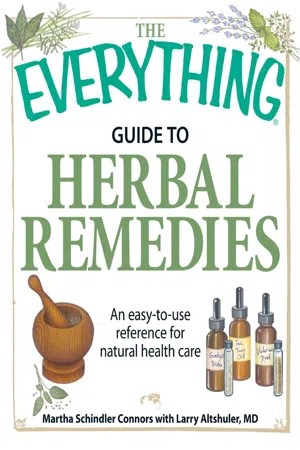
The Everything Guide to Herbal Remedies
An easy-to-use reference for natural health care
- 304 pages
- English
- ePUB (mobile friendly)
- Available on iOS & Android
eBook - ePub
The Everything Guide to Herbal Remedies
An easy-to-use reference for natural health care
About this book
Beat the blues with St. JohnÆs Wort.
Improve your memory with ginseng.
Calm down with chamomile.
People have used herbs and other plants for thousands of years to improve health and vitality. This practical guide reveals the timeless healing power of the best herbs and natural remedies available today. You learn how to strengthen immunity, ease hormonal mood swings, and treat such common ailments and conditions as:
With this guide, you have the information you need to enjoy a happier, healthier life!
Improve your memory with ginseng.
Calm down with chamomile.
People have used herbs and other plants for thousands of years to improve health and vitality. This practical guide reveals the timeless healing power of the best herbs and natural remedies available today. You learn how to strengthen immunity, ease hormonal mood swings, and treat such common ailments and conditions as:
- Aches and Pains
- Allergies
- Psychological and emotional issues
- Digestion problems
With this guide, you have the information you need to enjoy a happier, healthier life!
Frequently asked questions
Yes, you can cancel anytime from the Subscription tab in your account settings on the Perlego website. Your subscription will stay active until the end of your current billing period. Learn how to cancel your subscription.
No, books cannot be downloaded as external files, such as PDFs, for use outside of Perlego. However, you can download books within the Perlego app for offline reading on mobile or tablet. Learn more here.
Perlego offers two plans: Essential and Complete
- Essential is ideal for learners and professionals who enjoy exploring a wide range of subjects. Access the Essential Library with 800,000+ trusted titles and best-sellers across business, personal growth, and the humanities. Includes unlimited reading time and Standard Read Aloud voice.
- Complete: Perfect for advanced learners and researchers needing full, unrestricted access. Unlock 1.4M+ books across hundreds of subjects, including academic and specialized titles. The Complete Plan also includes advanced features like Premium Read Aloud and Research Assistant.
We are an online textbook subscription service, where you can get access to an entire online library for less than the price of a single book per month. With over 1 million books across 1000+ topics, weâve got you covered! Learn more here.
Look out for the read-aloud symbol on your next book to see if you can listen to it. The read-aloud tool reads text aloud for you, highlighting the text as it is being read. You can pause it, speed it up and slow it down. Learn more here.
Yes! You can use the Perlego app on both iOS or Android devices to read anytime, anywhere â even offline. Perfect for commutes or when youâre on the go.
Please note we cannot support devices running on iOS 13 and Android 7 or earlier. Learn more about using the app.
Yes, you can access The Everything Guide to Herbal Remedies by Martha Schindler Connors,Larry Altshuler in PDF and/or ePUB format, as well as other popular books in Medicine & Alternative & Complementary Medicine. We have over one million books available in our catalogue for you to explore.
Information
CHAPTER 1
What Is Herbal Medicine?
Herbal medicine, also called botanical medicine or phytomedicine, is the practice of using one or more parts of a plantâits seeds, berries, roots, leaves, bark, or flowersâto relieve physical and psychological problems, prevent disease, or just improve overall health and vitality. Although many modern drugs were originally developed from plants, they are based on isolated chemicals, while plants comprise myriad active components, which work together to create their medicinal actions. Herbs have a long history of use and, when used properly, are safe and powerful medicines.
The History of Herbal Healing
Long before doctors in lab coats started writing prescriptionsâin fact, even before human beings started writing at allâherbs were being used as medicine. Herbal medicine has prehistoric origins, and it continues today in virtually every culture in the world.
Herbal medicine dates back thousands of years, although no one is exactly sure when the first human used an herb to treat a health woe. In the American Southwest, for example, researchers have found human genetic material on hunks (called quids) of the herb yucca, which were chewed and spit out like a kind of ancient chewing gum. The quids are between 800 and 2,400 years old.

The World Health Organization reports that roughly 25 percent of all modern medicines are made from plants that came straight out of traditional medicine. For example, two South American species, the chinchona tree (Chinchona officinalis) and the coca plant (Erythroxylum coca), have given us the antimalaria drug quinine and several types of anesthetics.
In Europe, researchers discovered what looks to be herbal remedies on the body of the infamous âIce Man,â the 3,000-year-old mummy discovered in the early 1990s in the Italian Alps. Researchers found walnut-sized lumps of birch fungus, which has laxative and antibiotic properties, on his body. An autopsy revealed that the man had been suffering from an infestation of parasitic whipworms, leading the experts to guess that he had most likely been treating them with measured doses of the medicine.
As civilizations rose up around the world, so did herbal medicine. And although some of the ancientsâ remedies have fallen by the wayside, most are still popular.
The Egyptian priest and physician Imhotep, who lived around 2600 B.c. and is often credited with the earliest medical writings, described the diagnoses and treatmentsâmany of them herbalâof more than 200 diseases.
In China, the emperor Shen Nung, in 2735 B.c., wrote what is generally believed to be the earliest treatise on herbs, discussing hundreds of medicinal plants that are still in use. And in India, a manuscript from around 2000 B.c. mentions the herbs cinnamon, ginger, and sandalwood as ingredients in several medical preparations.

To avoid confusion (and language barriers), an herb is usually identified by its common name as well as its scientific (botanical) name, which comprises the Latin words for the plantâs genus and species. That way, if youâre looking for chamomile, youâll know if youâre getting the popular German or Hungarian variety (Matricaria recutita) or the less common Roman or English variety (Chamaemelum nobile).
Principles and Traditions
No matter where in the world it originated, any school of traditional herbal medicine is based on a simple concept: that herbal remedies can be used to createâor re-createâa state of health within the body. Herbal healers categorize diseases according to a specific set of symptoms, then use their remedies to restore the patient to the state he was in before the disease struck.
A âHumor"ous Approach
Western herbalism evolved from the Greeks, who in turn were strongly influenced by Egyptian and Middle Eastern civilizations. The Greek system uses a system of âhumors,â which are tied to four dynamic elements (air, earth, water, and fire). The Greeks believed that diseases were caused by an imbalance of these humors. The humors were part of an individualâs nature and werenât necessarily good or bad. But if they got out of balance, illness would ensue.
The theory of the humors is similar to the basic beliefs of Traditional Chinese Medicine (TCM) and Ayurvedic medicine, which originated in India at roughly the same time. In Ayurveda, for example, there are three doshas, or body types, which correspond to the natural world and also reflect an individualâs innate nature.
Actions Speak Louder
Traditional herbal medicine is also organized around each herbâs physiological actionsâwhat it does in the body. (Not surprisingly, modern herbalists do the same thing.) For example, the Greeks categorized their herbs as warming, drying, cooling, binding, and relaxing. The Chinese have classifications like purging, lubricating, stimulating, clearing, and calming. Not too far from our modern-day classifications, which youâll see as you walk down the aisle of any drug store: expectorants, laxatives, sedatives, stimulants, and so on.
And while some consumers might scoff at some traditional terminology, modern research shows that, for the most part, the ancients had it right. In fact, of the 100-plus known medicinal plant compounds used today, roughly 80 percent are used for purposes that are identical or very close to their traditional use.

One of the most powerful chemotherapy agents existing today comes from the Pacific yew (Taxus brevifolia). Yew trees were routinely discarded in logging enterprises until 1967, when somebody discovered a compound called taxol that could inhibit the division of cancerous cells. Today, taxol is used to treat breast, ovarian, and lung cancer.
The Chemistry of Plants
Although people have been using herbs for centuries, we donât know a whole lot about the pharmacology, or chemical makeup, of many of them. Unlike pharmaceuticalsâdrugs created in a lab from a precise chemical recipeâherbs are often chemical mysteries.
Unraveling the Mysteries
In recent years, scientists have been deconstructing herbs to determine the chemical compoundsâcalled phytochemicalsâbehind their actions.
For example, researchers have determined that garlic (Allium sativum) owes much of its antibacterial and cholesterol-lowering action to a phyto-chemical called allicin. Ginger (Zingiber officinale) apparently gets its stomach-settling powers from two chemicals, 6-gingerol and gingerdione. And cayenne peppers (Capsicum annuum, C. frutescens) contain capsaicin, which dulls pain and produces a warming sensation.
Primary and Secondary
In most cases, the compounds that are so helpful to humans are actually secondary to the plantâs survival. The most important things, at least as far as the plant is concerned, are the primary constituents, which are used in the plantâs primary metabolic processes (like photosynthesis) and include things like sugars and chlorophyll.
Secondary constituents are things that the plant developed over the course of its evolution to defend itself against animals, insects, disease, or environmental stresses such as changes in temperature or water levels. Quite often these compoundsâwhich include vitamins, minerals, essential oils, and phytochemicalsâare key to both the plantâs viability and its bioactivity (the effect it has on another living organism or tissue).

According to the latest estimates, there are 122 scientifically identified plant compounds being used as drugs throughout the world, which are drawn from just 94 plant species. With several thousand known medicinal plants now in use, scientists still have quite a few more chemicals to name.
Luckily, the chemicals that make a plant unappealing to microbes can serve as antimicrobial agents in humans, too. And the neurotoxic chemicals that a plant uses to defend itself against foraging deer can work as sedatives, muscle relaxants, or anesthetics in people.
Most of the secondary constituents in plants can be lumped into three categories: terpenoids, alkaloids, and polyphenols.
Terpenoids
Many terpenoids are either toxic or just unappetizing to grazing animals; others make a plant more appealing to pollinating insects. Feverfew (Tanacetum parthenium) and chamomile (Matricaria recutita) contain medicinal terpenoids.
Alkaloids
Alkaloids can have potent medicinal activity. Examples are nitrogen, caffeine, quinine, morphine, and nicotine. The Chinese herb ma huang (Ephedra sinica) contains the alkaloid ephedrine. Cocaine is found in the leaves of the coca shrub (Erythroxylum coca).
Polyphenols
Polyphenols include tannins and flavonoids. Tannins are astringent chemicals (once used to tan animal hides) found in the seeds and stems of grapes (Vitis vinifera), the leaves and bark of trees or shrubs like witch hazel (Hamamelis virginiana), and tea leaves (Camellia sinensis). Flavonoids are a broad class of compounds that act as antioxidants (agents that counteract the process of oxidation, which can damage cells and trigger disease). They are found in ginkgo (Ginkgo biloba), hawthorn (Crataegus monogyna, C. oxyacantha), and milk thistle (Silybum marianum), among others. Iso-flavones are one type of flavonoid that act as phytoestrogens (plant compounds that mimic the effects of estrogen in the body). Isoflavones are found in soybeans (Glycine max).
The Sum Versus the Whole
But while scientists have identified the active constituents in many herbs, many more remain a mystery, in part because the chemicals in the plant appear to work synergistically instead of individually.
That means that, in most cases, we donât know which ingredient in a plant is causing a therapeutic effect, or if that ingredient is acting alone or in combination with other ingredients. Moreover, because itâs a natural thing, an herbâs biochemical composition is inherently variable and can change from year to year or crop to crop.
The Evolution of Herbal Medicine
As early civilizations developed, they slowly left behind the hunting-and-gathering routine in favor of cultivation, building settlements, and developing a more cohesive social structure. In virtually every part of the world, herbs were part of the arsenal of healers, who combined spiritual and religious elements in their medicine.

Before test tubes and research labs, herbalists around the world used a decidedly nonscientific method called âthe doctrine of signatures,â which held th...
Table of contents
- Cover
- Title Page
- Dedication
- Copyright
- Contents
- Acknowledgments
- Top Ten Ways to Ease Herbs into Your Health Care Routine
- Introduction
- 1 What Is Herbal Medicine?
- 2 Herbs and Their Actions
- 3 Herbs for Women
- 4 Herbs for Men
- 5 Older Adults
- 6 Caring for Kids
- 7 Chronic Diseases and Conditions
- 8 Treating Aches and Pains
- 9 Taming Allergies and Asthma
- 10 Managing Psychological and Emotional Issues
- 11 Improving Digestion
- 12 Strengthening Immunity
- 13 The Herbal Medicine Cabinet
- 14 Emergencies and First Aid
- 15 Self-Care and Beauty
- 16 Diet, Exercise, and Weight Management
- 17 Safety and Efficacy
- 18 Putting Herbs to Work
- 19 Making Your Own Herbal Remedies
- Appendix A: Common Health Concerns
- Appendix B: Popular Herbs A-Z
- Appendix C: Additional Resources
- Index