
- English
- ePUB (mobile friendly)
- Available on iOS & Android
eBook - ePub
Why the Reformation Still Matters
About this book
Does the Reformation Still Matter?
In 1517, a German monk nailed a poster to the door of a church, disputing key doctrines taught by the Roman Catholic Church in that day. This moment set in motion a movement that changed the entire trajectory of church history. But do the Reformers still have something to teach us?
In this accessible primer, Michael Reeves and Tim Chester answer eleven key questions raised by the Reformersāquestions that remain critically important for the church today.
Frequently asked questions
Yes, you can cancel anytime from the Subscription tab in your account settings on the Perlego website. Your subscription will stay active until the end of your current billing period. Learn how to cancel your subscription.
No, books cannot be downloaded as external files, such as PDFs, for use outside of Perlego. However, you can download books within the Perlego app for offline reading on mobile or tablet. Learn more here.
Perlego offers two plans: Essential and Complete
- Essential is ideal for learners and professionals who enjoy exploring a wide range of subjects. Access the Essential Library with 800,000+ trusted titles and best-sellers across business, personal growth, and the humanities. Includes unlimited reading time and Standard Read Aloud voice.
- Complete: Perfect for advanced learners and researchers needing full, unrestricted access. Unlock 1.4M+ books across hundreds of subjects, including academic and specialized titles. The Complete Plan also includes advanced features like Premium Read Aloud and Research Assistant.
We are an online textbook subscription service, where you can get access to an entire online library for less than the price of a single book per month. With over 1 million books across 1000+ topics, weāve got you covered! Learn more here.
Look out for the read-aloud symbol on your next book to see if you can listen to it. The read-aloud tool reads text aloud for you, highlighting the text as it is being read. You can pause it, speed it up and slow it down. Learn more here.
Yes! You can use the Perlego app on both iOS or Android devices to read anytime, anywhere ā even offline. Perfect for commutes or when youāre on the go.
Please note we cannot support devices running on iOS 13 and Android 7 or earlier. Learn more about using the app.
Yes, you can access Why the Reformation Still Matters by Michael Reeves,Tim Chester,Michael Reeves in PDF and/or ePUB format, as well as other popular books in Theology & Religion & Christian Theology. We have over one million books available in our catalogue for you to explore.
Information
1
Justification
How Can We Be Saved?
Lutherās Story and Justification
The first biography of Luther was written by his friend Philip Melanchthon in 1549. Melanchthon tells us that after Luther graduated, he started to study law. His family and friends confidently expected that the bright young Luther would make a major contribution to the state, but instead he joined the Augustinian monks.
On his entrance there, he not only applied with the closest diligence to ecclesiastical studies; but also, with the greatest severity of discipline, he exercised the government of himself, and far surpassed all others in the comprehensive range of reading and disputation with a zealous observance of fasting and prayer.8
But all his religious endeavors could not give Luther any assurance. When a close friend died, Luther became terrified by the thought of the judgment of God. And it was all made worse by the theology of the day.
Medieval theology saw sin as a problem of being that needed healing. This took place through sacraments. In this life the Christian is suspended between the grace of God (mediated through the sacraments) and the judgment of God. Medieval theology, then, added a distinction between actual grace and habitual grace. Actual grace gave forgiveness of sins, provided they were confessed. Habitual grace changed people deeper down, in their very beingāovercoming the problem of original sin.
Lutherās problem was that since only actual sins confessed were forgiven, he was obsessed with not overlooking sin. He would spend hours in confessing to his superior in the Augustinian order, and then come rushing back with some new misdemeanor he had remembered. At one point his superior said: āLook here, Brother Martin. If youāre going to confess so much, why donāt you go do something worth confessing? Kill your mother or father! Commit adultery! Stop coming in here with such flummery and fake sins!ā9
In 1512 Luther, aged twenty-six, was sent by his order as a lecturer of biblical studies to the new university at Wittenberg. It was here, studying Augustine and lecturing on the Psalms, Romans, and Galatians, that Luther came to a radically fresh understanding of the gospel.
Sorting out the development of Lutherās thought is notoriously difficult. Lutherās new convictions took time to form. There is a lot of debate among scholars about what he believed and when he believed it. So we shall present it in a simplified form as a double movement. It is more complex than this, with significant overlaps, but this form will help us understand what was going on in theological terms.
Lutherās First Step: Righteousness as a Gift
One key moment is what is known as Lutherās ātower experience.ā Its date is contested, and it may have a longer process than one āeurekaā moment. Luther described his experience like this:
Meanwhile in that same year, 1519, I had begun interpreting the Psalms once again. I felt confident that I was now more experienced, since I had dealt in university courses with St. Paulās Letters to the Romans, to the Galatians, and the Letter to the Hebrews. I had conceived a burning desire to understand what Paul meant in his Letter to the Romans, but thus far there had stood in my way, not the cold blood around my heart, but that one word which is in chapter one: āThe justice of God is revealed in it.ā I hated that word, ājustice of Godā (iustitia Dei), which, by the use and custom of all my teachers, I had been taught to understand philosophically as referring to formal or active justice, as they call it, i.e., that justice by which God is just and by which he punishes sinners and the unjust.
But I, blameless monk that I was, felt that before God I was a sinner with an extremely troubled conscience. I couldnāt be sure that God was appeased by my satisfaction. I did not love, no, rather I hated the just God who punishes sinners. In silence, if I did not blaspheme, then certainly I grumbled vehemently and got angry at God. I said, āIsnāt it enough that we miserable sinners, lost for all eternity because of original sin, are oppressed by every kind of calamity through the Ten Commandments? Why does God heap sorrow upon sorrow through the Gospel and through the Gospel threaten us with his justice and his wrath?ā This was how I was raging with wild and disturbed conscience. I constantly badgered St. Paul about that spot in Romans 1 and anxiously wanted to know what he meant.
I meditated night and day on those words until at last, by the mercy of God, I paid attention to their context: āThe justice of God is revealed in it, as it is written: āThe just person lives by faith.āā I began to understand that in this verse the justice of God is that by which the just person lives by a gift of God, that is by faith. I began to understand that this verse means that the justice of God is revealed through the Gospel, but it is a passive justice, i.e. that by which the merciful God justifies us by faith, as it is written: āThe just person lives by faith.ā All at once I felt that I had been born again and entered into paradise itself through open gates. Immediately I saw the whole of Scripture in a different light. I ran through the Scriptures from memory and found that other terms had analogous meanings, e.g., the work of God, that is, what God works in us; the power of God, by which he makes us powerful; the wisdom of God, by which he makes us wise; the strength of God, the salvation of God, the glory of God.
I exalted this sweetest word of mine, āthe justice of God,ā with as much love as before I had hated it with hate. This phrase of Paul was for me the very gate of paradise. Afterward I read Augustineās āOn the Spirit and the Letter,ā in which I found what I had not dared hope for. I discovered that he too interpreted āthe justice of Godā in a similar way, namely, as that with which God clothes us when he justifies us. Although Augustine had said it imperfectly and did not explain in detail how God imputes justice to us, still it pleased me that he taught the justice of God by which we are justified.10
In Romans 1:17 Paul writes, āFor in it [the gospel] the righteousness of God is revealed from faith for faith, as it is written, āThe righteous shall live by faith.āā Luther could not understand how the righteousness or justice of God could be gospelāgood news. It seemed to offer only the threat of judgment. Not only does the law condemn us, but so does the gospel! āFor in the gospel a righteousness of God is revealed.ā But Luther began to see the righteousness of God revealed in the gospel not simply as a quality of Godāhis impartial justice by which he judges sinners. Instead he saw it as a gift from God. The righteousness of God is the ri...
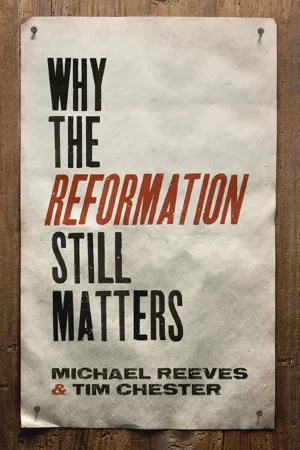
Table of contents
- Cover
- Newsletter Signup
- Endorsements
- Title Page
- Copyright
- Dedication
- Contents
- Abbreviations
- Introduction
- 1 Justification
- 2 Scripture
- 3 Sin
- 4 Grace
- 5 The Theology of the Cross
- 6 Union with Christ
- 7 The Spirit
- 8 The Sacraments
- 9 The Church
- 10 Everyday Life
- 11 Joy and Glory
- General Index
- Scripture Index