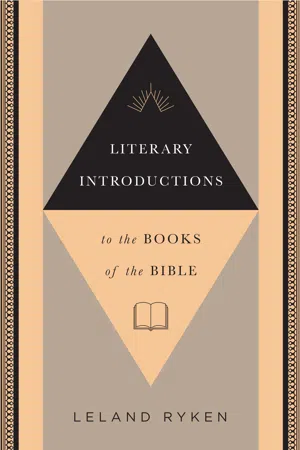
The Bible is more than a collection of ancient stories. It's actually a unified whole, consisting of carefully crafted pieces of literature, each with its own unique literary style, form, and techniques. In this comprehensive volume, renowned literary expert and Bible scholar Leland Ryken introduces readers to the distinct literary features of each book of the Bible. Exploring how such features shed light on the message of the biblical writers through book outlines, helpful charts, and succinct definitions, this companion to Ryken's A Complete Handbook of Literary Forms in the Bible will help Bible readers and students read, interpret, and teach God's Word with greater precision and deeper insight.
- English
- ePUB (mobile friendly)
- Available on iOS & Android
eBook - ePub
Literary Introductions to the Books of the Bible
About this book
Information
Topic
Teología y religión
1 SAMUEL
First Samuel is not the first historical narrative in the Old Testament, but it initiates the section of historical chronicles. With 1 Samuel we enter a world of relative political and religious stability when compared to the previous three-hundred-year history narrated in Judges. The events of 1 Samuel cover approximately one hundred years and tell the story of an important transition in the life of Israel from a loose confederation of tribes ruled by judges to a monarchy. In contrast to the family histories of Genesis and the book of Ruth, the history recorded in 1 Samuel covers not primarily the life and times of ordinary people but instead the actions and decisions of national leaders.
First Samuel is more than a history book, however. Because it is a work of literature, it embodies universal human experience and thereby teaches moral and spiritual lessons for all people at all times. Some of the lessons are individual and personal, involving the specific family situations of Eli, Saul, and David. But others apply to communities and nations, such as the lessons we learn about good and bad leadership for a people as seen in the conduct of Eli, Samuel, and Saul. Through positive and negative examples, we can learn much about our daily lives by reading and pondering 1 Samuel. Because the author is more interested in a few important figures than in groups and movements, we naturally remember the book partly by the characters who remain in our memories, especially Hannah, Eli, Samuel, Saul, Jonathan, and David.
The Book at a Glance | |
31 chapters, 810 verses | |
1–3 | Leadership change from Eli to Samuel |
4–7 | Samuel leads Israel |
8–10 | Leadership change from Samuel to Saul |
11–15 | Saul leads Israel |
16–31 | Leadership change from Saul to David |
1 Samuel as a Book
As we read 1 Samuel, we move in a narrative world. We are constantly aware of events happening around us, which are momentous in the lives of individuals and the nation. As we vicariously live through the era presented, we sense that these are not ordinary times but history-changing and exciting ones. God speaks to a boy in his dreams. The man who had judged Israel for forty years falls off his chair and dies from a broken neck when he hears the news of the latest defeat in battle. The boy hero David kills a giant with a slingshot. The future king lives as a fugitive with his merry band. A king who had reigned for some forty years disguises himself, visits a witch, and listens to Samuel, brought back from the dead, tell him that he will die the next day. That very king is wounded in battle and commits suicide by falling on his sword. There is never a dull moment.
But if we thus experience the book as one of memorable events, we remember it also as a gallery of colorful characters. The early phases feature the priest and judge Eli; Hannah, the godly mother of Samuel; and the boy Samuel, who grows into the position of charismatic national leader right before our eyes. Saul, a towering figure, is initially just what the nation needs as a leader, and then he becomes a full-fledged tragic figure whose decline is traced in painful detail. Saul’s decline is played off against David’s rise in the last third of the book. David and Jonathan’s friendship may well be the most famous friendship in history.
The Genres and Literary Forms of 1 Samuel
Biography. The most obvious feature of 1 Samuel is that the author’s preferred way to record history is to focus on heroic leaders. This is the biographical approach to history as opposed to writing about groups or the nation as a whole. The three primary personalities are Samuel, Saul, and David. In the second tier are Hannah, Eli, and Jonathan. The stories of Samuel and Saul are narrated in the literary form of hero story, but there is a sense in which the life of David, which occupies the second half of the book (starting with chapter 16), is less slanted around a heroic model and more thoroughly resembles the biographical chronicle of a person, with the material resembling a journalistic account of a life. We get the impression that the author is here selecting the material not to present a heroic model to emulate but to tell the chronological biography of the future king during the years leading up to his coronation.

Hero story. The distinguishing feature of a hero story is that the material selected by the author is molded around a heroic figure and is not a mere recording of a life. This hero is a representative figure who embodies the experiences and values of an entire group or nation. Heroes are bigger-than-life figures who possess a certain overflowing energy and magnitude. If they are national leaders, they have something of the celebrity in them. The right way to assimilate a hero story is to view oneself as the observant traveling companion of the hero, sharing his or her experiences. Whatever the author of 1 Samuel wishes to say to us, he embodies in the heroic characters he puts before us.
Hero’s childhood. An additional feature of a hero story is that if the hero is famous within his society, the story is likely to include the hero’s birth and childhood as well as the adult exploits for which he is famous. This is true of Samuel, Saul, and David in 1 Samuel, with the birth and boyhood of Samuel narrated most fully. One by-product of the inclusion of the hero’s childhood in 1 Samuel is that we are given glimpses of the domestic life of the public figure. One thinks immediately of such homey details as Samuel’s mother bringing him “a little robe” when she visited him at Shiloh each year (2:19), or the father of the youngest boy of the family, the boy of stay-at-home age, dispatching him to visit his brothers on the front line with a container of parched grain and ten loaves of bread (7:17). As part of this pattern, we see the young hero undergo an initiation from childhood or young adulthood into adult and/or public life. The boy Samuel becomes a man when he receives an oracle of doom that he delivers to the priest and judge Eli the next morning (chap. 3). The “young man” Saul undertakes an excursion to find the family’s lost donkeys and ends up being anointed king by Samuel (chaps. 9–10). On a single day the boy David leaves his sheep, visits his bothers on the front line, and is initiated into the world of military heroism when he kills the giant Goliath (chap. 17). All this shows that certain archetypes (recurrent patterns) operate powerfully in 1 Samuel.
Historical chronicle. Even though biography and hero story dominate the book, we need to put the genre of historical chronicle on the table because of the way in which the stories of individuals overlap. Self-contained biographies or hero stories do not overlap in this way. The story of Eli and his family overlaps with the story of Samuel. The story of Samuel is threaded through the stories of Saul and David. Most importantly, the story of Saul’s tragic decline is intermixed with the rise of David over the second half of the book. This feature leads us to stand back from the stories of individuals and view the book as a panoramic history of the nation over a hundred-year era as well as a collection of biographies and hero stories.
Tragedy. Literary scholars agree that the most indisputable example of a full-fledged literary tragedy in the Bible is the story of King Saul as narrated in this book. We can plot the story of Saul according to the usual paradigm of literary tragedy, preceded by a prologue (chap. 8) in which Samuel denounces kingship as an institution: (1) the hero’s exalted initial position (chaps. 9–11); (2) dilemma, as Saul is placed in a position that requires him to choose between obeying God or trying to win favor with the people (chaps. 12–13); (3) Saul’s tragic choice (chap. 15); (4) catastrophe and suffering (chaps. 16; 18; 24; 26); (5) moment of perception in which Saul attains an insight into what he did wrong, namely, disobey God (chap. 28); (6) death (chap. 31).
Fugitive story (person on the run). As David is forced to flee from Saul, he becomes the archetypal fugitive or person on the run (chaps. 21–27; 29–31). These chapters come to take on the quality of an adventure story, with interspersed battle stories as well. Another way to view this phase of the book is to understand that it tells the story of the future king before he became Israel’s most famous monarch (the story told in 2 Samuel). It is a story of patience (as David refuses to grab the kingship from Saul), endurance, resilience, or resourcefulness (as David needs to find food and safety for his band of fugitives), and occasional military prowess.
Poem. Although narrative dominates the book, a famous poem is embedded early in the narrative. It is the Song of Hannah (2:1–10), which has the general qualities of a song of thanksgiving. The main motif is God’s exaltation of a barren woman, which is portrayed metaphorically as the triumph of a warrior over enemies. This poem is probably the template on which Mary the mother of Jesus built her similar song known as the Magnificat (Luke 1:46–55).
Farewell discourse. A farewell discourse is a formal address by a leader to his followers at the end of his rule. Chapter 12 is the farewell speech that Samuel delivered to “all Israel,” not (as is customary) at the end of his life but as he terminates his judgeship and turns over the reins of government to the nation’s first king (Saul). The content of Samuel’s farewell discourse is reminiscent of the farewell discourses of Moses in Deuteronomy, as he places the great either/or before the nation: “If you will fear the LORD and serve him and obey his voice. . . . But if you will not obey the voice of the LORD . . .” (vv. 14–15).
Battle story. The story of David and Goliath (chap. 17) is the prototypical battle story in the Bible, the one that encompasses nearly all the motifs of a battle story: a general three-stage sequence consisting of preparation for battle, battle, and aftermath of battle; provocation to battle; challenge to single combat; taunting of the enemy; boasts; arming of the hero; single combat between two warriors; surprise tactics; carrying away a trophy such as an enemy’s armor or head; flight by the defeated army and pursuit by the victorious army; rewarding the victorious hero, often by allowing him to marry the king’s daughter (or some other prized woman).
Literary Form and Religious Vision in 1 Samuel
Inferred Literary Intentions of 1 Samuel
The book is designed to achieve the following: exalt God as the great standard of goodness and sovereignty who transcends the struggles of the human race to manage its affairs; enable readers to know a gallery of memorable characters and learn lessons for life from their example; draw us into gripping narrative action, with all the attendant pleasures of literary narrative; dazzle us with the writer’s skill at character portrayal; lead us to ponder what constitutes success and failure in leaders and in every person’s life; prompt us to reflect on how political structures and rulers are an inevitable part of the life of believers and the ways in which this needs to be implemented within a context of our religious worldview and allegiance to God.
What the Literary Forms of 1 Samuel Silhouette with Heightened Clarity
- First Samuel is a collection of hero stories and a historical chronicle, but not in the ordinary sense. In 1 Samuel, events on the human plane are consistently placed into a context of obeying or disobeying God. The literary term for the perspective that an author embodies toward the material presented is point of view. Point of view in 1 Samuel highlights the idea that rulership and political history are ultimately spiritual, not purely human.
- The author’s point of view does not disparage the importance of human decisions, however. The genres of biography, hero story, and tragedy all focus on what people do. As we progress through 1 Samuel, the presence of these genres leads us to understand that the goodness or badness of social and political structures depends on people. As an extension, these same genres lead us to understand that our own human lives and choices matter to God. The great either-or alternative that Samuel puts before the nation in his farewell discourse faces us individually every day.
- It is in the nature of narrative to put examples before us to ponder. If the focus is on characters more than events, as it is in 1 Samuel, it is particularly the characters who embody the examples that the author expects us to emulate (when they are exemplary) and avoid (if they do the wrong thing). The author of 1 Samuel uses this persuasive technique, common in literary narrative, of getting us to feel positively and negatively toward the characters as a way of embodying his moral vision and worldview. Then we are expected to apply what the storyteller has persuaded us is right or wrong.
Literary Tips for Reading 1 Samuel
(1) We should focus particularly on characters and personalities. (2) A leading purpose of the book is to teach us what makes good and bad rulers, so we need to formulate our understanding of what the book says about rulers. (3) Rulers are ordinary people too; furthermore, they are understood as being representative of people generally. Accordingly, we need to codify what the book says about human nature and about how to live morally and spiritually in God’s world. At some level, 1 Samuel is a ...
Table of contents
- Cover Page
- Title Page
- Copyright
- Dedication
- Contents
- Preface
- The Bible as a Whole
- Genesis
- Exodus
- Leviticus
- Numbers
- Deuteronomy
- Joshua
- Judges
- Ruth
- 1 Samuel
- 2 Samuel
- 1 Kings
- 2 Kings
- 1 Chronicles
- 2 Chronicles
- Ezra
- Nehemiah
- Esther
- Job
- Psalms
- Proverbs
- Ecclesiastes
- Song of Solomon
- Isaiah
- Jeremiah
- Lamentations
- Ezekiel
- Daniel
- Hosea
- Joel
- Amos
- Obadiah
- Jonah
- Micah
- Nahum
- Habakkuk
- Zephaniah
- Haggai
- Zechariah
- Malachi
- Matthew
- Mark
- Luke
- John
- Acts
- Romans
- 1 Corinthians
- 2 Corinthians
- Galatians
- Ephesians
- Philippians
- Colossians
- 1 Thessalonians
- 2 Thessalonians
- 1 Timothy
- 2 Timothy
- Titus
- Philemon
- Hebrews
- James
- 1 Peter
- 2 Peter
- 1 John
- 2 John
- 3 John
- Jude
- Revelation
Trusted by 375,005 students
Access to over 1.5 million titles for a fair monthly price.
Study more efficiently using our study tools.
Frequently asked questions
Yes, you can cancel anytime from the Subscription tab in your account settings on the Perlego website. Your subscription will stay active until the end of your current billing period. Learn how to cancel your subscription
No, books cannot be downloaded as external files, such as PDFs, for use outside of Perlego. However, you can download books within the Perlego app for offline reading on mobile or tablet. Learn how to download books offline
Perlego offers two plans: Essential and Complete
- Essential is ideal for learners and professionals who enjoy exploring a wide range of subjects. Access the Essential Library with 800,000+ trusted titles and best-sellers across business, personal growth, and the humanities. Includes unlimited reading time and Standard Read Aloud voice.
- Complete: Perfect for advanced learners and researchers needing full, unrestricted access. Unlock 1.5M+ books across hundreds of subjects, including academic and specialized titles. The Complete Plan also includes advanced features like Premium Read Aloud and Research Assistant.
We are an online textbook subscription service, where you can get access to an entire online library for less than the price of a single book per month. With over 1.5 million books across 990+ topics, we’ve got you covered! Learn about our mission
Look out for the read-aloud symbol on your next book to see if you can listen to it. The read-aloud tool reads text aloud for you, highlighting the text as it is being read. You can pause it, speed it up and slow it down. Learn more about Read Aloud
Yes! You can use the Perlego app on both iOS and Android devices to read anytime, anywhere — even offline. Perfect for commutes or when you’re on the go.
Please note we cannot support devices running on iOS 13 and Android 7 or earlier. Learn more about using the app
Please note we cannot support devices running on iOS 13 and Android 7 or earlier. Learn more about using the app
Yes, you can access Literary Introductions to the Books of the Bible by Leland Ryken in PDF and/or ePUB format, as well as other popular books in Teología y religión & Crítica e interpretación bíblicas. We have over 1.5 million books available in our catalogue for you to explore.