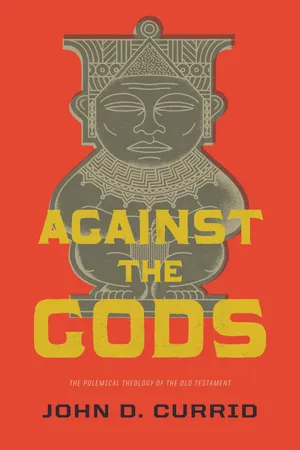
Did Moses borrow ideas from his cultural neighbors when he wrote the Pentateuch? Scholars disagree on the relationship between portions of the Old Testament and similar ancient Near Eastern accounts. Following in the footsteps of higher critics, some evangelical scholars now argue that Moses drew significantly from the worldview of his pagan contemporaries. Respected Old Testament scholar John Currid, however, pushes back against this trend by highlighting the highly polemical nature of Moses' writings. From the Genesis creation account to the story of Israel's exodus from Egypt, Currid shows how the biblical author's continually emphasized the futility of paganism in contrast with the unparalleled worldview of the Hebrews. Currid's penetrating analysis and thoughtful argumentation make this a ground-breaking resource for anyone interested in this ongoing discussion.
- English
- ePUB (mobile friendly)
- Available on iOS & Android
eBook - ePub
About this book
Information
1
A Brief History of Ancient Near Eastern Studies
Ancient Near Eastern study today is a highly developed discipline that includes much modern technology, with computer analysis and data organization as dominating forces. Obviously,s this has not always been the case because at its inception in the beginning of the nineteenth century no such tools were available. As we will see, the first researchers in the discipline were those who discovered unknown languages and those who deciphered them. In reality, the serious examination and study of the cultures of the ancient Near East are relatively recent phenomena. The field of study is barely two hundred years old. Presently, the discipline is thriving, becoming specialized, and the amount of information is exploding.1 How did such a development occur in a mere two-hundred-year period? How did the discipline evolve into what it is today? This chapter will attempt to do two things: first, it will provide a cursory outline of the history of ancient Near Eastern studies and, second, it will briefly consider the relationship of that field to the field of biblical studies.
The Beginnings of Research in the Ancient Near East (1798–1872)
Prior to 1798, the world’s knowledge of the history of the ancient Near East was principally derived from the Bible and from some early Greek writers who preserved some aspects of it in their own histories. One of the more important of these historians was Herodotus, who lived in the fifth century BC. He introduced his history with a famous statement:
I, Herodotus of Halicarnassus, am here setting forth my history, that time may not draw the color from what man has brought into being, nor those great and wonderful deeds, manifested by both Greeks and barbarians, fail of their report, and, together with all this, the reason why they fought one another.2
One of Herodotus’s primary goals in writing a history was to give explanation and understanding to the hostilities between the Greeks and the Persians that occurred in the first half of the fifth century BC. Part of his work included some information about the histories of Egypt, Babylon, Assyria, Phoenicia, and other areas of the ancient Near East. Much of his testimony came from oral tradition that was provided by contemporary natives of the fifth century BC, such as the priests of Egypt. The trustworthiness of Herodotus’s history is a matter of raging debate: to some he is “the father of history,” and to others he is “the father of lies.” 3 No matter, the evidence of the history of the ancient Near East prior to the nineteenth century was paltry.
Archaeology was of little help before the nineteenth century in providing evidence for our understanding of the ancient Near East. The field of archaeology was in existence before that century; modern fieldwork had begun with organized digs at Herculaneum, located on the Bay of Naples, in AD 1738:4
Tunnels dug at Herculaneum led to the recovery of magnificent statuary now housed in the Naples Museum. Karl Weber drew some very accurate architectural plans during these early excavations. The digs were eventually suspended at Herculaneum because of the great problem of having to chop through meters of volcanic residue that covered the site.5
Excavations at Pompeii soon followed, beginning in 1748. The first buildings to be excavated included “the smaller theatre (or Odeon, 1764), the Temple of Isis (1764), the so-called Gladiator’s barracks (1767), and the Villa of Diomedes outside the Herculaneum Gate (1771).” 6
Systematic archaeological work in the Near East, however, did not begin until the turn into the nineteenth century. The first great stride in the field was in Egyptian research. In 1798 Napoleon invaded Egypt. He brought with him a scientific expedition of scholars, architects, and draftsmen whose primary purpose was to survey the ancient monuments of Egypt. The account of their findings was published in a series of tomes, from 1809–1829, titled Description de l’Egypte.7 This exploration was important because Egypt was the first ancient land of the Near East rediscovered in modern times: it opened up the eyes of the West to a vast ancient civilization. When Napoleon’s army gathered at the base of the pyramids to engage the Mameluke army in battle (July 21, 1798), Napoleon said to his troops, “Soldiers! From atop these pyramids, fifty centuries look down upon you!” This message was not merely encouragement for the French expeditionary force; it was intended for all Europe.
In regard to the future of Egyptian archaeology, Napoleon’s expedition made a most important discovery: the Valley of the Kings.8 From the Eighteenth–Twentieth Dynasties, which is the New Kingdom period of Egyptian history (c. 1550–1070 BC), the Egyptian rulers at Thebes built for themselves royal tombs on the west side of the Nile River.9 The Valley of the Kings contains more than sixty tombs, although not all of them belong to royalty. This area, of course, became a central spot for excavation work beginning in the middle of the nineteenth century and continuing today. The most famous discovery here was the tomb of Pharaoh Tutankhamen by the archaeologist Howard Carter in 1922.
The reality is that no real advances could be made until the hieroglyphic language was deciphered, which leads us to consider the most significant find of the Napoleonic excursion: the Rosetta Stone (1799):
It proved to be invaluable because it was the key to unlocking ancient Egyptian hieroglyphics, a picture script unutilized for over fourteen hundred years. Dating to the time of King Ptolemy V (204–180 BC), the Rosetta Stone is inscribed in three scripts: demotic, Greek, and hieroglyphs. The Greek proved to be a translation of the ancient Egyptian language on the stone.10
The English physician Thomas Young (1819) and the French philologist Jean-François Champollion (1822) performed linguistic work on the stone, and they were able to decipher the hieroglyphic language. The cracking of the language was an important step. As Andrews comments, it “marked the beginning of the scientific reading of hieroglyphs and the first step toward formulation of a system of ancient Egyptian grammar, the basis of modern Egyptology.” 11 Thus, this early find by the Napoleonic expedition proved to be one of the greatest discoveries ever as it opened up the world of ancient Egypt.
The decipherment of hieroglyphs not only led to the discovery of ancient Egypt as a highly civilized culture worthy of investigation; it was also seen as important for the study of the Old Testament. For example, the work of Champollion soon bore fruit with the translation of a monumental triumphal relief on the Bubastite Portal of the main temple of Amon at Karnak.12 The relief provides striking verification of the biblical account of Shishak’s invasion of Judah and Israel in the tenth century BC (see 1 Kings 14:25–26 and 2 Chron. 12:2–4).
Archaeological work also began in Mesopotamia in the first half of the nineteenth century. Georges Roux comments:
But in 1843 Paul Emile Botta, Italian-born French consul in Mosul, started at Khorsabad the first archaeological excavations in Iraq, discovered the Assyrians and opened a new era. Almost at once (1845) an Englishman, Sir Henry Layard, followed his example at Nimrud and Nineveh, and soon a number of tells were excavated.13
Based on these excavations, scholars began to reconstruct the history of Mesopotamia, including the lands of Assyria and Babylonia. In this early period of discovery, Mesopotamia yielded many more monuments and inscriptions relevant to the history of the Old Testament than did Egypt. For instance, the annals of Sargon II were found at this time, and the king called himself “the conqueror of Samaria and of the entire country of Israel.” In these same annals, Sargon II says that he deported 27,290 upper-class citizens from Israel and replaced them with peoples from other nations. He made Israel an Assyrian province, placed a governor over it, and exacted heavy tribute from the inhabitants. Thus Israel, the northern kingdom, met its end and ceased to exist. The annals of Sargon II provide helpful information about this important period.
For the scholarship of this time, there was a general sense of innocent discovery. Certainly the researchers recognized some problems with harmonization of ancient Near Eastern history and biblical history, but there does not appear to have been a dominant hermeneutic of suspicion in the academy. When, for example, the influential Society of Biblical Archaeology was founded in 1870, one of the founding members, Samuel Birch of the British Museum, made the following remarks to the first official meeting of the society:
It is true that these results have not been obtained without difficulties. There has been some conflict between Assyrian and Jewish history, and although Assyrian scholars, dealing with the special subject of Assyria, naturally lean with favour to the information monuments of Nineveh afford, it is by no means sure that the Assyrians, especially in speaking of foreign nations, may not have recorded errors. As the research advances, the difficulty of reconciling the chronology of the Assyrians and the Jews will melt away before the additional monuments that may be acquired. There is nothing to alarm the exegetical critic in the slight discrepancies that always present themselves in the world’s history when the same fact is differently recorded by the actors in some national struggle.14
Although Birch may be accused of naivete, in reality the most that can be said about him with certainty is that he was not prescient. For indeed, right around the corner—in fact, in an article just about to be published in the journal of Birch’s own society—George Smith announced that he had discovered an Assyrian account of the flood.15 Everything was about to change.
The Period of Suspicion Begins (1873–1905)
Although we will deal with the ancient Near Eastern flood accounts in chapter 4 of this work, it is important to mention the discovery of the Assyrian flood story because it is a watershed event in the history of ancient Near Eastern studies. Smith began his report with the following statement:
A short time back I discovered among the Assyrian tablets in the British Museum, an account of the flood; which, under the advice of our President, I now bring before the Society.16
After translating and commenting on the Assyrian text of the flood, Smith concluded the following:
In conclusion I would remark that this account of the Deluge opens to us a new field of inquiry in the early part of Bible history. The question has often been asked, “What is the origin of the accounts of the antediluvians, with their long live...
Table of contents
- Cover
- Title
- Copyright
- Content
- Prologue
- 1 A Brief History of Ancient Near Eastern Studies
- 2 The Nature of Polemical Thought and Writing
- 3 Genesis 1 and Other Ancient Near Eastern Creation Accounts
- 4 Ancient Near Eastern Flood Accounts and the Noahic Deluge of Genesis 6–9
- 5 Joseph, the Tale of the Two Brothers, and the “Spurned Seductress” Motif
- 6 The Birth of the Deliverer
- 7 The Flights of Sinuhe and Moses
- 8 Who Is “I Am that I Am”? Exodus 3 and the Egyptian Book of the Heavenly Cow
- 9 The Rod of Moses
- 10 The Parting of the Waters of the Red Sea
- 11 Canaanite Motifs
Trusted by 375,005 students
Access to over 1.5 million titles for a fair monthly price.
Study more efficiently using our study tools.
Frequently asked questions
Yes, you can cancel anytime from the Subscription tab in your account settings on the Perlego website. Your subscription will stay active until the end of your current billing period. Learn how to cancel your subscription
No, books cannot be downloaded as external files, such as PDFs, for use outside of Perlego. However, you can download books within the Perlego app for offline reading on mobile or tablet. Learn how to download books offline
Perlego offers two plans: Essential and Complete
- Essential is ideal for learners and professionals who enjoy exploring a wide range of subjects. Access the Essential Library with 800,000+ trusted titles and best-sellers across business, personal growth, and the humanities. Includes unlimited reading time and Standard Read Aloud voice.
- Complete: Perfect for advanced learners and researchers needing full, unrestricted access. Unlock 1.5M+ books across hundreds of subjects, including academic and specialized titles. The Complete Plan also includes advanced features like Premium Read Aloud and Research Assistant.
We are an online textbook subscription service, where you can get access to an entire online library for less than the price of a single book per month. With over 1.5 million books across 990+ topics, we’ve got you covered! Learn about our mission
Look out for the read-aloud symbol on your next book to see if you can listen to it. The read-aloud tool reads text aloud for you, highlighting the text as it is being read. You can pause it, speed it up and slow it down. Learn more about Read Aloud
Yes! You can use the Perlego app on both iOS and Android devices to read anytime, anywhere — even offline. Perfect for commutes or when you’re on the go.
Please note we cannot support devices running on iOS 13 and Android 7 or earlier. Learn more about using the app
Please note we cannot support devices running on iOS 13 and Android 7 or earlier. Learn more about using the app
Yes, you can access Against the Gods by John D. Currid in PDF and/or ePUB format, as well as other popular books in Teologia e religione & Critica e interpretazione biblica. We have over 1.5 million books available in our catalogue for you to explore.