This study of the Antonescu regime's forced-labor system "offers precious insights to historians and social scientists alike" (Dennis Deletant, author of
Ion Antonescu: Hitler's Forgotten Ally).
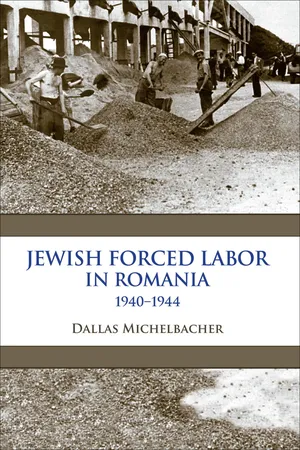
Between Romania's entry into World War II in 1941 and the ouster of dictator Ion Antonescu three years later, over 105,000 Jews were forced to work in internment and labor camps, labor battalions, government institutions, and private industry. Particularly for those in the labor battalions, this period was characterized by extraordinary physical and psychological suffering, hunger, inadequate shelter, and dangerous or even deadly working conditions. And yet the situation that arose from the combination of Antonescu's paranoias and the peculiarities of the Romanian system of forced-labor organization meant that most Jewish laborers survived.
Jewish Forced Labor in Romania explores the ideological and legal background of this system of forced labor, its purpose, and its evolution. Author Dallas Michelbacher examines the relationship between the system of forced labor and the Romanian government's plans for the "solution to the Jewish question." In doing so, Michelbacher highlights the key differences between the Romanian system of forced labor and the well-documented use of forced labor in Nazi Germany and neighboring Hungary.
Jewish Forced Labor in Romania explores the internal logic of the Antonescu regime and how it balanced its ideological imperative for antisemitic persecution with the economic needs of a state engaged in total war whose economy was still heavily dependent on the skills of its Jewish population.
- 170 pages
- English
- ePUB (mobile friendly)
- Available on iOS & Android
eBook - ePub
Jewish Forced Labor in Romania, 1940–1944
About this book
Information
Publisher
Indiana University PressYear
2020Print ISBN
9780253047380
9780253047380
eBook ISBN
9780253047441
1“Work in the Community Interest”
ION ANTONESCU’S GOVERNMENT introduced forced labor for Romanian Jews on December 5, 1940, through the Law on the Military Status of the Jews, which barred Jews from serving in the armed forces and replaced their compulsory military service with a requirement to perform “work in the community interest” (muncă în folos obştesc). This law was part of a succession of antisemitic legislation that was designed to remove Jews from every facet of the Romanian economy and public life and replace them with non-Jewish Romanians. This process, known as Romanianization, was the culmination of several decades of antisemitic politics that preceded Antonescu’s dictatorship. Romanianization was the central focus of Antonescu’s Jewish policy prior to Romania’s entry into the Second World War.
Forced labor had an important role in Romanianization as a solution to the problems created by the exclusion of Jews from the labor force and the military. Jews who had been removed from their jobs would no longer be able to make an economic contribution to the state by paying taxes, and the prohibition on Jewish military service prevented them from directly participating in a potential future war (which, by late 1940, seemed increasingly likely). By performing forced labor, Jews could provide economic utility to Romanian state institutions and businesses and support any war effort by working on projects of military importance, such as improving Romania’s road and railway network or building fortifications and other defensive works. Forced labor thus met both the ideological requirements of Romanianization and the needs of the Romanian economy and military, making it a logical extension of Antonescu’s Romanianization program.
The concept of Romanianization did not originate with Antonescu, nor were his anti-Jewish policies sui generis. Antisemitism rooted in economic resentment had a long history in Romania prior to his accession to power. Laws excluding Jews from certain parts of the Romanian economy had existed even before Romania formally gained independence in 1878; for example, an 1874 law prohibited Jews from serving as chief doctors in Romanian hospitals.1 However, it was not until after the First World War that the conception of Romanianization as it was later implemented by Antonescu began to take shape. One of the main promoters of antisemitic legislation during the early twentieth century was Alexandru C. Cuza, a jurist and professor from Iaşi, a city in the historic region of Moldavia that had a large Jewish population (more than one-third of the city’s population, as of the 1930 census). In 1922, Cuza founded an antisemitic political party, the National Christian Union, which was renamed the National Christian Defense League the following year. The league’s platform called for the exclusion of Jews from the Romanian economy, followed by their physical removal from the country. To remedy alleged Jewish “domination” of Romanian society, Cuza proposed to restrict Jewish representation in industry, business, education, and government to Jews’ proportion of the national population—around 4 percent in 1930—which he referred to as the “principle of proportionality.”2
In 1927, Corneliu Zelea Codreanu, the leader of the party’s student wing, split with Cuza and founded the ultranationalistic and antisemitic Legion of the Archangel Michael, later known as the Iron Guard (after the name of its paramilitary wing).3 The Iron Guard gained notoriety through acts of antisemitic and political violence, including the assassination of Prime Minister Ion Duca—who had attempted to suppress the Iron Guard—on December 29, 1933.4 Fear of Iron Guard violence and a potential revolt was omnipresent in Romanian politics during the 1930s, and the organization was one of King Carol II’s primary domestic policy concerns.
The National Christian Defense League remained a marginal political force and never entered into government as an independent party. However, by the early 1930s, the ideology of Romanianization had begun to make inroads with the mainstream democratic parties, and both of the major political parties of the interwar period—the National Liberal Party and the National Peasant Party—made attempts at excluding Jews from the Romanian economy. Iuliu Maniu’s National Peasant government passed legislation to restrict minority participation in the workforce in 1930. A similar law, known as the Law for the Use of Romanian Personnel in Enterprises, was passed by Gheorghe Tătărescu’s National Liberal government in 1934. The 1934 law required that ethnic minorities comprise no more than 20 percent of the workforce of any firm. However, both of these measures failed, primarily because business owners were uninterested in terminating their Jewish employees and replacing them with unknown and potentially less qualified workers. Less than 1 percent of the labor force was Romanianized under the 1934 law.5 A third law, passed by the Tătărescu government in 1937, required factories seeking military contracts to have a payroll that was at least 95 percent ethnic Romanian. This law failed for similar reasons as the previous two. Wilhelm Filderman, president of the country’s largest Jewish organization, the Union of Romanian Jews, derided the 1937 law as “the country cutting off its nose to spite its face” because of the harm it would have caused to the Romanian economy.6
In 1935, the National Christian Defense League merged with the right-wing National Agrarian Party, led by the poet Octavian Goga, to form the National Christian Party. The new party combined Goga’s agrarian ideology with Cuza’s antisemitism and Romanianization policies.7 The first election the National Christian Party contested, in December 1937, was a decisive one for the future of Romanian politics and the Romanian Jews. The National Christian Party achieved only modest success, finishing in fourth place with just over 9 percent of the vote and winning thirty-nine seats. However, for the first time since Romania’s independence, the party the king had chosen to form the government, the National Liberals, failed to win a majority of the votes or even achieve the 40 percent threshold that would have granted it a parliamentary majority under the constitution. In the past, the party chosen by the king had always managed to secure itself a strong majority because it controlled the conduct of the elections through the county prefects, which it appointed.8
The shock result in the 1937 election was largely due to an alliance between the National Peasant Party and the Iron Guard’s All for the Fatherland Party, which finished as the second and third parties, respectively, and won a total of 152 seats, equal to the number won by the National Liberals.9 Because no party had obtained a sufficient mandate, the king was entitled to select a new prime minister to form a government. Carol feared the ascendant Iron Guard, but he was unwilling to reward the cynical strategy of the National Peasants (whose leader, Maniu, he personally disliked) and was dissatisfied with Dinu Brătianu’s National Liberals. Thus, he chose Goga and the National Christian Party to lead the new cabinet. On December 28, Goga was proclaimed prime minister.10
The Goga-Cuza government, as it is often known, remained in power for only forty-four days, but during that time it introduced a radical measure—the Law for the Review of Jewish Citizenship—which resulted in the denaturalization of almost one-third of the country’s Jewish population.11 However, the new government’s plans for additional antisemitic legislation, including a new law for the Romanianization of labor, did not come to fruition. While Nazi Germany had approved of the ascent of the Goga-Cuza government, the Western Allies strongly opposed its behavior toward the Jews and made their displeasure known to Carol.12 On February 10, the king dismissed Goga and suspended constitutional rule. Romanian Orthodox patriarch Miron Cristea was named prime minister and a new constitution that granted Carol immense power and created what was effectively a royal dictatorship was announced on February 20. It was ratified eight days later in a sham referendum in which over 99 percent of the electorate allegedly voted in its favor.13 During the following months, Carol moved against his primary domestic enemy, the Iron Guard, imprisoning a number of its leaders. Many of them, including Codreanu, were shot by gendarmes on the night of November 29–30, 1938. In retaliation, members of the Iron Guard assassinated Cristea’s successor as prime minister, Armand Călinescu, on September 21, 1939. The domestic stability Carol had sought to create by concentrating political power in his own hands proved illusory.14
However, the primary agent in Carol’s downfall and Antonescu’s rise to power was the deteriorating situation outside Romania’s borders, not the political tensions within them. The Munich Agreement of September 30, 1938, concerned Carol, who feared German expansionism in eastern Europe and doubted the feasibility of maintaining Romania’s territorial integrity against its irredentist neighbors, Hungary, Bulgaria, and the Soviet Union. The policy of appeasement embraced by the Western Allies diminished Carol’s confidence in France and Britain as potential guarantors of Romanian sovereignty. The Molotov-Ribbentrop Pact of August 1939 was an even more devastating blow. One of the secret provisions of the pact was German recognition of the Soviet Union’s territorial “interests” in Bessarabia and an understanding that Germany would not intervene militarily to oppose Soviet actions to recover this territory from Romania. On June 26, 1940, the Soviet Union presented Romania with an ultimatum to withdraw from Bessarabia and northern Bukovina (the latter of which had not been included in the terms of the pact) within forty-eight hours or face an invasion. Carol was initially hesitant to comply with such odious demands and attempted to negotiate with the Soviets; however, a second ultimatum forced his hand, and he ordered the withdrawal of Romanian troops and the evacuation of civilians from the two territories on June 30.15
After the loss of Bessarabia and northern Bukovina and the rapid German defeat of France, Carol believed Nazi Germany was the only country that could protect Romania against further Soviet aggression and Hungarian and Bulgarian revanchism. To curry Hitler’s favor, he dismissed Prime Minister Gheorghe Tătărescu and replaced him with his firmly pro-German foreign minister, Ion Gigurtu, on July 4. Gigurtu was palatable to Hitler both because of his Germanophile orientation and because he was a wealthy industrialist with close ties to German businessmen. Gigurtu enabled increased German economic penetration of Romania and invited Germany to station troops in Romania. While the appointment of Gigurtu prolonged Carol’s reign by only two more months, it was a watershed moment for Romania’s Jews. In keeping with his and Carol’s desire to promote closer relations with Nazi Germany, Gigurtu carried out a miniature Gleichschaltung in Romania, bringing the country’s domestic and foreign policy in line with Germany’s. This realignment of policy included the introduction of restrictive measures against the country’s Jews, such as the expulsion of Jews from the civil service on July 9.16
On August 8, 1940, Gigurtu issued the Decree-Law Concerning the Legal Status of the Jewish Residents of Romania, commonly referred to simply as the Jewish Statute, which laid the foundation for the Romanianization policies that Antonescu enacted after he came into power. Like the Nazi Nuremberg Laws, the Jewish Statute created a new legal definition of Jewishness based on racial criteria. In addition to practicing Jews, secular Jews and unbaptized converts to Christianity with at least one Jewish parent were considered “Jews by blood” (evrei de sânge).17 Those considered Jews by this definition were divided into three categories based on when they had arrived in Romania or gained Romanian citizenship. Category I consisted of Jews who arrived in Romania after December 30, 1918, which included Jews born in Bessarabia and Bukovina before those territories were incorporated into Romania after the First World War. Category II comprised Jews who had been individually naturalized by parliamentary decree (the only way Jews could obtain Romanian citizenship before the First World War); Jews from Dobruja, who were naturalized under a series of laws in the early twentieth century; and Jews who had served in comba...
Table of contents
- Cover
- Title Page
- Copyright
- Dedication
- Contents
- Acknowledgments
- Introduction
- 1. “Work in the Community Interest”
- 2. Trial and Error
- 3. The “Review of the Working Jews”
- 4. In the Shadow of Belzec
- 5. The Apogee
- 6. Travails Ended, Justice Averted
- Conclusion
- Bibliography
- Index
- About the Author
Trusted by 375,005 students
Access to over 1.5 million titles for a fair monthly price.
Study more efficiently using our study tools.
Frequently asked questions
Yes, you can cancel anytime from the Subscription tab in your account settings on the Perlego website. Your subscription will stay active until the end of your current billing period. Learn how to cancel your subscription
No, books cannot be downloaded as external files, such as PDFs, for use outside of Perlego. However, you can download books within the Perlego app for offline reading on mobile or tablet. Learn how to download books offline
We are an online textbook subscription service, where you can get access to an entire online library for less than the price of a single book per month. With over 1.5 million books across 990+ topics, we’ve got you covered! Learn about our mission
Look out for the read-aloud symbol on your next book to see if you can listen to it. The read-aloud tool reads text aloud for you, highlighting the text as it is being read. You can pause it, speed it up and slow it down. Learn more about Read Aloud
Yes! You can use the Perlego app on both iOS and Android devices to read anytime, anywhere — even offline. Perfect for commutes or when you’re on the go.
Please note we cannot support devices running on iOS 13 and Android 7 or earlier. Learn more about using the app
Please note we cannot support devices running on iOS 13 and Android 7 or earlier. Learn more about using the app
Yes, you can access Jewish Forced Labor in Romania, 1940–1944 by Dallas Michelbacher in PDF and/or ePUB format, as well as other popular books in History & Eastern European History. We have over 1.5 million books available in our catalogue for you to explore.