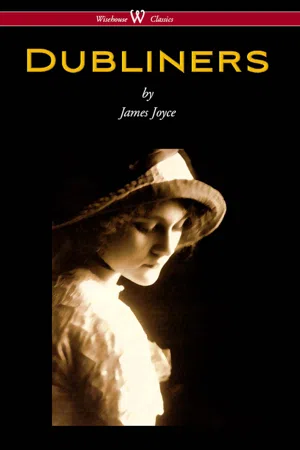
DUBLINERS is a collection of fifteen short stories by James Joyce, first published in 1914. They form a naturalistic depiction of Irish middle class life in and around Dublin in the early years of the 20th century. The stories were written when Irish nationalism was at its peak, and a search for a national identity and purpose was raging; at a crossroads of history and culture, Ireland was jolted by various converging ideas and influences. They centre on Joyce's idea of an epiphany: a moment where a character experiences a life-changing self-understanding or illumination. Many of the characters in Dubliners later appear in minor roles in Joyce's novel Ulysses. The initial stories in the collection are narrated by child protagonists, and as the stories continue, they deal with the lives and concerns of progressively older people. This is in line with Joyce's tripartite division of the collection into childhood, adolescence and maturity. (more on: www.wisehouse-classics.com)
- 170 pages
- English
- ePUB (mobile friendly)
- Available on iOS & Android
eBook - ePub
Dubliners (Wisehouse Classics Edition)
About this book
Information
The Dead
L
ily, the caretaker’s daughter, was literally run off her feet. Hardly had she brought one gentleman into the little pantry behind the office on the ground floor and helped him off with his overcoat than the wheezy hall-door bell clanged again and she had to scamper along the bare hallway to let in another guest. It was well for her she had not to attend to the ladies also. But Miss Kate and Miss Julia had thought of that and had converted the bathroom upstairs into a ladies’ dressing-room. Miss Kate and Miss Julia were there, gossiping and laughing and fussing, walking after each other to the head of the stairs, peering down over the banisters and calling down to Lily to ask her who had come.
It was always a great affair, the Misses Morkan’s annual dance. Everybody who knew them came to it, members of the family, old friends of the family, the members of Julia’s choir, any of Kate’s pupils that were grown up enough, and even some of Mary Jane’s pupils too. Never once had it fallen flat. For years and years it had gone off in splendid style, as long as anyone could remember; ever since Kate and Julia, after the death of their brother Pat, had left the house in Stoney Batter and taken Mary Jane, their only niece, to live with them in the dark, gaunt house on Usher’s Island, the upper part of which they had rented from Mr. Fulham, the corn-factor on the ground floor. That was a good thirty years ago if it was a day. Mary Jane, who was then a little girl in short clothes, was now the main prop of the household, for she had the organ in Haddington Road. She had been through the Academy and gave a pupils’ concert every year in the upper room of the Antient Concert Rooms. Many of her pupils belonged to the better-class families on the Kingstown and Dalkey line. Old as they were, her aunts also did their share. Julia, though she was quite grey, was still the leading soprano in Adam and Eve’s, and Kate, being too feeble to go about much, gave music lessons to beginners on the old square piano in the back room. Lily, the caretaker’s daughter, did housemaid’s work for them. Though their life was modest, they believed in eating well; the best of everything: diamond-bone sirloins, three-shilling tea and the best bottled stout. But Lily seldom made a mistake in the orders, so that she got on well with her three mistresses. They were fussy, that was all. But the only thing they would not stand was back answers.
Of course, they had good reason to be fussy on such a night. And then it was long after ten o’clock and yet there was no sign of Gabriel and his wife. Besides they were dreadfully afraid that Freddy Malins might turn up screwed. They would not wish for worlds that any of Mary Jane’s pupils should see him under the influence; and when he was like that it was sometimes very hard to manage him. Freddy Malins always came late, but they wondered what could be keeping Gabriel: and that was what brought them every two minutes to the banisters to ask Lily had Gabriel or Freddy come.
“O, Mr. Conroy,” said Lily to Gabriel when she opened the door for him, “Miss Kate and Miss Julia thought you were never coming. Good-night, Mrs. Conroy.”
“I’ll engage they did,” said Gabriel, “but they forget that my wife here takes three mortal hours to dress herself.”
He stood on the mat, scraping the snow from his goloshes, while Lily led his wife to the foot of the stairs and called out:
“Miss Kate, here’s Mrs. Conroy.”
Kate and Julia came toddling down the dark stairs at once. Both of them kissed Gabriel’s wife, said she must be perished alive, and asked was Gabriel with her.
“Here I am as right as the mail, Aunt Kate! Go on up. I’ll follow,” called out Gabriel from the dark.
He continued scraping his feet vigorously while the three women went upstairs, laughing, to the ladies’ dressing-room. A light fringe of snow lay like a cape on the shoulders of his overcoat and like toecaps on the toes of his goloshes; and, as the buttons of his overcoat slipped with a squeaking noise through the snow-stiffened frieze, a cold, fragrant air from out-of-doors escaped from crevices and folds.
“Is it snowing again, Mr. Conroy?” asked Lily.
She had preceded him into the pantry to help him off with his overcoat. Gabriel smiled at the three syllables she had given his surname and glanced at her. She was a slim, growing girl, pale in complexion and with hay-coloured hair. The gas in the pantry made her look still paler. Gabriel had known her when she was a child and used to sit on the lowest step nursing a rag doll.
“Yes, Lily,” he answered, “and I think we’re in for a night of it.”
He looked up at the pantry ceiling, which was shaking with the stamping and shuffling of feet on the floor above, listened for a moment to the piano and then glanced at the girl, who was folding his overcoat carefully at the end of a shelf.
“Tell me. Lily,” he said in a friendly tone, “do you still go to school?”
“O no, sir,” she answered. “I’m done schooling this year and more.”
“O, then,” said Gabriel gaily, “I suppose we’ll be going to your wedding one of these fine days with your young man, eh? ”
The girl glanced back at him over her shoulder and said with great bitterness:
“The men that is now is only all palaver and what they can get out of you.”
Gabriel coloured, as if he felt he had made a mistake and, without looking at her, kicked off his goloshes and flicked actively with his muffler at his patent-leather shoes.
He was a stout, tallish young man. The high colour of his cheeks pushed upwards even to his forehead, where it scattered itself in a few formless patches of pale red; and on his hairless face there scintillated restlessly the polished lenses and the bright gilt rims of the glasses which screened his delicate and restless eyes. His glossy black hair was parted in the middle and brushed in a long curve behind his ears where it curled slightly beneath the groove left by his hat.
When he had flicked lustre into his shoes he stood up and pulled his waistcoat down more tightly on his plump body. Then he took a coin rapidly from his pocket.
“O Lily,” he said, thrusting it into her hands, “it’s Christmastime, isn’t it? Just . . . here’s a little. . . . ”
He walked rapidly towards the door.
“O no, sir!” cried the girl, following him. “Really, sir, I wouldn’t take it.”
“Christmas-time! Christmas-time!” said Gabriel, almost trotting to the stairs and waving his hand to her in deprecation.
The girl, seeing that he had gained the stairs, called out after him:
“Well, thank you, sir.”
He waited outside the drawing-room door until the waltz should finish, listening to the skirts that swept against it and to the shuffling of feet. He was still discomposed by the girl’s bitter and sudden retort. It had cast a gloom over him which he tried to dispel by arranging his cuffs and the bows of his tie. He then took from his waistcoat pocket a little paper and glanced at the headings he had made for his speech. He was undecided about the lines from Robert Browning, for he feared they would be above the heads of his hearers. Some quotation that they would recognise from Shakespeare or from the Melodies would be better. The indelicate clacking of the men’s heels and the shuffling of their soles reminded him that their grade of culture differed from his. He would only make himself ridiculous by quoting poetry to them which they could not understand. They would think that he was airing his superior education. He would fail with them just as he had failed with the girl in the pantry. He had taken up a wrong tone. His whole speech was a mistake from first to last, an utter failure.
Just then his aunts and his wife came out of the ladies’ dressing-room. His aunts were two small, plainly dressed old women. Aunt Julia was an inch or so the taller. Her hair, drawn low over the tops of her ears, was grey; and grey also, with darker shadows, was her large flaccid face. Though she was stout in build and stood erect, her slow eyes and parted lips gave her the appearance of a woman who did not know where she was or where she was going. Aunt Kate was more vivacious. Her face, healthier than her sister’s, was all puckers and creases, like a shrivelled red apple, and her hair, braided in the same old-fashioned way, had not lost its ripe nut colour.
They both kissed Gabriel frankly. He was their favourite nephew the son of their dead elder sister, Ellen, who had married T. J. Conroy of the Port and Docks.
“Gretta tells me you’re not going to take a cab back to Monkstown tonight, Gabriel,” said Aunt Kate.
“No,” said Gabriel, turning to his wife, “we had quite enough of that last year, hadn’t we? Don’t you remember, Aunt Kate, what a cold Gretta got out of it? Cab windows rattling all the way, and the east wind blowing in after we passed Merrion. Very jolly it was. Gretta caught a dreadful cold.”
Aunt Kate frowned severely and nodded her head at every word.
“Quite right, Gabriel, quite right,” she said. “You can’t be too careful.”
“But as for Gretta there,” said Gabriel, “she’d walk home in the snow if she were let.”
Mrs. Conroy laughed.
“Don’t mind him, Aunt Kate,” she said. “He’s really an awful bother, what with green shades for Tom’s eyes at night and making him do the dumb-bells, and forcing Eva to eat the stirabout. The poor child! And she simply hates the sight of it! . . . O, but you’ll never guess what he makes me wear now!”
She broke out into a peal of laughter and glanced at her husband, whose admiring and happy eyes had been wandering from her dress to her face and hair. The two aunts laughed heartily, too, for Gabriel’s solicitude was a standing joke with them.
“Goloshes!” said Mrs. Conroy. “That’s the latest. Whenever it’s wet underfoot I must put on my galoshes. Tonight even, he wanted me to put them on, but I wouldn’t. The next thing he’ll buy me will be a diving suit.”
Gabriel laughed nervously and patted his tie reassuringly, while Aunt Kate nearly doubled herself, so heartily did she enjoy the joke. The smile soon faded from Aunt Julia’s face and her mirthless eyes were directed towards her nephew’s face. After a pause she asked:
“And what are goloshes, Gabriel?”
“Goloshes, Julia!” exclaimed her sister “Goodness me, don’t you know what goloshes are? You wear them over your . . . over your boots, Gretta, isn’t it?”
“Yes,” said Mrs. Conroy. “Guttapercha things. We both have a pair now. Gabriel says everyone wears them on the Continent.”
“O, on the Continent,” murmured Aunt Julia, nodding her head slowly.
Gabriel knitted his brows and said, as if he were slightly angered:
“It’s nothing very wonderful, but Gretta thinks it very funny because she says the word reminds her of Christy Minstrels.”
“But tell me, Gabriel,” said Aunt Kate, with brisk tact. “Of course, you’ve seen about the room. Gretta was saying . . . ”
“0, the room is all right,” replied Gabriel. “I’ve t...
Table of contents
- The Sisters
- An Encounter
- Araby
- Eveline
- After the Race
- Two Gallants
- The Boarding House
- A Little Cloud
- Counterparts
- Clay
- A Painful Case
- Ivy Day in the Committee Room
- A Mother
- Grace
- The Dead
Trusted by 375,005 students
Access to over 1.5 million titles for a fair monthly price.
Study more efficiently using our study tools.
Frequently asked questions
Yes, you can cancel anytime from the Subscription tab in your account settings on the Perlego website. Your subscription will stay active until the end of your current billing period. Learn how to cancel your subscription
No, books cannot be downloaded as external files, such as PDFs, for use outside of Perlego. However, you can download books within the Perlego app for offline reading on mobile or tablet. Learn how to download books offline
Perlego offers two plans: Essential and Complete
- Essential is ideal for learners and professionals who enjoy exploring a wide range of subjects. Access the Essential Library with 800,000+ trusted titles and best-sellers across business, personal growth, and the humanities. Includes unlimited reading time and Standard Read Aloud voice.
- Complete: Perfect for advanced learners and researchers needing full, unrestricted access. Unlock 1.5M+ books across hundreds of subjects, including academic and specialized titles. The Complete Plan also includes advanced features like Premium Read Aloud and Research Assistant.
We are an online textbook subscription service, where you can get access to an entire online library for less than the price of a single book per month. With over 1.5 million books across 990+ topics, we’ve got you covered! Learn about our mission
Look out for the read-aloud symbol on your next book to see if you can listen to it. The read-aloud tool reads text aloud for you, highlighting the text as it is being read. You can pause it, speed it up and slow it down. Learn more about Read Aloud
Yes! You can use the Perlego app on both iOS and Android devices to read anytime, anywhere — even offline. Perfect for commutes or when you’re on the go.
Please note we cannot support devices running on iOS 13 and Android 7 or earlier. Learn more about using the app
Please note we cannot support devices running on iOS 13 and Android 7 or earlier. Learn more about using the app
Yes, you can access Dubliners (Wisehouse Classics Edition) by James Joyce in PDF and/or ePUB format, as well as other popular books in Literature & Classics. We have over 1.5 million books available in our catalogue for you to explore.