PYGMALION is a play by George Bernard Shaw, named after a Greek mythological character. It was first presented on stage to the public in 1913. Professor of phonetics Henry Higgins makes a bet that he can train a bedraggled Cockney flower girl, Eliza Doolittle, to pass for a duchess at an ambassador's garden party by teaching her to assume a veneer of gentility, the most important element of which, he believes, is impeccable speech. The play is a sharp lampoon of the rigid British class system of the day and a commentary on women's independence.
In ancient Greek mythology, Pygmalion fell in love with one of his sculptures, which then came to life. The general idea of that myth was a popular subject for Victorian era English playwrights, including one of Shaw's influences, W. S. Gilbert, who wrote a successful play based on the story called Pygmalion and Galatea first presented in 1871. Shaw would also have been familiar with the burlesque version, Galatea, or Pygmalion Reversed. Shaw's play has been adapted numerous times, most notably as the musical My Fair Lady and the film of that name. (more o: www.wisehouse-classics.com)
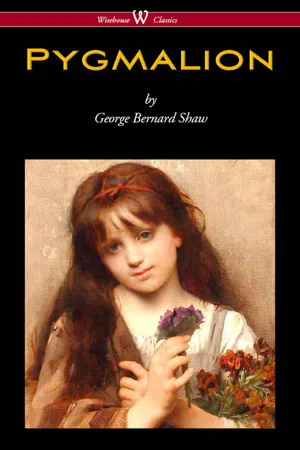
- 94 pages
- English
- ePUB (mobile friendly)
- Available on iOS & Android
eBook - ePub
Pygmalion (Wisehouse Classics Edition)
About this book
Trusted by 375,005 students
Access to over 1 million titles for a fair monthly price.
Study more efficiently using our study tools.
Information
ACT II
Next day at 11 a.m. Higgins’s laboratory in Wimpole Street. It is a room on the first floor, looking on the street, and was meant for the drawing-room. The double doors are in the middle of the back hall; and persons entering find in the corner to their right two tall file cabinets at right angles to one another against the walls. In this corner stands a flat writing-table, on which are a phonograph, a laryngoscope, a row of tiny organ pipes with a bellows, a set of lamp chimneys for singing flames with burners attached to a gas plug in the wall by an indiarubber tube, several tuning-forks of different sizes, a life-size image of half a human head, showing in section the vocal organs, and a box containing a supply of wax cylinders for the phonograph.
Further down the room, on the same side, is a fireplace, with a comfortable leather-covered easy-chair at the side of the hearth nearest the door, and a coal-scuttle. There is a clock on the mantelpiece. Between the fireplace and the phonograph table is a stand for newspapers.
On the other side of the central door, to the left of the visitor, is a cabinet of shallow drawers. On it is a telephone and the telephone directory. The corner beyond, and most of the side wall, is occupied by a grand piano, with the keyboard at the end furthest from the door, and a bench for the player extending the full length of the keyboard. On the piano is a dessert dish heaped with fruit and sweets, mostly chocolates.
The middle of the room is clear. Besides the easy chair, the piano bench, and two chairs at the phonograph table, there is one stray chair. It stands near the fireplace. On the walls, engravings; mostly Piranesis and mezzotint portraits. No paintings.
Pickering is seated at the table, putting down some cards and a tuning-fork which he has been using. Higgins is standing up near him, closing two or three file drawers which are hanging out. He appears in the morning light as a robust, vital, appetizing sort of man of forty or thereabouts, dressed in a professional-looking black frock-coat with a white linen collar and black silk tie. He is of the energetic, scientific type, heartily, even violently interested in everything that can be studied as a scientific subject, and careless about himself and other people, including their feelings. He is, in fact, but for his years and size, rather like a very impetuous baby “taking notice” eagerly and loudly, and requiring almost as much watching to keep him out of unintended mischief. His manner varies from genial bullying when he is in a good humor to stormy petulance when anything goes wrong; but he is so entirely frank and void of malice that he remains likeable even in his least reasonable moments.
HIGGINS. | [as he shuts the last ... |
Table of contents
- Cover
- Half-Title Page
- Title Page
- Copyright
- Table of Contents
- Preface to Pygmalion
- Act I
- Act II
- Act III
- Act IV
- Act V
Frequently asked questions
Yes, you can cancel anytime from the Subscription tab in your account settings on the Perlego website. Your subscription will stay active until the end of your current billing period. Learn how to cancel your subscription
No, books cannot be downloaded as external files, such as PDFs, for use outside of Perlego. However, you can download books within the Perlego app for offline reading on mobile or tablet. Learn how to download books offline
Perlego offers two plans: Essential and Complete
- Essential is ideal for learners and professionals who enjoy exploring a wide range of subjects. Access the Essential Library with 800,000+ trusted titles and best-sellers across business, personal growth, and the humanities. Includes unlimited reading time and Standard Read Aloud voice.
- Complete: Perfect for advanced learners and researchers needing full, unrestricted access. Unlock 1.4M+ books across hundreds of subjects, including academic and specialized titles. The Complete Plan also includes advanced features like Premium Read Aloud and Research Assistant.
We are an online textbook subscription service, where you can get access to an entire online library for less than the price of a single book per month. With over 1 million books across 990+ topics, we’ve got you covered! Learn about our mission
Look out for the read-aloud symbol on your next book to see if you can listen to it. The read-aloud tool reads text aloud for you, highlighting the text as it is being read. You can pause it, speed it up and slow it down. Learn more about Read Aloud
Yes! You can use the Perlego app on both iOS and Android devices to read anytime, anywhere — even offline. Perfect for commutes or when you’re on the go.
Please note we cannot support devices running on iOS 13 and Android 7 or earlier. Learn more about using the app
Please note we cannot support devices running on iOS 13 and Android 7 or earlier. Learn more about using the app
Yes, you can access Pygmalion (Wisehouse Classics Edition) by George Bernard Shaw in PDF and/or ePUB format, as well as other popular books in Literature & British Drama. We have over one million books available in our catalogue for you to explore.