The TÂO TEH KING, Tao Te Ching, Daodejing, Dao De Jing, or Daode jing (simplified Chinese: ???; traditional Chinese: ???; pinyin: Dàodéj?ng), also simply referred to as the Laozi (Chinese: ??; pinyin: L?oz?), is a Chinese classic text. According to tradition, it was written around 6th century BC by the sage Laozi (or Lao Tzu, Chinese: ??; pinyin: L?oz?, literally meaning "Old Master"), a record-keeper at the Zhou dynasty court, by whose name the text is known in China. The text's true authorship and date of composition or compilation are still debated, although the oldest excavated text dates back to the late 4th century BC.
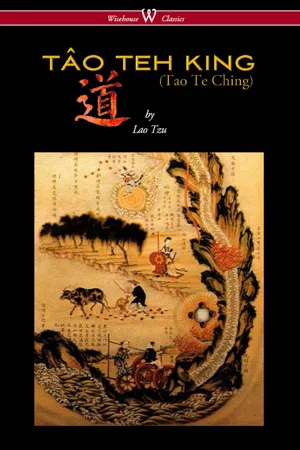
- 31 pages
- English
- ePUB (mobile friendly)
- Available on iOS & Android
eBook - ePub
THE TÂO TEH KING (TAO TE CHING - Wisehouse Classics Edition)
About this book
Trusted by 375,005 students
Access to over 1.5 million titles for a fair monthly price.
Study more efficiently using our study tools.
Information
PART I
ji
Chapter 1
1. | The Tâo that can be trodden is not the enduring and unchanging Tâo. The name that can be named is not the enduring and unchanging name. |
2. | (Conceived of as) having no name, it is the Originator of heaven and earth; (conceived of as) having a name, it is the Mother of all things. |
3. | Always without desire we must be found, If its deep mystery we would sound; But if desire always within us be, Its outer fringe is all that we shall see. |
4. | Under these two aspects, it is really the same; but as development takes place, it receives the different names. Together we call them the Mystery. Where the Mystery is the deepest is the gate of all that is subtle and wonderful. |
Chapter 2
1. | All in the world know the beauty of the beautiful, and in doing this they have (the idea of) what ugliness is; they all know the skill of the skilful, and in doing this they have (the idea of) what the want of skill is. |
2. | So it is that existence and non-existence give birth the one to (the idea of) the other; that difficulty and ease produce the one (the idea of) the other; that length and shortness fashion out the one the figure of the other; that (the ideas of) height and lowness arise from the contrast of the one with the other; that the musical notes and tones become harmonious through the relation of one with another; and that being before and behind give the idea of one following another. |
3. | Therefore, the sage manages affairs without doing anything, and conveys his instructions without the use of speech. |
4. | All things spring up, and there is not one which declines to show itself; they grow, and there is no claim made for their ownership; they go through their processes, and there is no expectation (of a reward for the results). The work is accomplished, and there is no resting in it (as an achievement). |
The work is done, but how no one can see; 'Tis this that makes the power not cease to be. |
Chapter 3
1. | Not to value and employ men of superior ability is the way to keep the people from rivalry among themselves; not to prize articles which are difficult to procure is the way to keep them from becoming thieves; not to show them what is likely to excite their desires is the way to keep their minds from disorder. |
2. | Therefore, the sage, in the exercise of his government, empties their minds, fills their bellies, weakens their wills, and strengthens their bones. |
3. | He constantly (tries to) keep them without knowledge and without desire, and where there are those who have knowledge, to keep them from presuming to act (on it). When there is this abstinence from action, good order is universal. |
Chapter 4
1. | The Tâo is (like) the emptiness of a vessel; and in our employment of it we must be on our guard against all fulness. How deep and unfathomable it is, as if it were the Honoured Ancestor of all things! |
2. | We should blunt our sharp points, and unravel the complications of things; we should attemper our brightness, and bring ourselves into agreement with the obscurity of others. How pure and still the Tâo is, as if it would ever so continue! |
3. | I do not know whose son it is. It might appear to have been before God. |
Chapter 5
1. | Heaven and earth do not act from (the impulse of) any wish to be benevolent; they deal with all things as the dogs of grass are dealt with. The sages do not act from (any wish to be) benevolent; they deal with the people as the dogs of grass are dealt with. |
2. | May not the space between heaven and earth be compared to a bellows? |
'Tis emptied... |
Table of contents
- Cover
- Half-Title Page
- Title Page
- Copyright
- Table of Contents
- PART I
- PART II
Frequently asked questions
Yes, you can cancel anytime from the Subscription tab in your account settings on the Perlego website. Your subscription will stay active until the end of your current billing period. Learn how to cancel your subscription
No, books cannot be downloaded as external files, such as PDFs, for use outside of Perlego. However, you can download books within the Perlego app for offline reading on mobile or tablet. Learn how to download books offline
Perlego offers two plans: Essential and Complete
- Essential is ideal for learners and professionals who enjoy exploring a wide range of subjects. Access the Essential Library with 800,000+ trusted titles and best-sellers across business, personal growth, and the humanities. Includes unlimited reading time and Standard Read Aloud voice.
- Complete: Perfect for advanced learners and researchers needing full, unrestricted access. Unlock 1.5M+ books across hundreds of subjects, including academic and specialized titles. The Complete Plan also includes advanced features like Premium Read Aloud and Research Assistant.
We are an online textbook subscription service, where you can get access to an entire online library for less than the price of a single book per month. With over 1.5 million books across 990+ topics, we’ve got you covered! Learn about our mission
Look out for the read-aloud symbol on your next book to see if you can listen to it. The read-aloud tool reads text aloud for you, highlighting the text as it is being read. You can pause it, speed it up and slow it down. Learn more about Read Aloud
Yes! You can use the Perlego app on both iOS and Android devices to read anytime, anywhere — even offline. Perfect for commutes or when you’re on the go.
Please note we cannot support devices running on iOS 13 and Android 7 or earlier. Learn more about using the app
Please note we cannot support devices running on iOS 13 and Android 7 or earlier. Learn more about using the app
Yes, you can access THE TÂO TEH KING (TAO TE CHING - Wisehouse Classics Edition) by Lao Tzu in PDF and/or ePUB format, as well as other popular books in Philosophy & Eastern Philosophy. We have over 1.5 million books available in our catalogue for you to explore.