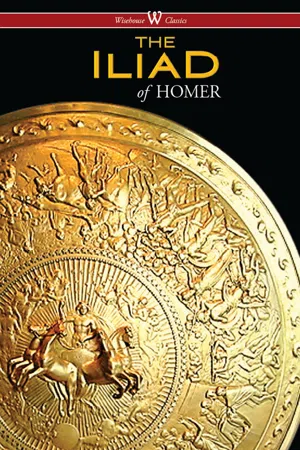
The Iliad (sometimes referred to as the Song of Ilion or Song of Ilium) is an ancient Greek epic poem in dactylic hexameter, traditionally attributed to Homer. Set during the Trojan War, the ten-year siege of the city of Troy (Ilium) by a coalition of Greek states, it tells of the battles and events during the weeks of a quarrel between King Agamemnon and the warrior Achilles.
Although the story covers only a few weeks in the final year of the war, the Iliad mentions or alludes to many of the Greek legends about the siege; the earlier events, such as the gathering of warriors for the siege, the cause of the war, and related concerns tend to appear near the beginning. Then the epic narrative takes up events prophesied for the future, such as Achilles' looming death and the sack of Troy, although the narrative ends before these events take place. However, as these events are prefigured and alluded to more and more vividly, when it reaches an end the poem has told an almost complete tale of the Trojan War.
The Iliad is paired with something of a sequel, the Odyssey, also attributed to Homer. Along with the Odyssey, the Iliad is among the oldest extant works of Western literature, and its written version is usually dated to around the 8th century BC. Recent statistical modelling based on language evolution gives a date of 760–710 BC. In the modern vulgate (the standard accepted version), the Iliad contains 15,693 lines; it is written in Homeric Greek, a literary amalgam of Ionic Greek and other dialects.
- 618 pages
- English
- ePUB (mobile friendly)
- Available on iOS & Android
eBook - ePub
The Iliad (Wisehouse Classics Edition)
About this book
Information
Table of contents
- Cover
- Half-Title Page
- Title Page
- Copyright
- Table of Contents
- Introduction by The Rev. Theodore Alois Buckley, M.A., F.S.A.
- Pope’s Preface to The Iliad of Homer
- Book I: The Contention of Achilles and Agamemnon.
- Book II: The Trial of the Army, and Catalogue of the Forces.
- Book III: The Duel of Menelaus and Paris.
- Book IV: The Breach of the Truce, and the First Battle.
- Book V: The Acts of Diomed.
- Book VI: The Episodes of Glaucus and Diomed, and of Hector and Andromache.
- Book VII: The Single Combat of Hector and Ajax.
- Book VIII: The Second Battle, and the Distress of the Greeks.
- Book IX: The Embassy to Achilles.
- Book X: The Night-Adventure of Diomed and Ulysses.
- Book XI: The Third Battle, and the Acts of Agamemnon.
- Book XII: The Battle at the Grecian Wall.
- Book XIII: The Fourth Battle Continued, in which Neptune Assists the Greeks: The Acts of Idomeneus.
- Book XIV: Juno Deceives Jupiter by the Girdle of Venus.
- Book XV: Argument.
- Book XVI: The Sixth Battle, the Acts and Death of Patroclus
- Book XVII: The Seventh Battle, for the Body of Patroclus. — The Acts of Menelaus.
- Book XVIII: The Grief of Achilles, and New Armour Made Him by Vulcan.
- Book XIX: The Reconciliation of Achilles and Agamemnon.
- Book XX: The Battle of the Gods, and the Acts of Achilles.
- Book XXI: The Battle in the River Scamander. 1
- Book XXII: The Death of Hector.
- Book XXIII: Funeral Games in Honour of Patroclus. 1
- Book XXIV: The Redemption of the Body of Hector.
- Concluding Note.
Trusted by 375,005 students
Access to over 1.5 million titles for a fair monthly price.
Study more efficiently using our study tools.
Frequently asked questions
Yes, you can cancel anytime from the Subscription tab in your account settings on the Perlego website. Your subscription will stay active until the end of your current billing period. Learn how to cancel your subscription
No, books cannot be downloaded as external files, such as PDFs, for use outside of Perlego. However, you can download books within the Perlego app for offline reading on mobile or tablet. Learn how to download books offline
Perlego offers two plans: Essential and Complete
- Essential is ideal for learners and professionals who enjoy exploring a wide range of subjects. Access the Essential Library with 800,000+ trusted titles and best-sellers across business, personal growth, and the humanities. Includes unlimited reading time and Standard Read Aloud voice.
- Complete: Perfect for advanced learners and researchers needing full, unrestricted access. Unlock 1.5M+ books across hundreds of subjects, including academic and specialized titles. The Complete Plan also includes advanced features like Premium Read Aloud and Research Assistant.
We are an online textbook subscription service, where you can get access to an entire online library for less than the price of a single book per month. With over 1.5 million books across 990+ topics, we’ve got you covered! Learn about our mission
Look out for the read-aloud symbol on your next book to see if you can listen to it. The read-aloud tool reads text aloud for you, highlighting the text as it is being read. You can pause it, speed it up and slow it down. Learn more about Read Aloud
Yes! You can use the Perlego app on both iOS and Android devices to read anytime, anywhere — even offline. Perfect for commutes or when you’re on the go.
Please note we cannot support devices running on iOS 13 and Android 7 or earlier. Learn more about using the app
Please note we cannot support devices running on iOS 13 and Android 7 or earlier. Learn more about using the app
Yes, you can access The Iliad (Wisehouse Classics Edition) by HOMER in PDF and/or ePUB format, as well as other popular books in Literature & Ancient & Classical Literary Collections. We have over 1.5 million books available in our catalogue for you to explore.