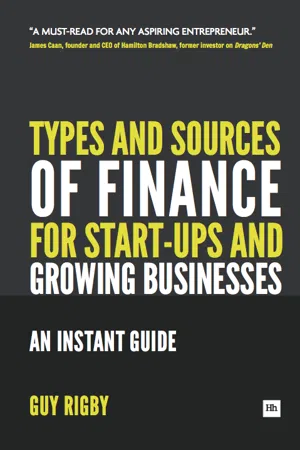
This eBook is about types and sources of finance for start-up and growing businesses.The author of this instant guide from Harriman House, Guy Rigby, has also written From Vision to Exit, which is a complete entrepreneurs' guide to setting up, running and passing on or selling a business.
eBook - ePub
Types and Sources of Finance for Start-up and Growing Businesses
An Instant Guide
- 20 pages
- English
- ePUB (mobile friendly)
- Available on iOS & Android
eBook - ePub
About this book
Information
Subtopic
Business GeneralIndex
BusinessTypes and Sources of Finance for Start-up and Growing Businesses
“Money often costs too much.”
— Ralph Waldo Emerson
Show me the money
There is more to life than equity. Businesses will normally have access to a variety of different types and sources of finance. The trick is in learning to combine these to create financial stability and maximise shareholder returns.
It may seem counter-intuitive but, in a successful business, external equity is likely to be the most expensive source of finance. It will ultimately create value for the investor far in excess of that available from deposits or similar investments and will deprive the founder of this value. From the founder’s perspective, this may represent a significant and unwelcome opportunity cost.
In addition, using equity as a sole means of funding may reduce risk but it will also reduce returns. Take the example of an investor who buys for £100 and sells for £150 – a good return of 50%. Now consider the same situation, but imagine that £75 of the investor’s original investment is borrowed, leaving only £25 as the equity investment. Ignoring the interest cost on the borrowing which, admittedly, is an over simplistic approach, the equity of £25 becomes equity of £75 (i.e. £150 - £75). In this case the investor’s equity return rises to 200%, a far more satisfying result.
This is known as the gearing or leverage effect, where non-equity funding can be used to boost equity returns.
In practice, lenders will not make unlimited loans, so the ability to gear the equity with borrowings will be dictated by market conditions and the assets or cash flows available to secure or service them. In addition, businesses that are highly geared (i.e. those with large borrowings in relation to their equity) are more likely to face difficulties in the event of a slowdown in demand or an unexpected loss.
As always, it’s a question of balance. The equity, which is the fixed capital of the business, needs to be sufficient to support the business after all other factors have been taken into account, with sufficient headroom to weather unexpected storms, should these occur.
One well-established principle is that a business should not borrow short to invest long – for example, the use of an overdraft facility that is repayable on demand to finance property or equipment that will be used by a business over many years. If the overdraft is called in, it may be difficult to realise the assets or secure alternative finance, potentially causing the business to commit the ultimate sin – running out of cash.
“Trying to fund growth in the long term using short-term finance is not going to work,” says David Molian of Cranfield School of Management. “Historically too many businesses have relied on short-term debt funding, principally overdraft arrangements from their bank, which are liable to be vulnerable in recessionary periods.”
There are four main financing options: equity, debt, sales and asset financing. All of these, bar equity, involve the business taking on borrowings. In practice, most businesses will use a number of different sources over time.
Financing options
TYPE: Debt or equity
SOURCE: Friends and family
Many businesses start with funding from friends or family, aka the ‘Bank of Friends’ or the ‘Bank of Mum & Dad’. In practice, this will often be the cheapest and easiest route to gaining early stage funding, with loans often being made on a low interest or even an interest-free basis. This is not to be confused with commercial funding.
In some cases, friends or family may consider getting involved or becoming ‘sleeping partners’ in the business by making loans or investing their money in return for equity. If they invest on this more formal basis, it’s wise to set up a proper loan and/or shareholders’ agreement to avoid the potential for any disputes later on. Remember that using your friends or family to finance your business can often affect personal relationships if the business fails or if the value of the loan or equity investment goes down.
Notwithstanding the potential difficulties, friends and family are a hugely important and growing source of funding. “It’s much easier to ask family or friends to write out a cheque for ten or twenty thousand pounds than trying to find the money elsewhere,” says Seb Bishop, founder of Espotting.
TYPE: Debt or asset-based finance
SOURCE: The bank
Banks represent the traditional and biggest source of finance for businesses. They are not venture capitalists but, in the good times, they can behave quite generously, often taking on risk that goes beyond the available security or lending on an unsecured basis against anticipated cash flows. In the bad times, they revert to a more cautious and measured approach. It’s worth remembering this in case the environment changes at a time when you are over-exposed. The often used, and sometimes unfair, analogy is that banks are very happy to lend you an umbrella when the sun is shining, but they may want it back when it starts to rain!
Because a bank’s primary function is to lend money and because of the wide array of facilities they can offer, it’s often worth approaching...
Table of contents
- Cover
- Publishing details
- Praise for From Vision to Exit
- About the Author
- Preface
- Types and Sources of Finance for Start-up and Growing Businesses
- From Vision to Exit
- Other Business eBooks From Harriman House
Trusted by 375,005 students
Access to over 1.5 million titles for a fair monthly price.
Study more efficiently using our study tools.
Frequently asked questions
Yes, you can cancel anytime from the Subscription tab in your account settings on the Perlego website. Your subscription will stay active until the end of your current billing period. Learn how to cancel your subscription
No, books cannot be downloaded as external files, such as PDFs, for use outside of Perlego. However, you can download books within the Perlego app for offline reading on mobile or tablet. Learn how to download books offline
Perlego offers two plans: Essential and Complete
- Essential is ideal for learners and professionals who enjoy exploring a wide range of subjects. Access the Essential Library with 800,000+ trusted titles and best-sellers across business, personal growth, and the humanities. Includes unlimited reading time and Standard Read Aloud voice.
- Complete: Perfect for advanced learners and researchers needing full, unrestricted access. Unlock 1.5M+ books across hundreds of subjects, including academic and specialized titles. The Complete Plan also includes advanced features like Premium Read Aloud and Research Assistant.
We are an online textbook subscription service, where you can get access to an entire online library for less than the price of a single book per month. With over 1.5 million books across 990+ topics, we’ve got you covered! Learn about our mission
Look out for the read-aloud symbol on your next book to see if you can listen to it. The read-aloud tool reads text aloud for you, highlighting the text as it is being read. You can pause it, speed it up and slow it down. Learn more about Read Aloud
Yes! You can use the Perlego app on both iOS and Android devices to read anytime, anywhere — even offline. Perfect for commutes or when you’re on the go.
Please note we cannot support devices running on iOS 13 and Android 7 or earlier. Learn more about using the app
Please note we cannot support devices running on iOS 13 and Android 7 or earlier. Learn more about using the app
Yes, you can access Types and Sources of Finance for Start-up and Growing Businesses by Guy Rigby in PDF and/or ePUB format, as well as other popular books in Business & Business General. We have over 1.5 million books available in our catalogue for you to explore.