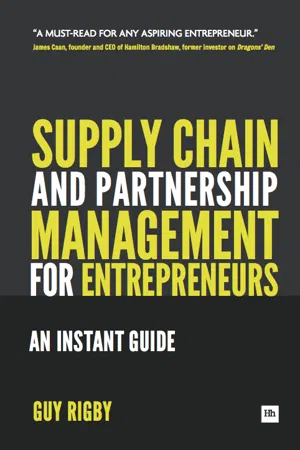
This eBook is about supply chain and partnership management for entrepreneurs.The author of this instant guide from Harriman House, Guy Rigby, has also written From Vision to Exit, which is a complete entrepreneurs' guide to setting up, running and passing on or selling a business.
- 20 pages
- English
- ePUB (mobile friendly)
- Available on iOS & Android
eBook - ePub
About this book
Trusted by 375,005 students
Access to over 1.5 million titles for a fair monthly price.
Study more efficiently using our study tools.
Information
Subtopic
Business GeneralIndex
BusinessSupply Chain and Partnership Management for Entrepreneurs
“Success in the modern world depends on the real connections you have.”
— Reid Hoffman, founder and CEO, LinkedIn
Collaborate to accumulate
The road to growth is paved with partnerships – successful businesses rarely operate alone. They collaborate with other businesses and people within and outside their supply chains to establish mutually beneficial alliances. They do this because they know that partnering can leverage their own competencies and those of others to help propel their growth.
Strategic alliances are nothing new. Accenture, the management consultancy, says that Fortune 500 companies have an average of 50–70 alliances each. In this chapter, we’ll examine how to work with alliance partners and build robust relationships with suppliers in order to improve your efficiency, productivity and results.
Collaboration is a watchword for the 21st century. We have discovered that working together and engaging with complementary, non-competing businesses is always more powerful than working alone – we collaborate to accumulate.
As Neal Gandhi points out in his book, Born Global: “It’s no longer a case of working with someone from a different department to create something innovative or high quality. It’s about opening our doors to working with people and organisations outside the four walls of our traditional HQs, from different corners of the globe. That’s how value is created in today’s economy – through collaborative networks that provide more access to talent, skills, knowledge, information and ideas. Sharing opens up a wider resource pool.”
Network thinking
Thomas and Penny Power are the founders of Ecademy, an online business network for entrepreneurs and small business owners. They talk about the difference between ‘institutional thinking’ and ‘network thinking’. The former, which is ‘closed, selective and controlling’ is bumping up against the latter, which is ‘open, random and supportive’.
They accept that both styles are required, depending on the situation and scenario, but say that network thinking is gaining ground against institutional thinking, with its evolution presenting real challenges to executives in both large and small organisations.
For me, network thinking is all about collaboration. If you are open to sharing and collaboration, you can create a community that is more engaged and inclusive, more active and participatory. In the online age, it won’t pay to hide yourself away.
There are many businesses that are fearful of adopting a network approach. They are worried about giving away their trade secrets or losing their competitive advantage. In most cases, they are wrong. If they won’t collaborate with their customers, suppliers, distributors and others, their competitors surely will.
“Growing up, the world was defined by the conflict between a democratic, free-market West, and a totalitarian, command-economy East,” says Jasper Westaway, CEO of software collaboration platform oneDrum. “Most companies persist with an industrial age model that resembles the latter and not an information age model that favours the former. We are by default closed [and that means] we are closed to success,” he continues. “In practice, organisations never fail because they are too open; they fail because they are too closed.”
Take the Body Shop, for example. A great deal of its success comes down to the strength of its partnerships at every level and its ability to build strong relationships with all of its stakeholders. These include suppliers (fair trade cooperatives), others in its supply chain (NGOs and charities) as well as its distributors (retail partners and ‘at home’ consultants), all of whom champion the Body Shop’s causes.
Other companies, ...
Table of contents
- Cover
- Publishing details
- Praise for From Vision to Exit
- About the Author
- Preface
- Supply Chain and Partnership Management for Entrepreneurs
- From Vision to Exit
- Other Business eBooks From Harriman House
Frequently asked questions
Yes, you can cancel anytime from the Subscription tab in your account settings on the Perlego website. Your subscription will stay active until the end of your current billing period. Learn how to cancel your subscription
No, books cannot be downloaded as external files, such as PDFs, for use outside of Perlego. However, you can download books within the Perlego app for offline reading on mobile or tablet. Learn how to download books offline
Perlego offers two plans: Essential and Complete
- Essential is ideal for learners and professionals who enjoy exploring a wide range of subjects. Access the Essential Library with 800,000+ trusted titles and best-sellers across business, personal growth, and the humanities. Includes unlimited reading time and Standard Read Aloud voice.
- Complete: Perfect for advanced learners and researchers needing full, unrestricted access. Unlock 1.5M+ books across hundreds of subjects, including academic and specialized titles. The Complete Plan also includes advanced features like Premium Read Aloud and Research Assistant.
We are an online textbook subscription service, where you can get access to an entire online library for less than the price of a single book per month. With over 1.5 million books across 990+ topics, we’ve got you covered! Learn about our mission
Look out for the read-aloud symbol on your next book to see if you can listen to it. The read-aloud tool reads text aloud for you, highlighting the text as it is being read. You can pause it, speed it up and slow it down. Learn more about Read Aloud
Yes! You can use the Perlego app on both iOS and Android devices to read anytime, anywhere — even offline. Perfect for commutes or when you’re on the go.
Please note we cannot support devices running on iOS 13 and Android 7 or earlier. Learn more about using the app
Please note we cannot support devices running on iOS 13 and Android 7 or earlier. Learn more about using the app
Yes, you can access Supply Chain and Partnership Management for Entrepreneurs by Guy Rigby in PDF and/or ePUB format, as well as other popular books in Business & Business General. We have over 1.5 million books available in our catalogue for you to explore.