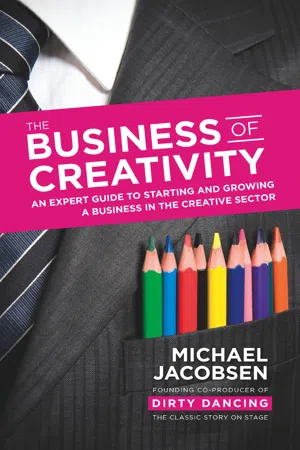
Would you like to earn a living following your creative passion and doing what you love every day? This book will show you how.In The Business of Creativity, Michael Jacobsen draws on his rich experience of owning and operating global entertainment businesses to provide the practical guidance that creative start-ups need to get going.His two key mantras are that each business needs a vision, mission and values, and that the route to success is to observe those who have been successful in your sector and to model their approach. As well as explaining exactly how to do this, he covers the business essentials that all creative entrepreneurs need to consider.The creative sector is worth £36bn a year to the British economy; it is big business and the opportunity is there for entrepreneurs in creative industries to start up and build successful businesses. But bridging the gap between creativity and commerce can be difficult - some see a conflict between artistic integrity and a profit motive, and how exactly do you take your spare room creative enterprise to the next level?In this book Jacobsen looks at:- what foundations to put in place to get your business started- how to set up and grow your business- sources of funding and tips for organising business finances- what angels and other investors will look for- where to find support- the psychology of business success.There are also numerous case studies from successful creative businesses of all sizes and wisdom from high-profile businesspeople operating in the creative sector.This straight-talking business guide is packed with actionable advice and essential tips to give you everything you need to start and grow your creative business.
eBook - ePub
The Business of Creativity
An expert guide to starting and growing a business in the creative sector
- 230 pages
- English
- ePUB (mobile friendly)
- Available on iOS & Android
eBook - ePub
The Business of Creativity
An expert guide to starting and growing a business in the creative sector
About this book
Trusted by 375,005 students
Access to over 1.5 million titles for a fair monthly price.
Study more efficiently using our study tools.
Information
CHAPTER 1: Curtain Up, Getting Started In Business
The Ingredients for Success
One of the things I am constantly witnessing is how obscure the path seems to be for entrepreneurs wanting to get into business in the creative industries. It is often opaque at best. Many creative entrepreneurs therefore understandably struggle to work out where to begin when aiming to turn their burning passion into a commercial start up.
As a consultant and mentor for creative sector businesses and entrepreneurs this is the No. 1 question I see from creative start ups – “Where do I start?” The other two key issues I see are concerns over finance (“I don’t have any money, I can’t start a business!”) and an overall lack of knowledge about business structure.
Creative sector businesses are unique in that often they are synonymous with their founder. Look at Sir Paul Smith and his eponymous fashion chain; The X Factor and Simon Cowell are inextricably linked; and where the man Steven Spielberg and the brand Steven Spielberg diverge is impossible to tell.
For this reason, it is more important than ever to ensure good business principles are enshrined. In that way the entrepreneur can be the person and the commercial business. If you don’t do this, you will always own a job, not a business.
So, having a clear vision and mission is the key starting point.
I have put together a full checklist for you to look at and refer to as often as you can, to ensure that you are laying the foundation for your creative business from day one. See how would you rate your own feelings on each one of these.
Checklist of ingredients for success
- A clear vision for the company.
- A clear mission (how you are going to implement your vision).
- A clear set of values (this underscores the integrity of your brand).
- A clear plan for the next 120 days laying out what you need to do day by day to get your business into shape. Make a brain dump and put timings around it with milestones. Easy!
- Engage with a coach, mentor or good friend who has business savvy. Someone you can bounce ideas off and who can elevate you. This is what works for athletes and performers.
- Know who your customer is and what needs they have that your business will fulfil. For example, if you are a jazz singer looking to do backing vocals, you are a freelancer and your customers may be TV producers, session bands or even touring bands who are auditioning backing singers.
- Know your unique selling point (USP). With creative businesses, the USP is often the very gift or skill of the creative individual: the singing skills (talent) of the freelance backing singer; the sculpting skills (talent) of the craft store owner; or the graphic and design skills (talent) of the small production house owner. USP is not just a unique selling point, however. USP is hooked into the need of your customer. Charles Revson, the legendary founder of the Revlon makeup company, said his USP was hope. He believed he was selling hope, rather than products, that would make his customers beautiful. Think about this and the oblique but smart logic behind his thoughts.
- Understand basic marketing and how this is relevant to your offering. So, for example, if you are a videographer looking to freelance at weddings is your marketing just word of mouth? No! Marketing is your product, that is the quality of your work; the price you charge; how you deliver yourself; and promotion. It is product, price, place and promotion – the 4 Ps. Understand them and base your marketing plan around them. It is a common misconception that marketing is only promotion.
- Have an understanding of basic business structure. If you are a freelancer, are you a company or a sole trader? Are you registered for VAT or do you fall below the threshold? If you set up a quick and easy structure now it could cause you problems later as the business launches on a growth trajectory. The creative sector is full of freelancers and small businesses, so sole traders are common, but you need advice on what structure fits you, your goal and your personal circumstances. This may make your eyes glaze over, but it is integral to ensuring your business is structured for commercial protection and success.
- Financials. You need an understanding of how you are going to make money if you are looking to commercialise your creativity. You don’t need to be a financial expert as there are many resources available to help you. We will cover this in greater detail later.

Run through the list and see how much progress you can make. If you address each of the points above, you will have a sufficient business plan to make a start.
A Sound Footing for Your Business
How do you put your business on the right footing for growth from the very beginning, to give yourself the best chance of becoming that next great creative entrepreneur? How do you become the Simon Cowell, Sir Paul Smith or Sir Terence Conran of your niche?
There are three key prerequisites to growing your start up creative business from day 1 that don’t involve balance sheets, business plans or complex modelling systems. I will look at these now.
1. Have courage in your vision
I repeatedly find the same things lacking in companies that are struggling to grow; it is a psychological impediment related to a lack of courage. From our early lives, there is a lot of negativity surrounding feelings of uncertainty or being mistaken about something. We then lack the courage to attempt new or unusual ventures. This leads to a collective, subconscious lack of courage in society, resulting in an anxiety that prevents individuals from starting businesses, or holding back their growth if they do.
You need to have a belief in your vision. If you don’t even have a vision yet, you don’t have anything to believe in. So you need one.
We all know people who are going to start a business one day, marketing their crafts or putting their videographer skills into commercial practice at weddings and functions, but they never do. They are talkers, but they lack courage. They also lack clarity. I happen to believe that never starting is more of a failure than starting and falling short.
Did Simon Cowell lack the courage to rebuild a business when he was broke 15 years ago and had to move back in with his parents? No. He had the courage to start again and build the empire he presides over today.
So write down your vision – your foundation – own it, and espouse it everywhere you go. This vision brings you clarity and manifests your dream day by day, giving you courage that this is not just a dream but a real business concept and a potentially commercial reality.
2. Assess the need
I often read questions such as “What is the magic formula for knowing if my product or creative business concept will be a success?”
This can be addressed by asking “What is the need?” and “Do you have the desire and the heart to serve that need?”
If there is no immediate or visible need for your product, that doesn’t necessarily preclude it. Ten years ago who knew we needed iPhones and iPads? No one except Steve Jobs who, as we know, saw the need and made people realise they had that need. He educated through clever marketing that tapped into basic desires.
Do you want to serve a need?
Do you know what need you are serving?
If you answer yes to both, you have a solid business foundation.
3. Coach, mentor or friend
Most successful creative sector entrepreneurs have someone to engage with, someone who they bounce ideas off and from whom they can obtain an objective opinion. It’s what all successful people in the world do, across all fields, not only the creative sector.
Who has ever heard of an athlete winning a race without a coach or training, or an actor in Hollywood or on the West End stage without a director and a team beside him or her, and who doesn’t do rehearsals?
Success doesn’t come in those fields without mentoring, coaching and support, and it won’t come without them in business either. You need a mentor who can provide you with clear, objective counsel and train your business skills and personal mindset.
Businesses are spoilt for choice in the UK as there are so many places to turn for help. Whatever your budget, even if it is nonexistent, there is help in the form of mentors and coaches, and even objective family and friends.
Obtaining advice and filling the gaps in your own knowledge strengthens your mindset and business skill base. Strengthening your mindset and business skill base trains you for success.
Thirty7 Productions
Thirty7 Productions is an independent theatre, film and media production company headquartered in London, with production offices in Cardiff and Los Angeles. I...
Table of contents
- Cover
- Publishing details
- About the author
- Preface
- Introduction
- CHAPTER 1: Curtain Up, Getting Started In Business
- CHAPTER 2: How To Set Up Your Business
- CHAPTER 3: How To Grow Your Business
- CHAPTER 4: Finance And Funding
- CHAPTER 5: where to find support
- CHAPTER 6: psychological mastery
- CHAPTER 7: What To Do Next
- CHAPTER 8: Famous British Success Stories
- CHAPTER 9: Words Of Wisdom
- Next Steps
- Concluding Thoughts
- Business books from Harriman House
Frequently asked questions
Yes, you can cancel anytime from the Subscription tab in your account settings on the Perlego website. Your subscription will stay active until the end of your current billing period. Learn how to cancel your subscription
No, books cannot be downloaded as external files, such as PDFs, for use outside of Perlego. However, you can download books within the Perlego app for offline reading on mobile or tablet. Learn how to download books offline
Perlego offers two plans: Essential and Complete
- Essential is ideal for learners and professionals who enjoy exploring a wide range of subjects. Access the Essential Library with 800,000+ trusted titles and best-sellers across business, personal growth, and the humanities. Includes unlimited reading time and Standard Read Aloud voice.
- Complete: Perfect for advanced learners and researchers needing full, unrestricted access. Unlock 1.5M+ books across hundreds of subjects, including academic and specialized titles. The Complete Plan also includes advanced features like Premium Read Aloud and Research Assistant.
We are an online textbook subscription service, where you can get access to an entire online library for less than the price of a single book per month. With over 1.5 million books across 990+ topics, we’ve got you covered! Learn about our mission
Look out for the read-aloud symbol on your next book to see if you can listen to it. The read-aloud tool reads text aloud for you, highlighting the text as it is being read. You can pause it, speed it up and slow it down. Learn more about Read Aloud
Yes! You can use the Perlego app on both iOS and Android devices to read anytime, anywhere — even offline. Perfect for commutes or when you’re on the go.
Please note we cannot support devices running on iOS 13 and Android 7 or earlier. Learn more about using the app
Please note we cannot support devices running on iOS 13 and Android 7 or earlier. Learn more about using the app
Yes, you can access The Business of Creativity by Michael Jacobsen in PDF and/or ePUB format, as well as other popular books in Business & Entrepreneurship. We have over 1.5 million books available in our catalogue for you to explore.