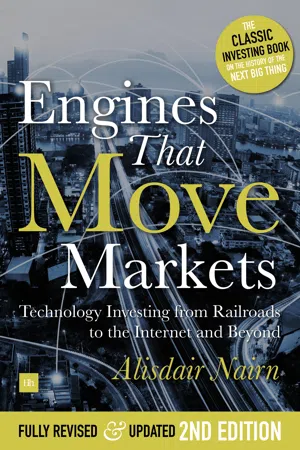
eBook - ePub
Engines That Move Markets
Technology Investing from Railroads to the Internet and Beyond
- English
- ePUB (mobile friendly)
- Available on iOS & Android
eBook - ePub
Engines That Move Markets
Technology Investing from Railroads to the Internet and Beyond
About this book
Find the most lucrative markets of the future by looking to the past
Some of the biggest technological innovations in the world have followed similar market and social patterns - scepticism is replaced by enthusiasm; venture capital is supplied; many companies are started and their stocks rise. But as the technology is developed and financial reality sets in, companies disappear, stocks collapse, and naive investors lose money.
Through exhaustive research, Alasdair Nairn captures this pattern and examines the impact that some of the greatest technological inventions of the past 200 years have had on financial markets and investors' fortunes. Each chapter explores a different technological innovation, and provides valuable insights on how to apply these lessons to appraise the 'new technology' companies of the future.
Some of the key historical episodes examined include:
- electric light and its commercial exploitation
- the railway boom in Britain and the United States
- the development of the automobile industry
- the discovery and early development of crude oil
- the rise of the PC
- the wireless world
- the Internet and dotcom bubble.
Don't be left behind when the next technological innovation revolutionises the market. With Engines That Move Markets you'll learn how to recognise the familiar patterns unfolding in today's economy so you can profit from these market-shaping events.
Read an extract of the book on Biblet https://b2l.bz/jcCSeR
Key takeaways
AI-Generated Insights
Insight 1
Analyze the recurring market and social patterns that characterize the lifecycle of major technological innovations, from initial skepticism to market bubbles and subsequent consolidation.
Insight 2
Assess the historical impact of significant technological advancements on financial markets and investor fortunes, including the dynamics of venture capital, stock performance, and market collapses.
Insight 3
Apply historical insights from past technological revolutions to recognize unfolding market patterns in contemporary economies and inform investment strategies for future innovations.
Information
Topic
Personal DevelopmentSubtopic
Personal FinanceForeword to the First Edition
by Sir John Templeton
by Sir John Templeton
Founder of the Templeton Investment mutual funds and of the Templeton charity foundations
There has never been a better time to be alive than today and we should count our blessings for this good fortune. I remain optimistic as to how the future will unfold – but that does not mean that one should not be careful when making investments. The river of good fortune may be flowing in our direction but we must plot a careful course through the rapids that threaten to upturn our boat. We must remain patient, flexible in our outlook and always aware that eventually all securities and assets will be priced according to their future earnings.
The impact of expectations underpinned by emotion adds up to a trend on stock markets. Those who attest to the singular nature of our current bull market – or, for that matter, any bull market – really ought to know better. The lessons of history are very clear in this regard. All bull markets come to an end, typically when people are most optimistic about the future, and they are followed by bear markets which similarly reach their conclusion when sentiment is at its most negative.
As George Santayana said, those who do not remember the past are condemned to repeat it. In this important new book, Sandy Nairn, my friend and former colleague, looks at old technologies when they were new, in order to see how they were received at the time and how events unfolded as the technology was deployed. The aim is to try and set what is happening today in the context of previous technological breakthroughs. What is unique about this book is that he has extensively researched global archives to find out what the press actually said at the time and how share prices responded. Many new technologies changed the way we live. Whether it was the railroads which opened up the Great Plains of America and helped change an emerging nation into the world’s greatest economic power in 50 years by revolutionising the transportation of goods and people; whether it was the telephone which changed communication forever; or whether it was the computer that created whole new industries – they all shared common characteristics. It is these common characteristics which Sandy has tried to highlight and place in the context of the time.
Like myself, Sandy is an investor who believes that investing in the stock market is an activity that calls for great patience and fortitude. To make superior returns the investor has to be prepared to act against the consensus and invest when sentiment is extremely negative, or, as I prefer to call it, at the point of maximum pessimism. Likewise, he must be prepared to sell when the levels of optimism are excessive.
In recent times it has become apparent that many prices for stocks have been pulled along by the increasing optimism of the longest bull market in post-war history, to the extent that their market prices are far in excess of their intrinsic worth. Hopefully the reader will understand this better by reading through the examples in this book.
Three years ago, Sandy cast around for research on the duration and magnitude of global bull and bear markets. He was surprised to find that in spite of the huge volume of investment literature, such research was not readily available. Undaunted, Sandy set about constructing his own study. The results confirmed what many value investors already knew. First, it is better to be in the market than out – over the long-term, world stock markets rise. Secondly, although on average a bull market is four times greater than bear markets, there is no set pattern that allows simple prediction of when a bull market will end.
The genesis of the book lay in Sandy’s desire to see what lessons could be learned from history – not just the statistics, but also the prevailing social attitudes. He has sifted through the archives in a bid to capture the atmosphere surrounding each new stock market boom. What were the common aspirations in early 19th-century England, or late 19th-century America? What investment opportunities generated enthusiasm?
Placing these historical market movements in context is important. It is helpful to remember that a market index is no more than the aggregate changes in prices of shares that comprise it. In order to come to an understanding of the intrinsic value of a security, the value investor’s main areas of focus should be estimated future earnings and the environment in which these companies are operating.
Hence, this book – an examination of the technological change in the context of the time. Sandy focuses on a number of economic milestones – electric light, the railroad, oil, the automobile, the telephone, the radio, the semiconductor, all of which have changed our world. In itself, the text would be engrossing enough. Sandy examines the ingenuity of the entrepreneurs of bygone years – how they struggled to develop their products and markets.
However, a striking feature of each chapter is the fact that while the patterns have not been identical in each case they have been very similar. First, a new invention is greeted with scepticism from incumbent technology and potential new investors. That scepticism is gradually replaced with enthusiasm, as businessmen come to appreciate the sales potential of the new technology. Soon, new entrants are flocking to the market, and venture capital funding is made available. Companies are started; almost all do well (in terms of share price) in the market on a tidal wave of enthusiasm. So far, so good; but as the technology begins to mature, a sense of realism sets in. Inevitably, for some, cash runs out. Companies begin to fold, only the strong survive and naive investors lose money in the huge rationalisation. Pessimism begins to pervade the marketplace and stock prices fall across the board. Eventually, the market stabilises.
This same pattern occurred with the development of the railroads, electric light, oil, the telephone, the automobile, the radio, the semiconductor. After reading Sandy Nairn’s excellent book, you may well recognise the familiar pattern unfolding once more in today’s economy. This is not something to be frightened of. Technology may have changed the world – but it has not changed human nature. To survive and prosper now requires only the same fortitude and common sense as it did 200 years ago.
john m. templeton, kt.
August 2000
introduction
Making Sense of Technology Bubbles
Purpose of the research
This book had its origins as an in-depth study of the impact that the great technological inventions of the past 200 years, from the railways to the Internet, have had on financial markets and investors’ fortunes. The research was begun in 1999, just as the great stock market bubble of 1999–2000 was coming to a head, and it seemed that any company connected with the Internet could do no wrong.
The original aim of the research was to satisfy my curiosity, as a professional investor, as to how and why new technologies can create such apparently irrational stock market bubbles. With hindsight we can see quite clearly now how the so-called TMT (technology-media-telecoms) bubble of 1999–2000 developed into the greatest of all stock market manias, just as many of us expected at the time. However, back then, living through it, it simply defied all notions of common sense or professional expertise.
As Director of Global Equity Research at Templeton Investment Management at the time, it was my job to lead the analysis of stocks for a leading international fund management house. I lost count of how many times well-paid analysts from Wall Street sought to promote this or that dot-com company – with no sales and no prospects of earnings in the foreseeable future – with a view to influencing our staff and ultimately our portfolios. The underlying message was that whether we liked it or not these stocks were something we should be adding to our list of stock buys. For this edition of the book, nearly 20 years on, it is somehow fitting that I find myself back working at Templeton. The fundamental truths of investment remain unchanged, as does the need for investment discipline and rigour.
Back in 1999 the problem was that I kept hearing: “This is the new economy, stupid. Don’t you know that things are different in the new economy?” As I scratched my head, trying to make sense of it all, this would often be followed up with the irritating phrase: “You just don’t get it, do you?” In other words: ‘It’s different this time.’ Well, I thought I did get it. My instinct was that the bubble was just that – an outbreak of collective insanity that was one day going to burst. There was no way that many of the companies being sold to investors could ever hope to make a profit, let alone justify the kind of market valuations that were placed on them at the time.
True, I was not alone in this. Many investors held a similar view. Few of them, however, were fortunate enough to work in organisations which held to their discipline during a time when the pressure to invest and maintain short-term performance was intense. In this regard I was very fortunate – I worked in an organisation where the owners were themselves long-term investors, and as such were willing to support a position if it could be logically justified. Many professional investors were not in this position and found themselves exiting the industry, ironically just when the bubble was about to burst.
One reason for that is that the incentives to participate in an emerging technology craze are so very powerful. Even in the most austere professional environment, any personal doubts about the sustainability of a high-profile momentum phenomenon tend to be swamped by the institutional imperative of grabbing a piece of the rich short-term pickings on offer. The investment business is dominated by corporations and partnerships whose internal processes are wired to echo St Augustine’s famous plea: “Lord, make me chaste – but not yet.”
At the time, with the pressure to jump on the bandwagon so intense, I had to admit that I did not know all there was to know about the new technology. The nagging doubts that I might just be missing something remained. It set me wondering: what happened in the past when new technologies with similar transforming potential had arrived on the scene? How did investors and the media react at the time? Who ended up as winners and losers from those episodes? Maybe there were lessons to be learnt that could explain what was happening with the phenomenon I was liv...
Table of contents
- Contents
- Acknowledgements
- Foreword to the First Edition by Sir John Templeton
Trusted by 375,005 students
Access to over 1.5 million titles for a fair monthly price.
Study more efficiently using our study tools.
Frequently asked questions
Yes, you can cancel anytime from the Subscription tab in your account settings on the Perlego website. Your subscription will stay active until the end of your current billing period. Learn how to cancel your subscription
No, books cannot be downloaded as external files, such as PDFs, for use outside of Perlego. However, you can download books within the Perlego app for offline reading on mobile or tablet. Learn how to download books offline
Perlego offers two plans: Essential and Complete
- Essential is ideal for learners and professionals who enjoy exploring a wide range of subjects. Access the Essential Library with 800,000+ trusted titles and best-sellers across business, personal growth, and the humanities. Includes unlimited reading time and Standard Read Aloud voice.
- Complete: Perfect for advanced learners and researchers needing full, unrestricted access. Unlock 1.5M+ books across hundreds of subjects, including academic and specialized titles. The Complete Plan also includes advanced features like Premium Read Aloud and Research Assistant.
We are an online textbook subscription service, where you can get access to an entire online library for less than the price of a single book per month. With over 1.5 million books across 990+ topics, we’ve got you covered! Learn about our mission
Look out for the read-aloud symbol on your next book to see if you can listen to it. The read-aloud tool reads text aloud for you, highlighting the text as it is being read. You can pause it, speed it up and slow it down. Learn more about Read Aloud
Yes! You can use the Perlego app on both iOS and Android devices to read anytime, anywhere — even offline. Perfect for commutes or when you’re on the go.
Please note we cannot support devices running on iOS 13 and Android 7 or earlier. Learn more about using the app
Please note we cannot support devices running on iOS 13 and Android 7 or earlier. Learn more about using the app
Yes, you can access Engines That Move Markets by Alasdair Nairn in PDF and/or ePUB format, as well as other popular books in Personal Development & Personal Finance. We have over 1.5 million books available in our catalogue for you to explore.