eBook - ePub
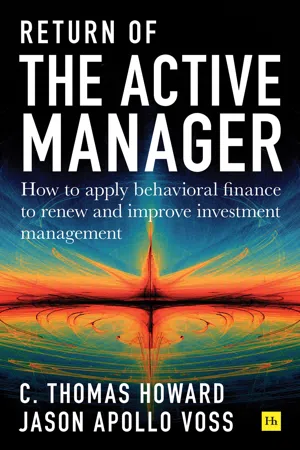
Return of the Active Manager
How to apply behavioral finance to renew and improve investment management
- English
- ePUB (mobile friendly)
- Available on iOS & Android
eBook - ePub
Return of the Active Manager
How to apply behavioral finance to renew and improve investment management
About this book
Emotional behavior and biases run throughout financial markets. This is the diagnosis of behavioral finance.
But it is not enough to know that investors make biased decisions. What do we do about it? How do we move beyond diagnosis, to prescription?
In this groundbreaking new book, investing and behavioural finance experts Thomas Howard and Jason A. Voss plug this void and show the new way ahead for investment managers and advisors. Return of the Active Manager provides a set of tools for investment professionals to overcome and take advantage of behavioral biases.
Across seven compelling chapters, Return of the Active Manager details actionable advice on topics such as behaviourally-enhanced fundamental analysis, active equity fund evaluation and selection, harnessing big data, and investment firm structure. You learn how to exploit behavioural price distortions, how to recognise and avoid behavioural biases (in both yourself and clients), how to extract behavioral insights from the executives of prospective investments, and how manager behaviour can be used to predict future fund performance.
An indispensable tool, Return of the Active Manager rationalises the financial markets and prescribes actionable strategies that build on the lessons of behavioural finance.
Information
Chapter 1. Behavioral Financial Markets
At a crossroads
Bruce Bennett was at a crossroads. He was well on his way to becoming a respected investment consultant, a profession in which it was thought difficult for investment managers to consistently beat their benchmarks. But he kept coming across investing strategies that were beating benchmarks, and by wide margins. This was unsettling as these superior returns were not being arbitraged away over time. He thought, ‘How could this be in light of the widely-held belief of informationally-efficient markets?’
Most recent was Bruce’s discovery of a strategy named Profiting from Media Outrage created by Dr. Richard Peterson, who developed Thomson Reuters’ MarketPsych Indices.24 Peterson and his team’s simple strategy held the 20 stocks most scorned by social media and the press. Each stock was chosen using objective criteria, held for a year, and featured monthly trading. In defiance of the efficient market hypothesis, the strategy beat the S&P 500 in all but two years from 1999 through early 2018, besting the broad market by an average of over 10% annually. Bruce found himself again asking, ‘How could this be?’
Straightforward yet emotionally difficult
Bruce observed that many of the most successful strategies, including Peterson’s, were straightforward, yet crucially they were also emotionally difficult to implement. He concluded such strategies were likely to continue working because they were based on the collective emotions of investors, and he was aware that people rarely alter their behavior. Another crucial factor to successful implementation required decision-making immune to the very emotional behaviors creating the alpha opportunities in the first place. In other words, implementation was emotionally challenging for the manager.
As Bruce thought about how to encourage pursuit of successful strategies for the benefit of the investing public, it slowly dawned on him that the techniques he and his fellow investment consultants used to select and evaluate managers discouraged investment teams from pursuing profitable strategies.
It turns out asking managers to minimize style drift, tracking error, volatility, and drawdown encouraged investment teams to react in lockstep with the emotional crowds, thus negating the possibility for outperformance. Bruce recognized that each of these represent an emotional trigger for investors and by minimizing them, the fund was catering to investor emotions. The problem is that each is also characteristic of successful active management, as it is necessary to differ from the benchmark in order to beat the benchmark. Minimizing these portfolio characteristics is the path to closet indexing.
Bruce thought to himself, ‘Don’t I want to encourage rather than discourage superior performance?’ Before addressing this question, he needed a new conceptual market framework on which he could build a new approach. Bruce was convinced that he must first accept markets as they are – irrational, and thus full of opportunities – rather than how many in the industry thought they should be – rational, and thus devoid of opportunity. But what was this better way of viewing markets?
Seeing markets as they are
“Indeed, we have to distance ourselves from the presumption that financial markets always work well and that price changes always reflect genuine information… The challenge for economists is to make this reality a better part of their models.”
— Robert Shiller in ‘From Efficient Markets Theory to Behavioral Finance’25
Professor Shiller wrote these words in 2003. Ten years later he received the 2013 Nobel Prize in Economics for his pioneering behavioral finance research, sharing the prize with Lars Peter Hansen and Eugene Fama. Naming Professor Fama as co-recipient created a Machiavellian buzz in anticipation of the award ceremony, as Shiller had described Fama’s efficient market hypothesis as “the most remarkable error in the history of economic thought.” Who says the Nobel committee doesn’t have a twisted sense of humor?
Behavioral finance received a further boost in 2017 when the Nobel Prize in Economics was awarded to Richard Thaler of the University of Chicago, also home to Fama. Thaler throughout his career has focused on the cognitive errors made by individuals and how government and business policy can be revised to nudge people to make better decisions.26
Today, behavioral finance appears everywhere in the financial services industry. Advisors are warming to the notion that behavioral coaching is important for the successful execution of a client’s financial plan. Many are concluding that such coaching should represent a significant portion of time spent with clients. And, in fact, many products are springing up to help advisors support their clients’ pursuit of rational outcomes in the face of many possible emotional stressors.
Since Shiller’s statement over 15 years ago, an avalanche of new academically-verified pricing anomalies have appeared to further challenge the notion “that price changes always reflect genuine information.” This has now gotten to the point that we must wonder if collective cognitive errors are the primary drivers of investment returns, displac...
Table of contents
- Contents
- About the Authors
- Preface
- Introduction
- Prologue. How Did We Get Here?
- Chapter 1. Behavioral Financial Markets
- Chapter 2. Prescriptions for Financial Advisors
- Chapter 3. Prescriptions for the Equity Investment Process
- Chapter 4. Prescriptions for Fundamental Analysis
- Chapter 5. Prescriptions for Manager Search
- Chapter 6. Prescriptions for Quantitative Analysis
- Chapter 7. Prescriptions for Managing the Active Investment Management Firm
- Conclusion
Trusted by 375,005 students
Access to over 1.5 million titles for a fair monthly price.
Study more efficiently using our study tools.
Frequently asked questions
Yes, you can cancel anytime from the Subscription tab in your account settings on the Perlego website. Your subscription will stay active until the end of your current billing period. Learn how to cancel your subscription
No, books cannot be downloaded as external files, such as PDFs, for use outside of Perlego. However, you can download books within the Perlego app for offline reading on mobile or tablet. Learn how to download books offline
We are an online textbook subscription service, where you can get access to an entire online library for less than the price of a single book per month. With over 1.5 million books across 990+ topics, we’ve got you covered! Learn about our mission
Look out for the read-aloud symbol on your next book to see if you can listen to it. The read-aloud tool reads text aloud for you, highlighting the text as it is being read. You can pause it, speed it up and slow it down. Learn more about Read Aloud
Yes! You can use the Perlego app on both iOS and Android devices to read anytime, anywhere — even offline. Perfect for commutes or when you’re on the go.
Please note we cannot support devices running on iOS 13 and Android 7 or earlier. Learn more about using the app
Please note we cannot support devices running on iOS 13 and Android 7 or earlier. Learn more about using the app
Yes, you can access Return of the Active Manager by C. Thomas Howard,Jason Apollo Voss in PDF and/or ePUB format, as well as other popular books in Business & Financial Accounting. We have over 1.5 million books available in our catalogue for you to explore.