- 176 pages
- English
- ePUB (mobile friendly)
- Available on iOS & Android
eBook - ePub
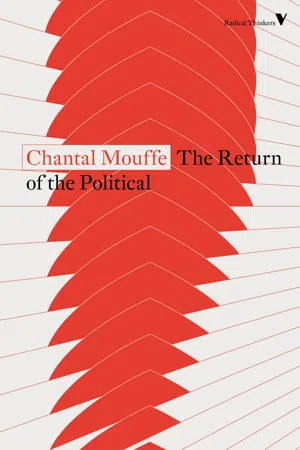
The Return of the Political
About this book
Chantal Mouffe is one of the most influential political theorists at work today. Her work has influenced political parties across Europe and continues to inform the direction of left politics. In this work, Mouffe argues that liberal democracy misunderstands the problems of ethnic, religious and nationalist conflicts because of its inadequate conception of politics.
Information
Topic
PhilosophySubtopic
Epistemology in Philosophy1
Radical Democracy:
Modern or Postmodern?
What does it mean to be on the left today? In the twilight years of the twentieth century is it in any way meaningful to invoke the Enlightenment ideals that lay behind the project of the transformation of society? We are undoubtedly living through the crisis of the Jacobin imaginary, which has, in diverse ways, characterized the revolutionary politics of the last two hundred years. It is unlikely that Marxism will recover from the blows it has suffered; not only the discredit brought upon the Soviet model by the analysis of totalitarianism, but also the challenge to class reductionism posed by the emergence of new social movements. But the fraternal enemy, the social democratic movement, is not in any better shape. It has proved incapable of addressing the new demands of recent decades, and its central achievement, the welfare state, has held up badly under attack from the right, because it has not been able to mobilize those who should have interests in defending its achievements.
As for the ideal of socialism, what seems to be in question is the very idea of progress that is bound up with the project of modernity. In this respect, discussion of the postmodern, which until now had focused on culture, has taken a political turn. Alas, the debate all too quickly petrified around a set of simplistic and sterile positions. Whereas Habermas accuses of conservatism all those who criticize the universalist ideal of the Enlightenment,1 Lyotard declares with pathos that after Auschwitz the project of modernity has been eliminated.2 Richard Rorty rightly remarks that one finds on both sides an illegitimate assimilation of the political project of the Enlightenment and its epistemological aspects. This is why Lyotard finds it necessary to abandon political liberalism in order to avoid a universalist philosophy, whereas Habermas, who wants to defend liberalism, holds on, despite all of its problems, to this universalist philosophy.3 Habermas indeed believes that the emergence of universalist forms of morality and law is the expression of an irreversible collective process of learning, and that to reject this implies a rejection of modernity, undermining the very foundations of democracy’s existence. Rorty invites us to consider Blumenberg’s distinction, in The Legitimacy of the Modern Age, between two aspects of the Enlightenment, that of ‘self-assertion’ (which can be identified with the political project) and that of ‘self-foundation’ (the epistemological project). Once we acknowledge that there is no necessary relation between these two aspects, we are in the position of being able to defend the political project while abandoning the notion that it must be based on a specific form of rationality.
Rorty’s position, however, is problematic because of his identification of the political project of modernity with a vague concept of ‘liberalism’ which includes both capitalism and democracy. For, at the heart of the very concept of political modernity, it is important to distinguish two traditions, liberal and democratic, both of which, as Macpherson has shown, are articulated only in the nineteenth century and are thus not necessarily related in any way. Moreover, it would be a mistake to confuse this ‘political modernity’ with ‘social modernity’, the process of modernization carried out under the growing domination of relations of capitalist production. If one fails to draw this distinction between democracy and liberalism, between political liberalism and economic liberalism; if, as Rorty does, one conflates all these notions under the term liberalism; then one is driven, under the pretext of defending modernity, to a pure and simple apology for the ‘institutions and practices of the rich North Atlantic democracies’,4 which leaves no room for a critique (not even an immanent critique) that would enable us to transform them.
Confronted by this ‘postmodernist bourgeois liberalism’ that Rorty advocates, I would like to show how the project of a ‘radical and plural democracy’, one that Ernesto Laclau and I have already sketched out in our book Hegemony and Socialist Strategy: Towards a Radical Democratic Politics,5 proposes a reformulation of the socialist project that avoids the twin pitfalls of Marxist socialism and social democracy, while providing the left with a new imaginary, an imaginary that speaks to the tradition of the great emancipatory struggles but that also takes into account recent theoretical contributions by psychoanalysis and philosophy. In effect, such a project could be defined as being both modern and postmodern. It pursues the ‘unfulfilled project of modernity’, but, unlike Habermas, we believe that there is no longer a role to be played in this project by the epistemological perspective of the Enlightenment. Although this perspective did play an important part in the emergence of democracy, it has become an obstacle in the path of understanding those new forms of politics, characteristic of our societies today, which demand to be approached from a nonessentialist perspective. Hence the necessity of using the theoretical tools elaborated by the different currents of what can be called the postmodern in philosophy and of appropriating their critique of rationalism and subjectivism.6
The Democratic Revolution
A number of different criteria have been suggested for defining modernity. They vary a great deal depending on the particular levels or features one wants to emphasize. I, for one, think that modernity must be defined at the political level, for it is there that social relations take shape and are symbolically ordered. In so far as it inaugurates a new type of society, modernity can be viewed as a decisive point of reference. In this respect the fundamental characteristic of modernity is undoubtedly the advent of the democratic revolution. As Claude Lefort has shown, this democratic revolution is at the origin of a new kind of institution of the social, in which power becomes an ‘empty place’. For this reason, modern democratic society is constituted as ‘a society in which power, law and knowledge are exposed to a radical indetermination, a society that has become the theatre of an uncontrollable adventure, so that what is instituted never becomes established, the known remains undetermined by the unknown, the present proves to be undefinable.’7 The absence of power embodied in the person of the prince and tied to a transcendental authority preempts the existence of a final guarantee or source of legitimation; society can no longer be defined as a substance having an organic identity. What remains is a society without clearly defined outlines, a social structure that is impossible to describe from the perspective of a single, or universal, point of view. It is in this way that democracy is characterized by the ‘dissolution of the markers of certainty’.8 I think that such an approach is extremely suggestive and useful because it allows us to put many of the phenomena of modern societies in a new perspective. Thus, the effects of the democratic revolution can be analysed in the arts, theory, and all aspects of culture in general, enabling one to formulate the question of the relation between modernity and postmodernity in a new and more productive way. Indeed, if one sees the democratic revolution as Lefort portrays it, as the distinctive feature of modernity, it then becomes clear that what one means when one refers to postmodernity in philosophy is a recognition of the impossibility of any ultimate foundation or final legitimation that is constitutive of the very advent of the democratic form of society and thus of modernity itself. This recognition comes after the failure of several attempts to replace the traditional foundation that lay within God or Nature with an alternative foundation lying in Man and his Reason. These attempts were doomed to failure from the start because of the radical indeterminacy that is characteristic of modern democracy. Nietzsche had already understood this when he proclaimed that the death of God was inseparable from the crisis of humanism.9
Therefore the challenge to rationalism and humanism does not imply the rejection of modernity but only the crisis of a particular project within modernity, the Enlightenment project of self-foundation. Nor does it imply that we have to abandon its political project, which is the achievement of equality and freedom for all. In order to pursue and deepen this aspect of the democratic revolution, we must ensure that the democratic project takes account of the full breadth and specificity of the democratic struggles in our times. It is here that the contribution of the so-called postmodern critique comes into its own.
How, in effect, can we hope to understand the nature of these new antagonisms if we hold on to an image of the unitary subject as the ultimate source of intelligibility of its actions? How can we grasp the multiplicity of relations of subordination that can affect an individual if we envisage social agents as homogeneous and unified entities? What characterizes the struggles of these new social movements is precisely the multiplicity of subject positions which constitute a single agent and the possibility that this multiplicity can become the site of an antagonism and thereby politicized. Hence the importance of the critique of the rationalist concept of a unitary subject, which one finds not only in post-structuralism but also in psychoanalysis, in the philosophy of language of the late Wittgenstein, and in Gadamer’s hermeneutics.
To be capable of thinking politics today, and understanding the nature of these new struggles and the diversity of social relations that the democratic revolution has yet to encompass, it is indispensable to develop a theory of the subject as a decentred, detotalized agent, a subject constructed at the point of intersection of a multiplicity of subject positions between which there exists no a priori or necessary relation and whose articulation is the result of hegemonic practices. Consequently, no identity is ever definitively established, there always being a certain degree of openness and ambiguity in the way the different subject positions are articulated. What emerges are entirely new perspectives for political action, which neither liberalism, with its idea of the individual who only pursues his or her own interest, nor Marxism, with its reduction of all subject positions to that of class, can sanction, let alone imagine.
It should be noted, then, that this new phase of the democratic revolution, while being, in its own way, a result of the democratic universalisam of the Enlightenment, also puts into question some of its assumptions. Many of these new struggles do in fact renounce any claim to universality. They show how in every assertion of universality there lies a disavowal of the particular and a refusal of specificity. Feminist criticism unmasks the particularism hiding behind those so-called universal ideals which, in fact, have always been mechanisms of exclusion. Carole Pateman, for example, has shown how classical theories of democracy were based upon the exclusion of women: ‘The idea of universal citizenship is specifically modern, and necessarily depends on the emergence of the view that all individuals are born free and equal, or are naturally free and equal to each other. No individual is naturally subordinate to another, and all must thus have public standing as citizens, that upholds their self-governing status. Individual freedom and equality also entails that government can arise only through agreement or consent. We are all taught that the “individual” is a universal category that applies to anyone or everyone, but this is not the case. “The individual” is a man.’10
The reformulation of the democratic project in terms of radical democracy requires giving up the abstract Enlightenment universalism of an undifferentiated human nature. Even though the emergence of the first theories of modern democracy and of the individual as a bearer of rights was made possible by these very concepts, they have today become a major obstacle to the future extension of the democratic revolution. The new rights that are being claimed today are the expression of differences whose importance is only now being asserted, and they are no longer rights that can be universalized. Radical democracy demands that we acknowledge difference – the particular, the multiple, the heterogeneous – in effect, everything that had been excluded by the concept of Man in the abstract. Universalism is not rejected but particularized; what is needed is a new kind of articulation between the universal and the particular.
Practical Reason: Aristotle versus Kant
This increasing dissatisfaction with the abstract universalism of the Enlightenment explains the rehabilitation of the Aristotelian concept of phronesis. This ‘ethical knowledge’, distinct from the knowledge specific to the sciences (episteme), is dependent on the ethos, the cultural and historical conditions current in the community, and implies a renunciation of all pretence to universality.11 This is a kind of rationality proper to the study of human praxis, which excludes all possibility of a ‘science’ of practice but which demands the existence of a ‘practical reason’, a region not characterized by apodictic statements, where the reasonable prevails over the demonstrable. Kant brought forth a very different notion of practical reason, one that required universality. As Ricoeur observes: ‘By elevating to the rank of supreme principle the rule of universalisation, Kant inaugurated one of the most dangerous ideas which was to prevail from Fichte to Marx; that the practical sphere was to be subject to a scientific kind of knowledge comparable to the scientific knowledge required in the theoretical sphere.’12 So, too, Gadamer criticizes Kant for having opened the way to positivism in the human sciences and considers the Aristotelian notion of phronesis to be much more adequate than the Kantian analysis of judgement to grasp the kind of relation existing between the universal and the particular in the sphere of human action.13
The development of the postempiricist philosophy of science converges with hermeneutics to challenge the positivistic model of rationality dominant in the sciences. Theorists such as Thomas Kuhn and Mary Hesse have contributed a great deal to this critique by pointing to the importance of rhetorical elements in the evolution of science. It is agreed today that we need to broaden the concept of rationality to make room for the ‘reasonable’ and the ‘plausible’ and to recognize the existence of multiple forms of rationality.
Such ideas are crucial to the concept of a radical democracy in which judgement plays a fundamental role that must be conceptualized appropriately so as to avoid the false dilemmas between, on the one hand, the existence of some universal criterion and, on the other, the rule of arbitrariness. That a question remains unanswerable by science or that it does not attain the status of a truth that can be demonstrated does not mean that a reasonable opinion cannot be formed about it or that it cannot be an opportunity for a rational choice. Hannah Arendt was absolutely right to insist that in the political sphere one finds oneself in the realm of opinion, or ‘doxa’, and not in that of truth, and that each sphere has its own criteria of validity and legitimacy.14 There are those, of course, who will argue that such a position is haunted by the spectre of relativism. But such an accusation makes sense only if one remains in the thrall of a traditional problematic which offers no alternative between objectivism and relativism.
To assert that one cannot provide an ultimate rational foundation for any given system of values does not imply that one considers all views to be equal. As Rorty notes, ‘the real issue is not between people who think one view as good as any other and people who do not. It is between people who think our culture, our purpose or institutions cannot be supported except conversationally and people who still hope for other sorts of support.’15 It is always possible to distinguish between the just and the unjust, the legitimate and the illegitimate, but this can only be done from within a given tradition, with the help of standards that this tradition provides; in fact, there is no point of view external to all tradition from which one can offer a universal judgement. Furthermore, to give up the distinction between logic and rhetoric to which the postmodern critique leads – and where it parts with Aristotle – does not mean that ‘might makes right’ or that one sinks into nihilism. To accept with Foucault that there cannot be an absolute separation between validity and power (since validity is always relative to a specific regime of truth, connected to power) does not mean that we cannot distinguish within a given regime of truth between those who respect the strategy of argumentation and its rules, and those who simply want to impose their power.
Finally, the absence of foundation ‘leaves everything as it is’, as Wittgenstein would say, and obliges us to ask the same questions in a new way. Hence the error of a certain kind of apocalyptical postmodernism which would like us to believe that we are at the threshold of a radically new epoch, characterized by drift, dissemination, and the uncontrollable play of significations. Such a view remains the captive of a rationalistic problematic, which it attempts to criticize. As has been pointed out: ‘The real mistake of the classical metaphysician was not the belief that there were metaphysical foundations, but rather the belief that somehow or other such foundations were necessary, the belief that unless there are foundations something is lost or threatened or undermined or just in question.’16
Tradition and Democratic Politics
Because of the importance it accords to the particular, to the existence of different forms of rationality, and to the role of tradition, the path of radical democracy paradoxically runs across some of the main currents of conservative thinking. One of the chief emphases of conservative thought does indeed lie in its critique of the Enlightenment’s rationalism and universalism, a critique it shares with postmodernist thought; this proximity might explain why certain postmodernists have been branded as conservative by Habermas. In fact, the affinities can be found not on the level of the political but in the fact that, unlike liberalism and Marxism, both of which are doctrines of reconciliation and mastery, conservative philosophy is predicated upon human finitude, imperfection and l...
Table of contents
- Cover Page
- Halftitle Page
- Title Page
- Copyright Page
- Contents
- Acknowledgements
- Foreword
- Introduction: For an Agonistic Pluralism
- 1. Radical Democracy: Modern or Postmodern?
- 2. American Liberalism and its Communitarian Critics
- 3. Rawls: Political Philosophy without Politics
- 4. Democratic Citizenship and the Political Community
- 5. Feminism, Citizenship and Radical Democratic Politics
- 6. Towards a Liberal Socialism
- 7. On the Articulation between Liberalism and Democracy
- 8. Pluralism and Modern Democracy: Around Carl Schmitt
- 9. Politics and the Limits of Liberalism
- Notes
- Index
Trusted by 375,005 students
Access to over 1.5 million titles for a fair monthly price.
Study more efficiently using our study tools.
Frequently asked questions
Yes, you can cancel anytime from the Subscription tab in your account settings on the Perlego website. Your subscription will stay active until the end of your current billing period. Learn how to cancel your subscription
No, books cannot be downloaded as external files, such as PDFs, for use outside of Perlego. However, you can download books within the Perlego app for offline reading on mobile or tablet. Learn how to download books offline
We are an online textbook subscription service, where you can get access to an entire online library for less than the price of a single book per month. With over 1.5 million books across 990+ topics, we’ve got you covered! Learn about our mission
Look out for the read-aloud symbol on your next book to see if you can listen to it. The read-aloud tool reads text aloud for you, highlighting the text as it is being read. You can pause it, speed it up and slow it down. Learn more about Read Aloud
Yes! You can use the Perlego app on both iOS and Android devices to read anytime, anywhere — even offline. Perfect for commutes or when you’re on the go.
Please note we cannot support devices running on iOS 13 and Android 7 or earlier. Learn more about using the app
Please note we cannot support devices running on iOS 13 and Android 7 or earlier. Learn more about using the app
Yes, you can access The Return of the Political by Chantal Mouffe in PDF and/or ePUB format, as well as other popular books in Philosophy & Epistemology in Philosophy. We have over 1.5 million books available in our catalogue for you to explore.