- 480 pages
- English
- ePUB (mobile friendly)
- Available on iOS & Android
eBook - ePub
About this book
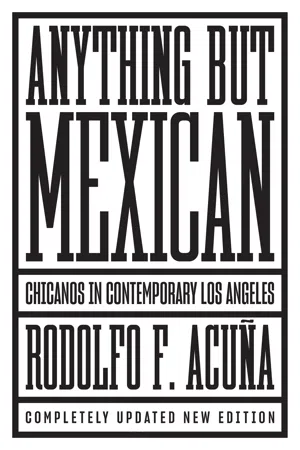
Originally published in the tumult of 1996, in an era of new nativism and panic about the Latinization of America, Anything But Mexican solidified Rodolfo Acu?a's place as "the W.E.B. Du Bois of Chicano Studies." A stirring, insightful chronicle of Los Angeles's working class chicanos, this new edition brings their story and struggles up to present day.
Information
1
“Whose America?”
__________________________
Introducing Chicano L.A.
In May 1993 I visited students staging a hunger strike on the UCLA campus. They wanted the university to establish an autonomous Chicana/o Studies department. On the way home my eight-year-old daughter, Angela, tearfully asked her mother why everyone couldn’t be the same. It was hard to be a Mexican; people didn’t like her father because he was Mexican; they didn’t give him a job because he was Mexican; and now her friends were starving because they were Mexicans. It was too hard to be Mexican! At an early age, Angela was learning that Los Angeles is a great place for Mexicans, as long as they caress their sombreros.
Although things have gotten better for the middle class, for a long time it was an insult to be a Mexican in this city. Until recently, for example, Mexican food was called “Spanish,” although it is one of the few things Mexican almost universally accepted by Euroamericans today. The neon signs at some of the most-established Mexican restaurants, like El Cholo, reputedly L.A.’s oldest, even today advertise “Spanish” food. This preference for the European reappears in L.A.’s public relations as the city fathers promote a mythical Los Angeles in which cultural borrowing and harmony are the rule. That myth includes the fantasy of a romantic “Hispanic”—read, European—past of dons and ranchos. That tradition is acceptable to Euroangelenos; the Mexican reality is not. So we find Los Angeles welcoming King Juan Carlos I and Queen Sofia of Spain to Los Angeles in October 1987.1 When I asked Bea Lavery, an aide to then Mayor Tom Bradley, what significance the trip held for Latinos, she replied: “That’s what the trip is all about.” After all, she added, “Felipe Neve discovered Los Angeles.” A statue of King Carlos III, who granted Los Angeles its first charter in 1781, was moved from MacArthur Park to El Pueblo Park for the royal visit. This allowed the king and queen to pay homage to their Bourbon ancestor in the place considered to be the city’s original center. While there, they walked Olvera Street—a piece of “Old Spain” in Los Angeles. If they so desired they could have eaten traditional “Spanish” food like tacos and tamales and listened to “Spanish” mariachi music. Totally ignored was the fact that Neve and the Spanish did not “discover” Southern California, any more than Columbus discovered America: they invaded it.
Mexican acceptability in Los Angeles varies according to the Mexican’s appearance and socioeconomic status. White Angelenos2 often stumble when asking people if they are Mexican, seeming surprised when the answer is “yes.” Almost apologetically, the questioner responds, with a smile, “Oh, you don’t look Mexican!”—as if that were some kind of compliment. Euroangelenos love French accents (they’re sexy), and Central European accents like Henry Kissinger’s (they sound so intelligent); on the other hand, they find Mexican and other Latino (or Asian) accents hard to understand. Minerva Pérez, a former KTLA-TV anchor, described how during her tenure at the station she irritated some viewers by simply pronouncing Spanish words properly, including her own name: “I got resistance to my Mexican ways from viewers and management … It took me by surprise, because I thought I was coming to a place that was mostly Hispanic. There were some very vocal people who told me to go back to Mexico.”3 Twenty years later the media has solved the problem—fewer Latinas or Latinos are hired for TV. However, the media has not solved its ignorance. As host of Oscars 2013, Seth MacFarlane made an inappropriate joke about Salma Hayek’s accent. Hayek was visibly shaken and tried very hard to enunciate her words.4
The Euroangelenos’ lack of any sense of local history makes it possible for even the most recent arrivals from the East Coast or Europe to think of themselves as more entitled, more “native,” than Chicanos or Mexicanos, even though Mexicans have lived in California for generations.5 It is difficult for Euroangelenos to fathom that they are not the only Americans, and that to call only white people “American” reflects the imperial pretensions of “manifest destiny,” which today is known as American Exceptionalism. Indeed, throughout its history Euroamerican society has almost always claimed for itself the privilege of whether or not to accept “outsiders,” and what to call them.6 Anglo-Americans gradually accepted the Irish and the immigrants from Southern and Eastern Europe; the only “unmelted ethnics” remaining in the United States are non-European and dark. Yet Euroangelenos want everyone to believe that they are open-minded, that traditional ethnic and racial biases have been left back East. They want everyone to “wannabe” Americans, and they are infuriated when people don’t “wannabe”, spitting out clichés such as “America: love it or leave it!” or smugly telling brown-skinned people to go back where they came from. A 1989 Los Angeles Times survey reported that four out of ten Euroangelenos resented seeing foreign-language signs in stores.7
They seem to want Mexicans to identify not as Mexicans but as Americans. Yet at the same time they insist on labeling all Mexicans—whether U.S.–born, legal immigrants, or undocumented—as “illegal aliens,” a term that is today’s euphemism for “wetbacks” or “greasers.” This hostility has many roots, but Euroangeleno insecurity in the face of continuing Mexican/Latino immigration is a key factor in the social and political life of Los Angeles.
Where and how Chicanas/os and Latinos live
According to the 2010 Census, the City of Los Angeles was 48.5 percent Latina/o and 28.7 percent non-Latino white. Mexicans were the largest ethnic group of Latinos with 31.9 percent of the total population, followed by Salvadorans at 6 percent and Guatemalans at 3.6 percent. African Americans scored 9.6 percent, Native Americans 0.7 percent, Asians 11.3 percent, and Pacific Islanders 0.1 percent.8 In 2016, out of L.A.’s 272 neighborhoods, eighty-seven were over 50 percent Latino. Those over 90 percent were:
| 1 | East Los Angeles | 96.7% |
| 2 | Maywood | 96.4% |
| 3 | Walnut Park | 95.4% |
| 4 | Huntington Park | 95.1% |
| 5 | Boyle Heights | 94.0% |
| 6 | Cudahy | 93.8% |
| 7 | Bell Gardens | 93.7% |
| 8 | Commerce | 93.4% |
| 9 | Vernon | 92.6% |
| 10 | South Gate | 92.1% |
| 11 | Bell | 90.7% |
| 12 | San Fernando | 89.5% |
Source: Los Angeles Times, maps.latimes.com
California became less white due to births, foreign immigration, and out-migration of whites. According to Joel Kotkin, writing in the Orange County Register in 2015, that while Los Angeles–Orange County was less white, its minorities were not doing so well. Looking at three key economic factors—income, homeownership, and self-employment—Kotkin found that LA–Orange “ranks 36th … among 52 major metropolitan areas, for African Americans, just slightly ahead of New York. Among Asians, Los Angeles–Orange ranks 36th, while the picture improves somewhat, to 32nd, for Hispanics.”9 Most new arrivals were from Mexico and Central America. Those going to Orange County were the overflow from crowded, traditional Mexican/Chicano barrios like Boyle Heights,10 East Los Angeles, and the Pico-Union district. They also moved north of the southern part of Downtown, into the five cities—Bell Gardens, Cudahy, Huntington Park, South Gate, and Maywood—that once comprised the industrial heartland of the county and were mostly white. Today those neighborhoods are over 90 percent Mexican/Latino. “From 2000–13, the Latino population of the five-county area grew by a remarkable 1.79 million. This amounted to a 27 percent increase, more than twice the overall growth rate for the region.”11
If Angelenos want to travel to the Inland Empire, aka San Bernardino, they hop on the Mexican Freeway, the 10, and drive east for sixty miles. The route has a familiar aroma of refried beans. On the advent of Proposition 187 in 1994, Xavier Hermosillo, a Republican, spoke out in defense of the immigrant community and against the Republican Party’s hyperbole, saying that Latinos are “going to take back California house by house, block by block” and exhorting non-Latinos to “wake up and smell the refried beans.”12 Today a driver can smell the beans in the San Gabriel Valley, Long Beach–South Bay and Whittier and Norwalk, all of which showed increases nearing 20 percent. By the time Angelenos arrive in Inland Empire they are ready to sit down and eat. It is here where the Mexican/Latino population is exploding. It accounted for nearly 900,000, which is more than half, of Southern California’s total growth in Latinas/os from 2000–13, a nearly 60 percent surge.13 The newcomers also pushed into South Central Los Angeles where, by the end of the 1970s, they were almost a majority—twenty years later they reached that milestone.14 Many Chicanas/os and other Latinos are concentrated in a large, inner-core area dubbed Nuevo Los Angeles. It includes the areas bounded by Hollywood, Boyle Heights, Lincoln Heights, and South Central, and is inhabited by over a million people. These solidly Latino enclaves are rapidly being gentrified. Twenty years ago this area would have been the seventh-largest city in the United States, had it been a separate city. Daily News reporters David Parrish and Beth Barrett reported that 51.5 percent of this area’s residents were not citizens, and that half did not speak English. “Culture, language, income, opportunity, and need separated them from the mainstream … Here workers, mostly immigrant women, toil 50 hours a week in garment factories to earn $200.” According to the reporters, these industries survive only because of the availability and exploitability of immigrant workers.15
The movement of the Black population out of South Central was accelerated by the deindustrialization of Los Angeles. The arrival of Mexican immigrants merely capped off the process. The demand was for Latino and Asian workers, especially women. In search of affordable housing, the immigrant moved into Koreatown, Monterey Park, and East L.A.16 “Today, immigrants from Mexico and Central America live on blocks that generations ago were the only places African Americans could live. In the former center of Black culture in Los Angeles, Spanish is often the only language heard on the streets.”17 Aside from immigrants moving into South Central, other factors drove Blacks out of the area: they included insurance companies racially redlining Blacks and police harassment. The process has had a devastating impact on the Black community, and since 1990 conservatively 80,000 Black people moved to places like the Moreno Valley. “Unemployment is high, and those who are able to secure a job typically earn little more than the minimum wage. Empty lots dot the streets, a stubborn reminder of the broken promises to rebuild the area after buildings were burned and razed in 1992.”18 Another source reported in 1992: “Among the half-million residents of South Central Los Angeles, one person in three lives in poverty. By contrast, the national poverty rate in 1989, the year covered by the Census figures, was 12.8 percent. Among California’s 29.9 million people, the rate was 12.5 percent.”19 The situation was worsened by gang problems and rivalries among gangs. There was considerable cooperation among community organizers of all races in South Central. Congresswoman Karen Bass (2011–present and formerly in the California Assembly from 2004–10) has a long history of serving African Americans and Latinas/os and was a founder of the Community Coalition.20
Another largely Latino/Mexican barrio that evolved by the 1940s was Lincoln Heights. Twenty years later, the greatest threat to the area was housing prices, which began to drive rents beyond the means of working-class people. Fox News Latino reported in February 2014,
a growing number of upwardly mobile Latinos would rather take the good and bad of Lincoln Heights than idyllic suburbs, in a trend that some refer to as “gentefication” [as in “gente,” Spanish for “people”]. This movement of Latinos returning to longstanding urban neighborhoods is most noteworthy in Los Angeles, but as the Latino population grows more educated and wealthier it is repeating itself in a variety of cities across the country, such as Houston, Phoenix, and Washington Heights, in New York City.21
The displacement process was hastened by rising property rates and the rise in median household incomes that rose from $33,235 in 2008 to $38,801 in 2012 in adjacent Boyle Heights, and from $30,579 to $33,019 in Lincoln Heights,22 making it no time for renters.23
Some Chicana/o families have lived in Nuevo Los Angeles for as many as five generations. Some remain there because they would feel out of place in other parts of the city: most remain because they like places like Pico-Union. The Pico-Union district, often called Pequeño Centro America or Nuevo Cuscatlán, lies within Nuevo Los Angeles along with Koreatown, the edge of Downtown, and Westlake.
Nearly half of the people living in selected tracts of Pico-Union came to this country in the 1980s, and slightly more than one in four were born in the United States. (In Boyle Heights, on the other hand, the ratio of 1980s immigrants to native-born was 32 percent to 40 percent—and 20 to 50 percent in selected census tracts in East Los Angeles.)24
It is in this area that the Salvadoran and Guatemala...
Table of contents
- Cover Page
- Halftitle Page
- Title Page
- Copyright Page
- Contents
- Preface: Anything But Mexican
- Acknowledgements
- Introduction to the Second Edition: The Context of Anything But Mexican
- 1. “Whose America?”: Introducing Chicano L.A.
- 2. Taking Back Chicano History
- 3. Chicanas/os in Politics: The Illusion of Inclusion
- 4. Marching Mothers
- 5. Politics for the Few
- 6. Immigration: “The Border Crossed Us”
- 7. The Politicization of the “Other”
- 8. Mexican/Latino Labor in L.A.: Working in a Meaner, Leaner World
- 9. Chicanas in Los Angeles
- 10. México Lindo and NAFTA
- 11. Troubled Angels
- 12. The Stairway to the Good Life
- Conclusion
- Notes
- Index
Trusted by 375,005 students
Access to over 1.5 million titles for a fair monthly price.
Study more efficiently using our study tools.
Frequently asked questions
Yes, you can cancel anytime from the Subscription tab in your account settings on the Perlego website. Your subscription will stay active until the end of your current billing period. Learn how to cancel your subscription
No, books cannot be downloaded as external files, such as PDFs, for use outside of Perlego. However, you can download books within the Perlego app for offline reading on mobile or tablet. Learn how to download books offline
Perlego offers two plans: Essential and Complete
- Essential is ideal for learners and professionals who enjoy exploring a wide range of subjects. Access the Essential Library with 800,000+ trusted titles and best-sellers across business, personal growth, and the humanities. Includes unlimited reading time and Standard Read Aloud voice.
- Complete: Perfect for advanced learners and researchers needing full, unrestricted access. Unlock 1.5M+ books across hundreds of subjects, including academic and specialized titles. The Complete Plan also includes advanced features like Premium Read Aloud and Research Assistant.
We are an online textbook subscription service, where you can get access to an entire online library for less than the price of a single book per month. With over 1.5 million books across 990+ topics, we’ve got you covered! Learn about our mission
Look out for the read-aloud symbol on your next book to see if you can listen to it. The read-aloud tool reads text aloud for you, highlighting the text as it is being read. You can pause it, speed it up and slow it down. Learn more about Read Aloud
Yes! You can use the Perlego app on both iOS and Android devices to read anytime, anywhere — even offline. Perfect for commutes or when you’re on the go.
Please note we cannot support devices running on iOS 13 and Android 7 or earlier. Learn more about using the app
Please note we cannot support devices running on iOS 13 and Android 7 or earlier. Learn more about using the app
Yes, you can access Anything But Mexican by Rodolfo F. Acuña in PDF and/or ePUB format, as well as other popular books in Social Sciences & Civil Rights in Politics. We have over 1.5 million books available in our catalogue for you to explore.