According to tradition, Moses wrote the first five books of the Bible. He is depicted there in a surprising way: with and against God; with and against his people; bringer of the Tablets of the Law, which he breaks; a stuttering prophet, guide to a Promised Land entry to which remains forbidden to him, and dead in an unknown tomb... Highly confusing for those who imagine a Moses carved out of a single block.
By way a series of possible portraits - including one of a female Moses - Jean-Christophe Attias follows the metamorphoses of the Hebrew liberator through ages and cultures. Drawing on rabbinical sources as well as the Bible itself, he examines the words of the texts and especially their silences. He discovers here a fragile prophet, teacher of a Judaism of the spirit, of wandering, and of incompleteness.
Receive and transmit. Listen, even when the message is confusing. Insistently question, especially when there is no answer. And always, remain free. This seems to be the Judaism of Moses. A Judaism that speaks to believers and others - to Jews, of course, but also far beyond them, inviting its hearers to have done with tribal pride, the violence of weapons, and the tyranny of a special place.
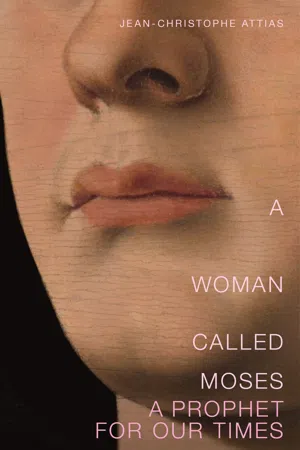
- 224 pages
- English
- ePUB (mobile friendly)
- Available on iOS & Android
eBook - ePub
About this book
Information
Subtopic
Biographie biblique1
The Prophet’s Wounded Body
I have little time for heroes. My personal pantheon is sometimes empty, sometimes overpopulated, and my enthusiasms ephemeral or changing. But one thing’s for sure: it is hard for Moses to find a place there. Other biblical characters have passed through, or even been enshrined for a spell.
Elijah, for example. So close to Moses, almost the prophet’s double, yet unquestionably a lesser figure. Why Elijah, then, rather than Moses? Because Elijah did not die, but was raised up to heaven in a whirlwind, on a chariot of fire, abandoning the mantle that had fallen from his shoulders to his disciple. Because Elijah will return, before the coming of ‘the great and dreadful day’, to ‘turn the heart of the fathers to the children, and the heart of the children to their fathers’ (Mal 4:5–6). Finally, perhaps, quite simply because Elijah was not as great as Moses and this actually enhances him in my eyes.
Readers may judge for themselves. After walking for forty days, Elijah, threatened with death by Queen Jezebel and deeply dispirited, reaches Horeb – another name for Mount Sinai – and takes refuge in a cave for the night. In the morning, the ‘word of God’ comes to him and requests him to go out and stand on the mountain. God reveals himself, just as he had to Moses centuries earlier on the same spot, but in a different and, above all, more ambiguous way: ‘a great and strong wind rent the mountains, and brake in pieces the rocks before the Lord; but the Lord was not in the wind: and after the wind an earthquake; but the Lord was not in the earthquake: And after the earthquake a fire; but the Lord was not in the fire; and after the fire a still small voice’ (I Kgs 19:11–12).1 Elijah knew that God himself could be humble.
The prophet Elijah can speak to me, and I hear him. As I hear Esther, the Jewish Queen of Persia and Media, an ordinary woman who has the courage to hesitate and then the courage to act, who changes the course of fate and saves her people from a planned extermination, in the tale to which she has given her name and where that of God – astonishing paradox – does not appear once. Elijah still makes me dream and hope a little. I can even imagine running into him one day on a street corner, as in so many popular Jewish stories. Esther too inhabits a world that resembles mine: a disenchanted world this time, where God’s name can no longer be uttered. But Moses? Immense, certainly, but brutal and remote as well. And definitely too kitsch.
Kitsch Moses
Obviously, we owe this kitsch very much to cinema. To Cecil B. DeMille, for example, and his Ten Commandments: seven months of filming, 10,000 extras, three hours and thirty-nine minutes of Technicolor.2 But it’s not only him.
We also owe it – if you’ll forgive the irreverence – to Michelangelo. Even Freud does not manage to completely redeem his work when he makes out this stone Moses to be a Moses containing his anger and refusing to destroy the Tables*, and when he sees in ‘the giant frame with its tremendous physical power’ sculpted by the Italian simply ‘a concrete expression of the highest mental achievement that is possible in a man, that of struggling successfully against an inward passion for the sake of a cause to which he has devoted himself’.3 However ‘mental’ the ‘achievement’, it remains crushing. And the muscles are always there, in the stone, and not merely as a metaphor.
The kitsch is attributable in the first instance – if you’ll forgive the blasphemy – to the Bible itself, which, even (or especially) when its language is ambiguous, always seems concerned to furnish us with garish scenes. For example, no one will ever be able to tell us for sure if the Moses who comes down the mountain transformed by his talks with God had a face that ‘shone’ or was wearing ‘horns’ (Exod 34:29).4 Both possibilities have their defenders. They are sometimes combined, and we then find Moses’s head emitting two rays … in the form of horns! This is all splendid, helping to fill (if needs be) a picture book which is already chock-full.
For the kitsch in Moses I am referring to is also due to this bric-a-brac of images. Images that are sometimes grandiose and often naive, enchanting the children we have remained but saddening the adults we have become, and which, willy-nilly, have ended up cluttering our memory and dominating our view for centuries. Here is something that ought to discourage my pen – I who have no desire, in the wake of so many others, to be the historian or analyst of a legacy which is rather too profuse, too glitzy, too rowdy.
Moses is certainly no second-rate hero, but this is not an argument in his favour. His mission, irrevocable and foundational, is imposing. He battles the despotic power of a megalomaniacal, pitiless pharaoh, and defeats him. He frees the Hebrews from slavery and provides them with a constitution, a Law dictated by God, which establishes them as a full-fledged nation and crowns their liberation. He severely punishes repeated instances of infidelity on the part of his flock, but also protects it from the excessive ire of the Almighty. For he is not afraid to oppose God himself, whose confidant he is and whom he sometimes induces to yield, bargaining for forgiveness and getting it (or less severe penalties, at least) for the recidivist rebels he is guiding through the desert. Moses leads Israel to the edge of the Promised Land, admittedly after various detours – forty years’ wandering in the sands that permits embellishment of the saga with many a picturesque episode. Mission impossible, then, but mission accomplished. Or almost, because, despite everything, it falls to his successor, Joshua, to settle the Hebrews in their land by means of conquest. Even the prophet’s death on the threshold of Canaan, far from diminishing his impressive stature, confirms and consecrates it. An exceptional Moses, certainly, but taking elegance to the point of not coming back to life at the story’s end. Others have not shown such restraint. Conclusively mortal – and all the greater for it.
The Mosaic gesture is, as it should be, spectacular. Minor and major miracles succeed one another. Above all, major ones. The minor ones are pleasing, but little more. I shall therefore not expatiate on the rod turned into a snake and vice versa (Exod 4:2–4). And for good reason: the Egyptian magicians, with whom Moses must contend in a public contest to impress Pharaoh, have apparently mastered the technique pretty well themselves (Exod 7:11). And need we linger over another wonder, over the sign God generously vouchsafes to his prophet, over Moses’s hand, which, when placed in his bosom, is covered with leprosy and then, placed there a second time, has its natural complexion restored (Exod 4:6–7)? Albeit temporary, this is a bit troubling surely? The Qur’an retains the episode while rewriting it: Moses’s hand emerges from his lap ‘white but unharmed’ (28:32). Even though this whiteness has seemed wholly miraculous to some (in a man of presumably olive complexion), and given rise to esoteric interpretations, I do not see any particular reason to linger over it. So on to the major miracles! And there is no lack of them.
Thus we might, amazed, mention the bush that burns but is not consumed, from inside which God hails his prophet. Above all, seized with dread, let us enumerate the ten plagues that strike Egypt, but spare the Hebrews: the waters of the Nile turned to blood, frogs, lice, ravening beasts, dying livestock, ulcers, hail, locusts, darkness, death of the firstborn. Columns of fire and cloud guiding the people. Crossing of the Red Sea without getting wet, followed by the wholesale drowning of the enemy pursuers. Water gushing from rocks to slake the thirsty. Nourishing manna. Quails falling from the sky in the desert. The earth ‘open[ing] her mouth, and swallow[ing]’ the renegades, thus cast ‘alive into the pit’ (Num 16:32–3). Finally, and especially, the theophany on Sinai: thunder, lightning, trumpet blast, thick cloud, fire, smoke, the mountain trembling on its base. The catalogue of wonders is almost inexhaustible, and I shall not exhaust it here. At all events, one thing is clear: the divine Director did not skimp on resources. Others were subsequently able to profit from this. It is no accident if, in 1957, Cecil B. DeMille’s biblical costume drama won a single Oscar: for special effects.
Perfect Moses
All this is grand. It is impressive. And the portrait of Moses the man – let us forget the hero with a divine mission for a moment – that emerges in the foreground of this formidable picture is commensurate with it. He is beautiful, ‘of a beauty superior to that of an ordinary man’, specifies Philo Judaeus.5 A beauty, adds the Christian Gregory of Nyssa, to which he owed his life.6 It dissuaded his birth parents from putting him to death and persuaded them to disobey Pharaoh’s orders. It is what ‘won’ the heart of his adoptive mother, Pharaoh’s daughter, when she found him drifting in his basket on the Nile. And if Moses is beautiful on the day of his birth (Exod 2:2), he remains so on the day of his death, which coincides with his 120th birthday: ‘his eye was not dim, nor his natural force abated’ (Deut 34:7).
Moses is therefore handsome, tall, and distinctly well-built. No one imagines a puny Moses. How could he play the role assigned to him? I shall not make much of his withstanding hunger and thirst. Even a weakling, provided he is sufficiently inspired by faith and has had a little training, will be able to go without bread and water – though not, perhaps, like Moses for forty days and forty nights in a row (Exod 34:28). No, this is not the kind of prowess, physical and spiritual, I have in mind, but something more trivial, more basic. The muscular strength that makes it possible, for example, for a man to descend a mountain laden with two heavy stone tablets on which God has engraved his Law; and then, in the rage provoked by discovery of the Golden Calf and the idolatrous worship his people have indulged in, to shatter these same tablets by casting them against the foot of that mountain. Anger and strength are conjoined in Moses, as they are in his God. This is the Moses glorified by Michelangelo, whatever else might have been said or written. And this is the Moses represented by Charlton Heston, as much athlete as actor.
A larger-than-life Moses: the Jewish tradition is as prone to this as others are. According to the Midrash, if the Bible takes care to inform us that the ‘child’ Moses ‘grew’ (Exod 2:10), when all children, by definition, grow, it is because he did not grow like everyone else. At the age of five, he was already an adult in intelligence, but also in size. Maybe intelligence would have been enough. But no, size had to be added to it. ‘Powerful neck’, ‘broad shoulders’, ‘arms like two hammers’ – thus, closer in time to us, is he seen by the Yiddish writer Sholem Asch (1880–1957).7 Asch continues: ‘Not a man strode here, but a giant who had fallen from heaven … Everything about him was mighty, stature, limbs, and presence; everything about him was cut more sharply, with keener and straighter lines…. The sharp aquiline nose, the great circles of his eyes resting on their cushions and sending forth a commanding, heavenly light, the modelled features – these were dominant.’8
There are few biblical figures in the text of Scripture itself who are so present in the flesh as Moses: his body, his gaze, his hand, his arms are regularly referred to. As we have seen, posterity has not squandered the opportunity to magnify the physical presence of Moses to the point of caricature. The profile of the muscular prophet has one merit at least. It is at the antipodes of another, mocked and reviled yesterday, and still sometimes today, by anti-Semites and Zionists: that of the bowed, puny, pale Jew of Exile. One may welcome it like a breath of fresh air. But there is another side to the coin. For here we have something that also distances us from the possible humanity of Moses. A Moses larger than life, supernatural, (almost) divine. Here beauty and power are in fact simply the terrestrial and corporeal expression of a celestial, spiritual perfection. The life of the ‘great’ Moses, Gregory tells us, ‘attained the extreme limit of perfection’; it can – and must – be described ‘as a vivid model of beauty’ and, by that token, offered for our imitation.9 Before him, Philo had said much the same thing: ‘like a well-fashioned painting’, Moses ‘presents himself and his life to our gaze, a work of utter beauty and divine form … a model for those who wish to imitate it’.10
Moses’s perfection: a great prophet whose like would never be seen again (Deut 34:10). A prophet, but not only that. His panegyrists will not stop there. Moses possesses all the talents and excels in each of them. King, philosopher, legislator, high priest, and so forth. And even a general, which is not the least surprising! Granted, it is Moses who, shortly after the Exodus, ensures his troops victory over the Amalekites (Amalek). He does so simply by raising his arms to heaven, stationed on a hill, while Joshua conducts the actual battle below. When his arms are lowered, Israel falters. As soon as he raises them again, Israel regains the advantage. He will finally be aided by two deputies (his brother Aaron and Hur), who will support his arms when he begins to tire (Exod 17:8–13). When, later, Israel endeavours to attack Canaan contrary to God’s express order, Moses ‘departed not out of the camp’ (Num 14:39–45). Scripture records the conquest of the northern part of Transjordan. Scarcely more. To discover a Moses who is genuinely a war leader, we need to look to extra-biblical traditions for help. Thus, Flavius Josephus* and various others place him at the head of a victorious campaign against Ethiopia, but this time on behalf of the Egyptians! His honour is thus safe: no string to Moses’s bow is wanting. This man unquestionably did everything and did it better than anyone.
Tenacious Moses
Kitsch hero or perfect, quasi-divine being – does it matter, in the end? Should we not rather see these as two sides of a counterfeit coin? This way of overdoing things ill conceals an original deficit. At all events, it inevitably induces a desire in every cynic – that is, every reasonable person – to puncture the balloon. Others before me have tried, and not without some success. In his Philosophical Dictionary two and a half centuries ago, in the article on ‘Moses’, Voltaire soberly took stock in his inimitable fashion: (1) no source outside the Bible confirms the miracles attributed to Moses in the Pentateuch; (2) the Pentateuch could not have been written by Moses; (3) moreover, Moses probably never existed … The circle is complete, that’s all there is to it. Exit Moses.
We may experience a temporary relief, but it will not last. For, however violent the historico-critical approach to Scripture invented in the West in the seventeeth century (a tradition that is probably much less ‘violent’ today than it was), it did not suffice to ‘kill off’ Moses, supposing this was what it had in mind. No, Moses is not dead. Ejected by the front door, he climbed back in through the window. If the historian’s task is, among other things, to deconstruct the facts or, via a critique of sources, the traditionally received account, to say nothing of the proliferation of subsequent developments, this deconstruction of the facts and narrative never really impinges on the terrain of what obsesses us: the imaginary. At all events, it in no wise cancels its power. That machine never runs out of fuel and never stops working. It sometimes seems to generate monsters, which are rather frightening or ridiculous. But there is probably not much we can do about that.
Almost a century and a half after the publication of the Philosophical Dictionary Ahad Ha’am*, the inspirer of what has been called ‘cultural’ Zionism, seems to me to have answered Voltaire very powerfully on this score. In 1904 he published a long article simply entitled ‘Moses’. In it he distinguished between two kinds of truth: ‘archaeological’ truth and ‘historical’ truth. In order to clearly understand what he meant, we must proceed to a transposition of terms. Ahad Ha’am’s ‘archaeological’ truth is what we would call historical truth today: the truth that can be established by the critique of sources and the science of historians. The second – which he labelled ‘historical’ – is what we would call the truth of memory or the imaginary. In his view, the latter had nothing to fear from the former. Even if scholars proved beyond a shadow of a doubt that ‘Moses the man’ never existed, or was never as taught by Tradition, the ‘ideal’ Moses – ‘our Moses’, as he calls him – would remain the central figure in the Jewish collective imaginary, the ultimate embodiment of the expectations and spirit, in its generally unaccomplished purity, of a whole people.11 A ‘hero’ is simply that, and the battering rams of science are ultimately unavailing against heroes, or pretty much so. For my part, I would add that the more tenuous the historical basis of the ideal hero, the less he has to fear from critical assault.
The ‘ideal’ Moses whose portrait is sketched by Ahad Ha’am in the remainder of his article – the figure said to permanently haunt the collective Jewish consciousness – is certainly not the multi-talented Moses we have already encountered. For starters, he is no longer a warrior. But nor is he a statesman, or even a legislator. He is fundamentally, exclusively, a prophet. And he is certainly not a priest – unlike his brother Aaron – since priests are the intermediate caste between the prophet and the world, transmitting, in an adaptive, circumstantial, contingent and degraded form, a ‘prophetic ideal’ that can ‘influence [them] to a certain exten...
Table of contents
- Cover Page
- Halftitle Page
- Title Page
- Copyright Page
- Contents
- Preface
- Note on the Translation
- Abbreviations Used for Books of the Bible
- The Life of Moses according to the Pentateuch
- 1. The Prophet’s Wounded Body
- 2. The Egyptian Woman’s Son
- 3. Journey, Night, Death
- 4. A Woman Called Moses
- 5. Divine Snares
- 6. Light and Shadow
- Conclusion
- Glossary and Biographical Notes
- Indicative Bibliography
- Acknowledgements
- Notes
- Index
Trusted by 375,005 students
Access to over 1.5 million titles for a fair monthly price.
Study more efficiently using our study tools.
Frequently asked questions
Yes, you can cancel anytime from the Subscription tab in your account settings on the Perlego website. Your subscription will stay active until the end of your current billing period. Learn how to cancel your subscription
No, books cannot be downloaded as external files, such as PDFs, for use outside of Perlego. However, you can download books within the Perlego app for offline reading on mobile or tablet. Learn how to download books offline
Perlego offers two plans: Essential and Complete
- Essential is ideal for learners and professionals who enjoy exploring a wide range of subjects. Access the Essential Library with 800,000+ trusted titles and best-sellers across business, personal growth, and the humanities. Includes unlimited reading time and Standard Read Aloud voice.
- Complete: Perfect for advanced learners and researchers needing full, unrestricted access. Unlock 1.5M+ books across hundreds of subjects, including academic and specialized titles. The Complete Plan also includes advanced features like Premium Read Aloud and Research Assistant.
We are an online textbook subscription service, where you can get access to an entire online library for less than the price of a single book per month. With over 1.5 million books across 990+ topics, we’ve got you covered! Learn about our mission
Look out for the read-aloud symbol on your next book to see if you can listen to it. The read-aloud tool reads text aloud for you, highlighting the text as it is being read. You can pause it, speed it up and slow it down. Learn more about Read Aloud
Yes! You can use the Perlego app on both iOS and Android devices to read anytime, anywhere — even offline. Perfect for commutes or when you’re on the go.
Please note we cannot support devices running on iOS 13 and Android 7 or earlier. Learn more about using the app
Please note we cannot support devices running on iOS 13 and Android 7 or earlier. Learn more about using the app
Yes, you can access A Woman Called Moses by Jean-Christophe Attias in PDF and/or ePUB format, as well as other popular books in Théologie et religion & Biographie biblique. We have over 1.5 million books available in our catalogue for you to explore.