The political ambitions of the movement behind Bernie Sanders have never been limited to winning the White House. Since Bernie first entered the presidential primaries in 2016, his supporters have worked to organize a revolution intended to encourage the active participation of millions of ordinary people in political life.
In Bigger than Bernie, activist writers Meagan Day and Micah Uetricht give us an intimate map of this movement to remake American politics top to bottom, profiling the grassroots organizers who are building something bigger, and more ambitious, than the career of any one candidate. As participants themselves, Day and Uetricht provide a serious analysis of the prospects for long-term change, offering a strategy for making "political revolution" more than just a campaign slogan. They provide a road map for how to entrench democratic socialism in the halls of power and in our own lives.
This new edition offers unmatched insights into the people behind the most unique campaign in modern American history and explores how the political revolution has been re-tooled for a time of economic crisis and pandemic.
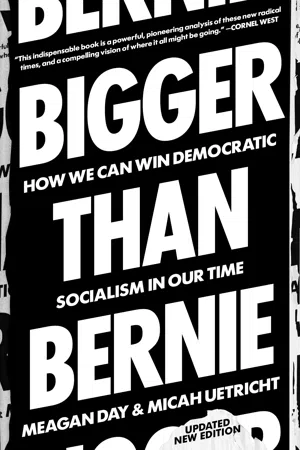
eBook - ePub
Bigger Than Bernie
How We Can Win Democratic Socialism in Our Time
- 256 pages
- English
- ePUB (mobile friendly)
- Available on iOS & Android
eBook - ePub
About this book
Information
1
The Man and the Movement
Contrary to conventional wisdom about the viability of class politics in the beating heart of global capitalism, Bernie Sanders’s rhetoric—calls for justice, equality, security, and shared prosperity in the form of free education, affordable housing, free high-quality health care, full employment, a secure retirement, and a clean environment for all—hasn’t scared off masses of people. Instead, by polarizing politics along class lines, insisting that the reason many are denied these basic rights is that wealth and resources are captured by the top of society and kept there by design, Sanders has inspired the masses: 13.2 million voted for Sanders in the Democratic Party presidential primary in 2016, and his 2020 presidential campaign broke records for individual donations and volunteers.
Even his adversaries are often forced to respond to him— some, mostly Democrats, by half-heartedly adopting his popular demands in order to appeal to a constituency that is clearly moving left on key issues like Medicare for All; others, both Republicans and Democrats, by reviving the Cold War specter of authoritarian socialism to scare people into opposing an ambitious vision for social and economic change.
Socialism is now on the tip of the nation’s tongue. In 2015, when Bernie first began running for president, it was the most-searched word on Merriam-Webster’s online dictionary. Tens of thousands have joined the Democratic Socialists of America, and millions more talk about the merits of socialism over capitalism in conversations with their friends, families, and coworkers. Democratic socialist politicians are running and winning at the local, state, and national level. The sun is rising again on the idea that capitalism cannot provide the freedom and prosperity that it promises, and that the wealth created by all belongs to all.
What’s most important about Sanders, however, isn’t the policy ideas he’s popularizing, or even his role in detoxifying the word “socialism.” Yes, Medicare for All and tuition-free college as well as full medical and student debt cancellation would transform millions of lives. Likewise, the fact that socialism is no longer anathema has opened up new possibilities in politics (and has significantly increased socialist magazine subscriptions and socialist magazine employment, for which we are both grateful). But what matters most is how Bernie has promoted the idea that nothing he or any other candidate can do in office will win the kind of change we need without a political revolution of millions of people, a mass working-class movement taking to the streets and workplaces and fighting on its own behalf.
Sanders has played an important role in sparking that movement, and demonstrated that electoral politics shouldn’t be seen as something contrary to or apart from its development. “He has absolutely infuriated the liberal establishment by committing a major crime,” said Noam Chomsky in an interview with the Intercept. “It’s not his policies. His crime was to organize an ongoing political movement that doesn’t just show up at the polls every four years and push a button, but keeps working. That’s no good. The rabble is supposed to stay home. Their job is to watch not to participate.” Sanders’s greatest contribution to American politics is that he continues to convince people that their own participation is necessary to win a better society.
If socialists had the opportunity to design the ideal scenario leading up to a viable democratic socialist presidential campaign, we would have scripted something very different. Ideally, a campaign like Sanders’s would have been the culmination of a long path paved with many smaller victories. Socialism would already be a powerful movement in electoral politics, the workplace, and civil society, and the candidate would rise organically through the ranks of this dynamic, popular, and organized movement.
Unfortunately, both socialism and working-class movements were nowhere near ascendant when Sanders first ran for president. Instead, in a strange feat of reverse-engineering that few socialists saw coming, his campaign helped revive those movements.
After decades of marginalization and defeat, US socialist politics are entering a new era. When future histories of the American socialist movement are written, Sanders will play a prominent role. How does his life fit into the broader trajectory of the American Left?
On the one hand, Bernie’s formative years aren’t that different from many people his age on the Left. Born to a Jewish immigrant family (a demographic that has played key roles in the history of the American Left), he dove headlong into the political upheavals of the 1960s, joining the civil rights and socialist movements. As those upheavals subsided, he, too, retreated momentarily—to the idyll of rural Vermont. That story tracks closely to what we hear from many fellow travelers who were young and active during the last period of American social unrest and mass agitation.
On the other hand, especially after the 1970s, Sanders has managed throughout his career to stand both outside the main currents of the socialist movement and outside the American political mainstream. He has largely walked alone, remaining politically independent of the Democratic Party and avoiding its open embrace of neoliberal policies and abandonment of the labor movement, while also carving a successful path as an elected official. We should be grateful he did; otherwise, Sanders wouldn’t have been able to hold the unique position he has held over the last four decades, culminating in his presidential runs and his contribution to the revival of socialist and working-class movements. Sanders’s unique political biography has a lot to teach us about how to weather periods of left marginalization and defeat by remaining true to leftist principles—and how to strike again when the iron’s hot.
Socialism and Sanders
Socialism has a long and storied history in the United States— never dominant, but at times popular and powerful.
Thomas Paine, one of the country’s founding fathers (and its most radical), was an ardent critic of economic inequality and rule over the many by the few. Socialism didn’t exist as an ideology in the late eighteenth century, but Paine believed in a society shaped by the ideals of democracy and equality, and even proposed the creation of proto–welfare state programs and taxing the rich. In the early nineteenth century, American utopian socialists inspired by thinkers like Robert Owen and Charles Fourier worked to create enclaves apart from society where labor was undertaken for the common good and not for profit, and where each community member had a say in the decisions that affected their lives. Those experiments didn’t have much staying power, but they were important early efforts to realize the values of socialism in the United States.
As the Industrial Revolution progressed and the world saw the rise of an industrial working class toiling in factories and mills, especially throughout Europe and the United States, Karl Marx and Friedrich Engels began writing, arguing that those workers had both the strategic power in society as well as the material self-interest to fight for and win socialism. In the second half of the nineteenth century, workers throughout the United States, many of them influenced by Marx and Engels’s theories but most simply interested in winning better lives for themselves and their families, began organizing unions to fight for dignified working conditions and fair pay—and waging some of the bloodiest battles in all of world history against bosses, police, and even soldiers.
Those battles ebbed and flowed past the turn of the twentieth century, with major strikes and union organizing kicking off in railroads, steel factories, and other industries, and even citywide general strikes like the one in Seattle in 1919. The Socialist and Communist parties also grew during this time, with the socialists electing over a thousand officials all over the country—from the “sewer socialists” who led Milwaukee, Wisconsin, for decades to two members of the US Congress.
The most prominent socialist political leader during the first decades of the twentieth century was Eugene V. Debs, whom Bernie Sanders cites as a personal hero. (Sanders made a documentary about Debs in the 1970s, and reportedly has a framed portrait of Debs in his office in Washington, DC.) Debs led militant strikes as an officer with the Brotherhood of Locomotive Firemen and Enginemen, prompting the New York Times to denounce him as “a lawbreaker at large, an enemy of the human race” in 1894. He first read the works of German socialists like Marx, Engels, and Karl Kautsky when he was imprisoned for his role in organizing a strike. Thereafter, he devoted himself to the cause not just of unionism, but of socialism.
Debs ran for president on the Socialist Party ticket five times—at his most successful in 1912, he won 6 percent of the popular vote. But Debs was steadfast in his belief that the task of the Socialist Party was not merely to win votes. It was to awaken the American working class and create an independent electoral expression of class struggle happening on the ground. “I would not lead you into the promised land if I could, because if I led you in, someone else would lead you out,” Debs said—a sentiment echoed in Sanders’s campaign slogan “Not Me, Us” over a century later. Victory for workers would remain elusive unless workers organized themselves.
In 1918, Debs was arrested for speaking out against World War I. The country had been whipped into a pro-war hysteria, and federal authorities charged him with intending to “cause and incite insubordination, disloyalty, mutiny and refusal of duty in the military,” and for trying “to obstruct the recruiting and enlistment service of the United States.” He knew that his antiwar agitation would likely result in his imprisonment, but he did it anyway, telling a crowd gathered in Canton, Ohio, “The master class has always declared the wars; the subject class has always fought the battles.”
Debs ran for president for a final time from behind bars in 1920, receiving, incredibly, over nine hundred thousand votes. But his incarceration delivered a blow to his health from which he never recovered. He died a few years later, in 1926.
For nearly a century, no American socialist has proven as popular a leader as Debs—not until Sanders began his first campaign for president in 2015. Debs was an important inspiration for Sanders, not just because of Debs’s socialist politics, but because of the way he communicated them. Debs’s biographer Nick Salvatore writes that he “remains the classic example of an indigenous American radical. He was not born a Socialist, and he did not reject American values when he became one.” Sanders, too, would speak about socialism in distinctly American tones, combatting the widespread notion that socialism is an exclusively foreign concept that could never take root in American soil—while also remaining critical of the role of the United States in perpetuating war and inequality around the world.
Shortly before Sanders was born, another burst of labor militancy kicked off. During the Great Depression, workers struck in enormous numbers. In 1934, San Francisco, Minneapolis, and Toledo, Ohio, all saw massive general strikes, while autoworkers in Flint, Michigan, famously sat down on the job and occupied their factories a few years later. This period led to the explosive growth of the labor movement. Communists, socialists, and other leftists played key roles in these fights. And elected socialists were still around too— including one, Vito Marcantonio, who was representing East Harlem in Congress at the very moment Bernie Sanders was born a few miles away in Brooklyn.
That explosion of working-class organizing was the impetus behind President Franklin Delano Roosevelt’s New Deal, the massive (and at times contradictory) project that remade American life in the 1930s and vastly improved the material well-being of millions of people throughout the country. Socialists and Communists would play key roles in every aspect of the New Deal, from organizing the working-class upheavals that spurred Roosevelt to pass pro-worker legislation to even working in some of the newly created New Deal agencies under Roosevelt. While Jim Crow white supremacy, sexism, and other oppressions weren’t ended by the New Deal, and some of the new labor reforms actually helped tame expressions of working-class militancy, the New Deal would become an important reference point for Sanders’s own politics over half a century later—showing, at the very least, that it was possible to undertake a massive mobilization to extend social rights at the federal level.
Sanders was born while Roosevelt was still president, on September 8, 1941, in Brooklyn, New York, to Jewish parents. His father had immigrated from Poland, and his mother’s parents were from Poland and Russia. The family was not impoverished, but money was a constant struggle for his paint salesman father and the entire Sanders household. “It wasn’t a question of putting food on the table. It was a question of arguing about whether you buy this or whether you buy that,” Sanders recollects. “I remember a great argument about drapes—whether we could afford them.”
Sanders has contrasted his upbringing in a rent-controlled apartment to that of Donald Trump, who is roughly his same age and also grew up in New York City. “I did not have a mom and dad who gave me millions of dollars to build luxury skyscrapers and casinos and country clubs,” he has said. “But I had something more valuable: I had the role model of a father who had unbelievable courage in journeying across an ocean, with no money in his pocket and not knowing a word of English.”
Sanders’s father had left Poland in 1921. “He came to escape the crushing poverty that existed in his community,” Sanders explains, “and to escape widespread antisemitism. Needless to say I would not be with you today if he had not made that trip from Poland because virtually his entire family there was wiped out by the Nazis.”
Bernie grew up in a milieu that was given to left-wing politics. His parents weren’t radicals—more like New Deal Democrats, who according to Bernie’s brother, Larry, “understood that the government could do good things.” But many Jewish European immigrants were radicals, playing key roles in the labor movement and in the Communist and Socialist parties and other radical organizations in the first half of the twentieth century. Those immigrants’ children and grandchildren often went on to play a sizable role in radical politics in the century’s second half. When McCarthyism and the Red Scare kicked off not long after Sanders’s birth, many reds who were expelled from the labor movement and blacklisted from the entertainment industry were descendants of Jewish immigrants.
Sanders’s mother died when she was forty-six after a difficult bout of illness. This experience was Sanders’s first brush with the intrusion of financial worry into people’s most private, painful moments, leading eventually to his embrace of national health insurance. As a New York Times reporter writes, “As his mother’s health declined and his family struggled to pay for medical treatment, he was spending more time attending to her than in classes at Brooklyn College, suffering through what his brother called ‘a wrecked year’ leading to her death.” After that year, Sanders transferred from Brooklyn College to the University of Chicago. His father died almost immediately thereafter, in 1962.
Newly parentless, Sanders found his footing in Chicago just as the student and civil rights movements took center stage in the country’s politics. Student activists like him were important drivers of the upsurges of the sixties, joining the civil rights movement’s efforts to win voting rights and end Jim Crow, and fighting the Vietnam War. Bernie was “radicalized by the grinding poverty he saw for the first time in places such as the city’s South Side.” He later described his time in Chicago as “the major period of intellectual ferment in my life.”
Sanders joined the civil rights movement in Chicago. In 1962, as the president of his college’s chapter of the Congress of Racial Equality (CORE), he led a sit-in at the University of Chicago. For thirteen days, student members of CORE occupied the university president’s office to demand the school end its policy of housing segregation in the off-campus buildings it owned. The administration agreed to create a committee to look into the issue, but according to Sanders at the time, this was not sufficient to resolve “an intolerable situation when Negro and white students of the university cannot live together in university-owned apartments.” CORE continued to pressure the university, picketing its buildings that refused to rent to African Americans.
In 1963, the University of Chicago finally gave in and ended its racist housing policy. But the struggles for racial justice in Chicago weren’t over. Months later, Sanders joined a protest against racist education policies in Chicago. Starved of public investment, crowded black schools were being supplied with temporary trailers to use as classrooms. Sanders went to protest the installation of these trailers and was arrested on the spot, his legs chained to those of black protesters. He was taken to jail, and bailed out by the NAACP. His arrest was captured by a photographer for the Chicago Sun-Times, his face in a grimace as police drag him away from the protest.
Later that year, Sanders traveled to Washington, DC, to attend the March on Washington for Jobs and Freedom, where Dr. Martin Luther King Jr.—Bernie’s other personal hero— gave his famous “I have a dream” speech. Many Americans remember the line from that speech about not judging people by the color of their skin but instead by the content of their character. Few remember that King praised the “marvelous new militancy which has engulfed the Negro community” and warned that “the whirlwinds of revolt will continue to shake the foundations of our nation until the bright days of justice emerge.”
At the helm of key positions in the civil rights movement were socialists like A. Philip Randolph, who had cut his teeth in the Socialist Party and as the leader of the Brotherhood of Sleeping Car Porters, and Bayard Rustin, whose activist life included stints in the antiwar movement, Communist Party, and Socialist Party. Even King called himself a democratic socialist. He had been recruited to the Montgomery Bus Boycott campaign by a labor organizer, E. D. Nixon, who had honed his politics and skills in the Brotherhood of Sleeping Car Porters. King’s final speech, the night before he was murdered, was delivered to Memphis sanitation workers who were on strike.
The socialist traditions of mass action and of struggle from below were also integral to the civil rights movement’s strategy. That movement overturned the white-supremacist Jim Crow order not simply by electing politicians sympathetic to civil rights (though it did that, too), but also by marching, getting arrested in civil disobedience actions, launching boycotts, and going on strike. Sanders’s participation in the most important American social movement of the twentieth century helped shape his views on the necessity of mass movements to win social change.
“My activities here in Chicago taught me a very important lesson that I have never forgotten,” Sanders said at a 2019 rally in front of 10,000 people in the city. “Real change never takes place from the top on down. It always takes place from the bottom on up.”
In Chicago, Sanders’s activities were not restricted to the civil rights movement. He also joined the Young People’s Socialist League (YPSL), the youth section of the Socialist Party. “It helped me put two and two together, in my mind,” Sanders said later about his time in the YPSL. “We don’t like poverty, we don’t like racism, we don’t like war, we don’t like exploitation. What do they all have in common? … What does wealth and power mean? How does it influence politics?”
This early experience with the socialist movement clearly made a deep impression—so deep that Sanders persisted in calling himself a socialist for the rest of his life, through all the decades during which the term was toxic. That persistence in claiming the socialist label led many to write him off as an eccentric over the years, but by refusing to give it up, Sanders helped popularize socialism decades later. His political steadfastness and stubbornness paid off.
When Sanders left the University of Chicago, he never rejoined a socialist group (though he did occasionally give ...
Table of contents
- Cover Page
- Title Page
- Copyright Page
- Contents
- Preface to the Paperback Edition
- Introduction: Socialism in Our Time
- 1. The Man and the Movement
- 2. Class Struggle at the Ballot Box
- 3. Socialists in Action
- 4. The Dirty Break
- 5. Engines of Solidarity
- 6. Rank-and-File Revolution
- Conclusion: A Better Day
- Acknowledgments
- Bibliographic Essay
Trusted by 375,005 students
Access to over 1.5 million titles for a fair monthly price.
Study more efficiently using our study tools.
Frequently asked questions
Yes, you can cancel anytime from the Subscription tab in your account settings on the Perlego website. Your subscription will stay active until the end of your current billing period. Learn how to cancel your subscription
No, books cannot be downloaded as external files, such as PDFs, for use outside of Perlego. However, you can download books within the Perlego app for offline reading on mobile or tablet. Learn how to download books offline
Perlego offers two plans: Essential and Complete
- Essential is ideal for learners and professionals who enjoy exploring a wide range of subjects. Access the Essential Library with 800,000+ trusted titles and best-sellers across business, personal growth, and the humanities. Includes unlimited reading time and Standard Read Aloud voice.
- Complete: Perfect for advanced learners and researchers needing full, unrestricted access. Unlock 1.5M+ books across hundreds of subjects, including academic and specialized titles. The Complete Plan also includes advanced features like Premium Read Aloud and Research Assistant.
We are an online textbook subscription service, where you can get access to an entire online library for less than the price of a single book per month. With over 1.5 million books across 990+ topics, we’ve got you covered! Learn about our mission
Look out for the read-aloud symbol on your next book to see if you can listen to it. The read-aloud tool reads text aloud for you, highlighting the text as it is being read. You can pause it, speed it up and slow it down. Learn more about Read Aloud
Yes! You can use the Perlego app on both iOS and Android devices to read anytime, anywhere — even offline. Perfect for commutes or when you’re on the go.
Please note we cannot support devices running on iOS 13 and Android 7 or earlier. Learn more about using the app
Please note we cannot support devices running on iOS 13 and Android 7 or earlier. Learn more about using the app
Yes, you can access Bigger Than Bernie by Meagan Day,Micah Uetricht in PDF and/or ePUB format, as well as other popular books in Politica e relazioni internazionali & Comunismo, post-comunismo e socialismo. We have over 1.5 million books available in our catalogue for you to explore.