![]()
Romeo and Juliet is Shakespeare’s early tragedy of ‘star-cross’d lovers’, whose youthful deaths ultimately reconcile their feuding families. Since its first performance in the mid-1590s it has remained one of his most popular plays. The lovers are united by their passion yet doomed to separation, and the fact that they have so little time together lends intensity to their relationship. They fall instantly in love, are married almost immediately, and enjoy just one single night together before their enforced separation. Romeo and Juliet brilliantly evokes the ardour of youth. A testament to the immortal power of what is frequently billed as ‘The Greatest Love Story Ever Told’, is the fact that each year thousands of letters are sent to ‘Juliet in Verona’ from young lovers, seeking her blessing or advice. The volume of mail is such that a local organisation, Il Club di Giulietta, devotes itself to replying on her behalf.
Romeo and Juliet has been revived, revised and adapted countless times on stage and film, and in musical, opera and ballet. The play draws much of its power from discord, and powerful versions have been made in areas of genuine conflict. It was famously transposed to 1950s New York for the musical West Side Story, depicting the rivalry between teenage street gangs, the Puerto Rican immigrant Sharks, and the ‘True American’ Jets. In 1994 it was set in Bosnia with a Christian Romeo and a Muslim Juliet. Romeo and Juliet has been filmed some sixty times, starting in 1900. Franco Zeffirelli’s 1968 movie recreated much of the atmosphere of his stage production.
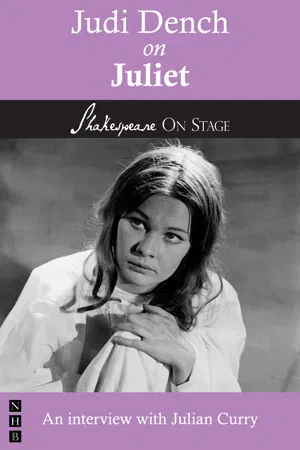
I was delighted when Judi Dench agreed to talk about playing Juliet, not least because my first job was as a limping, hunchbacked citizen of Verona in the same production, when it was recast for a long tour. By then the newspapers with their mixed notices were turning yellow, Judi was quite sensational, the show was eight months into its run and well on the way to becoming legendary. It was thrilling to be involved. I was a walk-on without a word to say but felt part of a rich onstage community. I knew what my character’s job was, who I was married to, where we lived. I can still remember the fabric of noises, the whistling and shouting, grunting and groaning, dogs barking, birdsong, the tolling of bells and general din, street cries, distant offstage snatches of song and vendors bawling their wares.
I went to meet Judi for this interview in 2006 at her beautiful Elizabethan home in Surrey. Having played Juliet forty-six years earlier, some details had necessarily become hazy. But others were still razor-sharp, and the longer we talked, the more memories came flooding back. It made perfect sense that, for all her later triumphs in Shakespeare, this was the part she chose to discuss.
![]()
Julian Curry: You’ve played most of the great parts for actresses in Shakespeare. But Juliet holds extra-special memories for you. Why’s that?
Judi Dench: Well, it was at the end of my second year at the Old Vic, I think. I’d been there since ’57. And I’d played lovely things – Maria in Twelfth Night, the First Fairy in the Dream and Ophelia. But it came very much from left field when Michael Benthall [the Artistic Director] said he wanted me to do this. He was casting for Franco Zeffirelli, who’d never directed a Shakespeare play before, and so he was casting in the dark. I remember being absolutely thrilled – John Stride as Romeo and Alec McCowen as Mercutio. And then worrying that Zeffirelli would arrive and I might not be what he would want.
So you didn’t audition for Zeffirelli?
No. Michael cast us, and I’ve never known whether Franco had been over and seen us all in something else beforehand.
Sent a spy, maybe. So it wasn’t quite your first Shakespeare, but it was very early days.
We were in everything at that time, we weren’t out of a play. Merry Wives, Twelfth Night and Hamlet, Lear. If you weren’t actually in them, you were walking on and understudying.
Or playing a soldier.
Or playing a soldier. We played a lot of soldiers in the Henry VIs. I remember when we got Asian flu, all of us, they said ‘Go, one of you, and pull down The Savoy.’ And I ran off carrying a ninety-foot pole with a toffee apple on top of it, to tumultuous applause. And then they said: ‘Let four captains / Bear Hamlet like a soldier to the stage’ – and during the Asian flu, there were only four girls! So we’d been through quite a lot, yes. Learnt a lot.
Did you know the play well, did you have preconceptions?
What I knew is the Prokofiev music very, very well, and the Tchaikovsky music very well. I knew the play, but I had no preconceptions. The way Franco worked was very much on instinct, tremendously on instinct. You would be rehearsing and, out of the corner of your eye, you’d see him doing it beside you… much, much better than you...