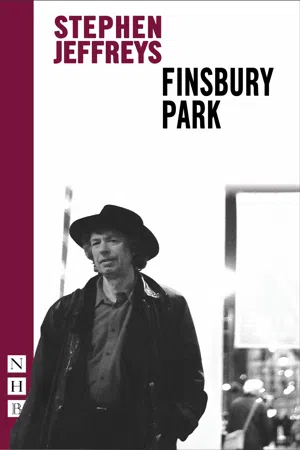
A short autobiographical monologue, first performed as part of the Come to Where I'm From festival at the Park Theatre, London, in 2016.
- 15 pages
- English
- ePUB (mobile friendly)
- Available on iOS & Android
eBook - ePub
Finsbury Park
About this book
Information
Subtopic
British DramaIndex
LiteratureThe pigeon slid slowly down the tiled wall. The man who had thrown it stooped and caught the bird before it hit the pavement. My father, walking homewards from the City Road, had just arrived at the railway bridges that cross Stroud Green Road next to Finsbury Park Station. He stopped to watch as the man threw the pigeon at the wall again and, when it skidded down, once more gathered it up, and, after a few moments pause to collect his strength, hurled it again. Once more, the pigeon hit the tiles with a splat. Once more it slithered down the wall into the man’s hands.
My father was intrigued twice over. Firstly he was a self-appointed protector of birdlife, frequently bringing home injured sparrows and thrushes for a couple of days recuperation in our cramped kitchen, patching them up and then releasing them back into the wild. Secondly he was an aficionado of the bizarre urban tableau and, in some curious way, seemed to attract incidents like this, to conjure them into being by his very presence.
He intervened: ‘What was the point of this torture?’ The hurler’s explanation was a good one. The bird, it seemed, had injured a wing. The man, spotting a small strip of grass at the top of the wall, high up under the railway bridge, had conceived the project of flinging the pigeon onto the grass so that it might enjoy some respite from the dogs and tramping feet that threatened its very life. Unfortunately, the hurler lacked the strength to achieve his objective. My father, tall, with a former merchant seaman’s physical power said ‘Allow me’ and, in a single attempt lobbed the injured bird onto its designated oasis. The two men shook hands and resumed their solitary journeys.
I find it hard to imagine this story taking place anywhere else but in the streets of Finsbury Park – not just because of the topography of the bridges, the tiles and the grassy retreat which you can still see today – but because the oddness of the encounter seems specific to the twilight world that defined, and still to some extent does define this area to me.
In the 1950s the area around Finsbury Park station was a place of darkness: no brightly lit shops, no theatre, not even a fruit stall (‘Banana, banana’). There was a man in a cloth cap who sat on an upturned wooden crate selling newspapers. And that was it. It was a location you passed through, a heads-down kind of world, a transit camp, a twilight zone where people dwelt in their own inner space, reading one of the three evening papers (the Standard, the News and the Star) while waiting for one of the three buses (the 233, the 212 and the 210.)
Yes, it was a dark place where the populace entertained their own peculiar thoughts, not speaking to or acknowledging e...
Table of contents
- Cover
- Title Page
- Contents
- Foreword by Ian Rickson
- Introduction by Annabel Arden
- Original Production
- Finsbury Park
- About the Author
- Copyright and Performing Rights Information
Trusted by 375,005 students
Access to over 1.5 million titles for a fair monthly price.
Study more efficiently using our study tools.
Frequently asked questions
Yes, you can cancel anytime from the Subscription tab in your account settings on the Perlego website. Your subscription will stay active until the end of your current billing period. Learn how to cancel your subscription
No, books cannot be downloaded as external files, such as PDFs, for use outside of Perlego. However, you can download books within the Perlego app for offline reading on mobile or tablet. Learn how to download books offline
We are an online textbook subscription service, where you can get access to an entire online library for less than the price of a single book per month. With over 1.5 million books across 990+ topics, we’ve got you covered! Learn about our mission
Look out for the read-aloud symbol on your next book to see if you can listen to it. The read-aloud tool reads text aloud for you, highlighting the text as it is being read. You can pause it, speed it up and slow it down. Learn more about Read Aloud
Yes! You can use the Perlego app on both iOS and Android devices to read anytime, anywhere — even offline. Perfect for commutes or when you’re on the go.
Please note we cannot support devices running on iOS 13 and Android 7 or earlier. Learn more about using the app
Please note we cannot support devices running on iOS 13 and Android 7 or earlier. Learn more about using the app
Yes, you can access Finsbury Park by Stephen Jeffreys in PDF and/or ePUB format, as well as other popular books in Literature & British Drama. We have over 1.5 million books available in our catalogue for you to explore.