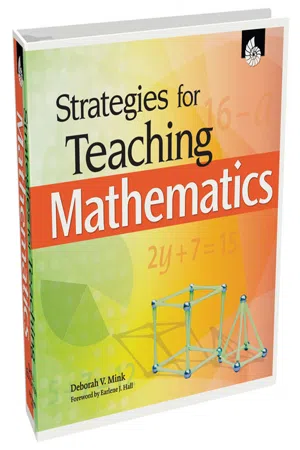
Enhance mathematics instruction and build students' understanding of mathematical concepts with this practical, research-based resource. Choose from a wide range of easy-to-implement strategies that enhance mathematics instruction, including developing students' mathematical vocabulary and problem-solving abilities, assessing students' mathematics thinking, and using manipulatives. Highlights include tips on planning instruction and managing the mathematics classroom, plus differentiation strategies for each lesson. This resource is correlated to College and Career Readiness and other state standards.
- 330 pages
- English
- PDF
- Available on iOS & Android
eBook - PDF
Strategies for Teaching Mathematics
About this book
Information
Table of contents
- Cover
- Credits
- Page 3 - Table of Contents
- Page 4 - Table of Contents (cont.)
- Page 5 - Foreword
- Page 7 - Research
- Page 20 - How to Use This Book
- Page 22 - Correlation to Standards
- Page 24 - About the Authors
- Page 25 - Strategies for Vocabulary Development
- Page 27 - Vocabulary Development Overview
- Page 27 - Common Questions About Vocabulary Development
- Page 29 - Tips for Implementing Vocabulary Strategies Successfully
- Page 30 - Alike and Different
- Page 36 - Total Physical Response
- Page 41 - Math Hunt
- Page 46 - Root Word Tree
- Page 53 - Sharing Mathematics
- Page 58 - Vocabulary Flip Book
- Page 64 - Content Links
- Page 69 - Strategies for Using Manipulatives
- Page 71 - Manipulatives Overview
- Page 71 - Common Questions About Manipulatives
- Page 73 - Using Manipulatives Effectively
- Page 74 - Strategies for Acquiring Manipulatives
- Page 74 - Strategies for Organizing Manipulatives
- Page 77 - Strategies for Individual Use of Manipulatives
- Page 77 - Strategies for Free Exploration of Manipulatives
- Page 78 - Strategies for Modeling While Using Manipulatives
- Page 79 - Strategies for Grouping Students While Using Manipulatives
- Page 81 - The Manipulative Survival Guide
- Page 82 - Preventing Manipulative Dependency
- Page 83 - Using Counters for Skip Counting by 2s and 5s
- Page 86 - Using Counters for Multiplication with Arrays
- Page 89 - Using Counters for Solving Linear Equations
- Page 92 - Using Linking Cubes for Data Analysis
- Page 95 - Using Linking Cubes for Understanding Area and Perimeter
- Page 98 - Using Linking Cubes for Understanding Probability
- Page 101 - Using Base Ten Blocks for Addition
- Page 104 - Using Base Ten Blocks for Division
- Page 107 - Using Algebra Tiles for Collecting Like Terms
- Page 111 - Using Pattern Blocks for Spatial Visualization
- Page 114 - Using Pattern Blocks for Transformations in Quadrant I
- Page 119 - Using Pattern Blocks for Rotational Symmetry
- Page 123 - Strategies for Teaching Procedures
- Page 125 - Teaching Procedures Overview
- Page 136 - Lessons
- Page 136 - Alternative Algorithm for Addition
- Page 139 - Alternative Algorithm for Subtraction
- Page 142 - Alternative Algorithm for Multiplication
- Page 145 - Alternative Algorithm for Division
- Page 148 - Adding Fractions
- Page 151 - Missing Addends
- Page 154 - Collecting Like Terms
- Page 157 - Linear Equations
- Page 160 - Calculating Area
- Page 163 - Calculating Perimeter
- Page 166 - Calculating Volume
- Page 169 - Finding Missing Angle Measures
- Page 172 - Measuring Length
- Page 175 - Converting Measurements
- Page 178 - Creating Graphs
- Page 181 - Finding Central Tendencies
- Page 185 - Strategies for Understanding Problem Solving
- Page 187 - Problem-Solving Overview
- Page 188 - Problem-Solving Difficulty Factors
- Page 195 - Teaching About Difficulty Factors
- Page 195 - Problem-Solving Process
- Page 198 - 12 Strategies for Problem Solving
- Page 199 - Drawing a Diagram
- Page 203 - Acting It Out or Using Concrete Materials
- Page 207 - Creating a Table
- Page 210 - Looking for a Pattern
- Page 214 - Guessing and Checking
- Page 217 - Creating an Organized List
- Page 220 - Working Backwards
- Page 223 - Creating a Tree Diagram
- Page 226 - Using Simpler Numbers
- Page 229 - Using Logical Reasoning
- Page 232 - Analyzing and Investigating
- Page 235 - Solving Open-Ended Problems
- Page 239 - Strategies for Using Mathematical Games
- Page 241 - Games Overview
- Page 241 - Motivation and Mathematical Learning
- Page 241 - Motivation with Games
- Page 242 - Games Are for All Learners
- Page 243 - Concept-Based Games
- Page 245 - Who Has? Games
- Page 247 - Category Quiz Games
- Page 249 - MATHO Games
- Page 251 - Matching Games
- Page 253 - Game Rules and Templates
- Page 263 - Strategies for Assessing Mathematical Thinking
- Page 265 - Assessment Overview
- Page 268 - Interviews
- Page 272 - Observation
- Page 275 - Performance Tasks
- Page 278 - Self- and Peer-Evaluations
- Page 282 - Graphic Organizers
- Page 286 - Mathematical Journals
- Page 289 - Rubrics
- Page 292 - Portfolios
- Page 295 - Appendices
- Page 296 - Appendix A: References Cited
- Page 300 - Appendix B: Mathematics-Related Children’s Literature List
- Page 305 - Appendix C: Grade-Level Vocabulary Lists
- Page 311 - Appendix D: Answer Key
- Page 317 - Appendix E: Contents of Teacher Resource CD
- Thank You Page
Trusted by 375,005 students
Access to over 1.5 million titles for a fair monthly price.
Study more efficiently using our study tools.
Frequently asked questions
Yes, you can cancel anytime from the Subscription tab in your account settings on the Perlego website. Your subscription will stay active until the end of your current billing period. Learn how to cancel your subscription
No, books cannot be downloaded as external files, such as PDFs, for use outside of Perlego. However, you can download books within the Perlego app for offline reading on mobile or tablet. Learn how to download books offline
Perlego offers two plans: Essential and Complete
- Essential is ideal for learners and professionals who enjoy exploring a wide range of subjects. Access the Essential Library with 800,000+ trusted titles and best-sellers across business, personal growth, and the humanities. Includes unlimited reading time and Standard Read Aloud voice.
- Complete: Perfect for advanced learners and researchers needing full, unrestricted access. Unlock 1.5M+ books across hundreds of subjects, including academic and specialized titles. The Complete Plan also includes advanced features like Premium Read Aloud and Research Assistant.
We are an online textbook subscription service, where you can get access to an entire online library for less than the price of a single book per month. With over 1.5 million books across 990+ topics, we’ve got you covered! Learn about our mission
Look out for the read-aloud symbol on your next book to see if you can listen to it. The read-aloud tool reads text aloud for you, highlighting the text as it is being read. You can pause it, speed it up and slow it down. Learn more about Read Aloud
Yes! You can use the Perlego app on both iOS and Android devices to read anytime, anywhere — even offline. Perfect for commutes or when you’re on the go.
Please note we cannot support devices running on iOS 13 and Android 7 or earlier. Learn more about using the app
Please note we cannot support devices running on iOS 13 and Android 7 or earlier. Learn more about using the app
Yes, you can access Strategies for Teaching Mathematics by Deborah V. Mink,Linda H.,Janis K. Drab Fackler in PDF and/or ePUB format, as well as other popular books in Education & Education Theory & Practice. We have over 1.5 million books available in our catalogue for you to explore.