- 306 pages
- English
- PDF
- Available on iOS & Android
eBook - PDF
About this book
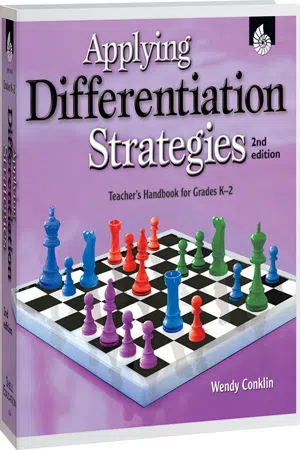
Give all learners in grades K-2 the opportunity for success in the classroom! This resource will teach you how to differentiate your lessons through content, process, and product in order to effectively accommodate all learning levels and styles of learning. Globally-focused social studies sample lessons and additional templates for use in lesson planning have been included in this latest edition. A variety of instructional strategies are featured including: Choices, Inquiry-Based Learning, Multiple Intelligences, Questioning, Self-Paced Strategies, and Tiered Assignments. All the strategies are anchored in extensive research on the importance of differentiation and addressing a variety of learning styles. Sample lessons are included in this notebook plus digital resources. This resource is correlated to College and Career Readiness and other state standards.
Information
Table of contents
- Cover
- Credits
- Page 3 - Table of Contents
- Page 4 - Table of Contents (cont.)
- Page 5 - New Beginnings with Differentiation
- Page 7 - Diverse Subpopulations of Learners
- Page 9 - Poverty, Another Type of Diversity
- Page 9 - Jigsaw Puzzle
- Page 10 - “De-tracking” America’s Schools
- Page 10 - Drop-Out Situation
- Page 11 - Expectations for Students and Their Teachers
- Page 15 - Mission Statements
- Page 16 - Conclusions
- Page 17 - Another Look Into the Classroom
- Page 19 - What Is Differentiation?
- Page 20 - Why Should We Differentiate?
- Page 21 - How to Begin Differentiating
- Page 22 - Vocabulary Development
- Page 25 - Differentiating Mathematics
- Page 26 - Tiered Assignments
- Page 26 - Questioning
- Page 27 - Multiple Intelligences
- Page 27 - Choices
- Page 28 - Inquiry-Based Learning
- Page 28 - Self-Paced Strategies
- Page 28 - Quick Ideas for Differentiating
- Page 29 - Establishing Rules for the Classroom
- Page 29 - Keeping Track of Differentiated Activities
- Page 29 - Distributing Differentiated Work
- Page 30 - Managing Talkative Classrooms
- Page 31 - Explaining Differentiation to Students and Parents
- Page 32 - What Is Flexible Grouping?
- Page 33 - Heterogeneous Grouping
- Page 36 - Homogenous Grouping
- Page 36 - Flexogeneous Grouping
- Page 37 - Management of Flexible Groups
- Page 38 - Anchor Activities
- Page 40 - How to Use This Product
- Page 41 - Correlation to Standards
- Page 43 - Works Cited for the Introduction
- Page 45 - Table of Contents and Overview
- Page 46 - Tiered Assignments Overview
- Page 48 - Tiered Assignments Sample Lessons
- Page 48 - Lesson Plan
- Page 51 - Student Reproducibles
- Page 55 - Lesson Plan
- Page 58 - Student Reproducibles
- Page 61 - Lesson Plan
- Page 63 - Student Reproducibles
- Page 67 - Lesson Plan
- Page 69 - Student Reproducibles
- Page 73 - Table of Contents and Overview
- Page 74 - Questioning Overview
- Page 76 - Bloom’s Taxonomy
- Page 79 - Bloom’s Taxonomy Sample Lessons
- Page 79 - Lesson Plan
- Page 82 - Student Reproducibles
- Page 84 - Lesson Plan
- Page 87 - Student Reproducibles
- Page 89 - Kaplan’s Depth and Complexity
- Page 96 - Kaplan’s Depth and Complexity Sample Lessons
- Page 96 - Lesson Plan
- Page 100 - Student Reproducibles
- Page 104 - Lesson Plan
- Page 108 - Three-Story Intellect
- Page 110 - Three-Story Intellect Sample Lessons
- Page 110 - Lesson Plan
- Page 113 - Student Reproducibles
- Page 117 - Lesson Plan
- Page 119 - Student Reproducibles
- Page 123 - Table of Contents and Overview
- Page 124 - Multiple Intelligences Overview
- Page 129 - Multiple Intelligences Sample Lessons
- Page 129 - Lesson Plan
- Page 132 - Student Reproducibles
- Page 138 - Lesson Plan
- Page 141 - Student Reproducibles
- Page 142 - Lesson Plan
- Page 144 - Student Reproducibles
- Page 146 - Lesson Plan
- Page 148 - Student Reproducibles
- Page 149 - Table of Contents and Overview
- Page 150 - Choices Overview
- Page 151 - Menu of Options
- Page 152 - Menu of Options Sample Lesson
- Page 152 - Lesson Plan
- Page 155 - Student Reproducibles
- Page 157 - Choices Board
- Page 158 - Choices Board Sample Lesson
- Page 158 - Lesson Plan
- Page 161 - Student Reproducibles
- Page 166 - Open-Ended Tasks
- Page 167 - Open-Ended Tasks Sample Lessons
- Page 167 - Lesson Plan
- Page 169 - Student Reproducibles
- Page 171 - Lesson Plan
- Page 173 - Student Reproducibles
- Page 175 - Stations/Interest Centers
- Page 176 - Stations/Interest Centers Sample Lessons
- Page 176 - Lesson Plan
- Page 182 - Student Reproducibles
- Page 188 - Lesson Plan
- Page 192 - Student Reproducibles
- Page 195 - Leveled Learning Centers
- Page 196 - Leveled Learning Centers Sample Lesson
- Page 196 - Lesson Plan
- Page 199 - Student Reproducibles
- Page 203 - Table of Contents and Overview
- Page 204 - Inquiry-Based Learning Overview
- Page 205 - Creative Problem Solving
- Page 208 - Creative Problem Solving Sample Lesson
- Page 208 - Lesson Plan
- Page 211 - Student Reproducibles
- Page 215 - Discovery Learning
- Page 215 - Discovery Learning Sample Lesson
- Page 218 - Lesson Plan
- Page 220 - Student Reproducibles
- Page 221 - Table of Contents and Overview
- Page 222 - Self-Paced Strategies Overview
- Page 223 - Personal Agendas
- Page 225 - Personal Agendas Sample Lesson
- Page 225 - Lesson Plan
- Page 227 - Student Reproducibles
- Page 230 - Orbital Studies
- Page 232 - Orbital Studies Sample Lesson
- Page 232 - Lesson Plan
- Page 236 - Student Reproducibles
- Page 241 - Independent Investigations
- Page 243 - Independent Investigations Sample Lesson
- Page 243 - Lesson Plan
- Page 246 - Student Reproducibles
- Page 252 - Learning Contracts
- Page 254 - Learning Contracts Sample Lessons
- Page 254 - Lesson Plan
- Page 256 - Student Reproducibles
- Page 258 - Lesson Plan
- Page 261 - Student Reproducibles
- Page 268 - Appendix A: Works Cited for Strategies and Other References
- Page 269 - Other References
- Page 270 - Appendix B: Differentiation—A Quick Look
- Page 270 - Tiered Assignments
- Page 271 - Questioning
- Page 272 - Multiple Intelligences
- Page 273 - Choices
- Page 274 - Inquiry-Based Assignments
- Page - 275 - Self-Paced Assignments
- Page 276 - Other Strategies
- Page 277 - Appendix C: Anchor Activities
- Page 293 - Appendix D: Vocabulary Activities
- Page 300 - Appendix E: Differentiating Mathematics
- Page 302 - Appendix F: Contents of the Teacher Resource CD
- Page 304 - Appendix G: About the Authors of This Series
- Thank You Page
Trusted by 375,005 students
Access to over 1.5 million titles for a fair monthly price.
Study more efficiently using our study tools.
Frequently asked questions
Yes, you can cancel anytime from the Subscription tab in your account settings on the Perlego website. Your subscription will stay active until the end of your current billing period. Learn how to cancel your subscription
No, books cannot be downloaded as external files, such as PDFs, for use outside of Perlego. However, you can download books within the Perlego app for offline reading on mobile or tablet. Learn how to download books offline
Perlego offers two plans: Essential and Complete
- Essential is ideal for learners and professionals who enjoy exploring a wide range of subjects. Access the Essential Library with 800,000+ trusted titles and best-sellers across business, personal growth, and the humanities. Includes unlimited reading time and Standard Read Aloud voice.
- Complete: Perfect for advanced learners and researchers needing full, unrestricted access. Unlock 1.5M+ books across hundreds of subjects, including academic and specialized titles. The Complete Plan also includes advanced features like Premium Read Aloud and Research Assistant.
We are an online textbook subscription service, where you can get access to an entire online library for less than the price of a single book per month. With over 1.5 million books across 990+ topics, we’ve got you covered! Learn about our mission
Look out for the read-aloud symbol on your next book to see if you can listen to it. The read-aloud tool reads text aloud for you, highlighting the text as it is being read. You can pause it, speed it up and slow it down. Learn more about Read Aloud
Yes! You can use the Perlego app on both iOS and Android devices to read anytime, anywhere — even offline. Perfect for commutes or when you’re on the go.
Please note we cannot support devices running on iOS 13 and Android 7 or earlier. Learn more about using the app
Please note we cannot support devices running on iOS 13 and Android 7 or earlier. Learn more about using the app
Yes, you can access Applying Differentiation Strategies by Wendy Conklin,Wendy Conklin M.A.Ed. in PDF and/or ePUB format, as well as other popular books in Education & Education General. We have over 1.5 million books available in our catalogue for you to explore.