The highly anticipated new collection from a poet whose previous book was a finalist for the Los Angeles Times Book Prize
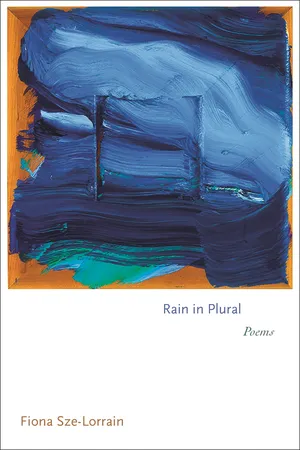
Rain in Plural is the much-anticipated fourth collection of poetry by Fiona Sze-Lorrain, who has been praised by The Rumpus as "a master of musicality and enlightening allusions." In the wholly original world of these new poems, Sze-Lorrain addresses both private narratives and the overexposed discourse of the polis, using silence and montage, lyric and antilyric, to envision what she calls "creating between liberties." With a moral precision embracing us without eschewing I, she rethinks questions of citizenship, the selections of sensory memory, and, by extension, the tether of word and image to the actual. She writes, "I accept the truth in newspapers / by holding the murder of my friends against my chest. // To each weather forecast I give thanks: / merci for every outdated // dusk/dawn." Agrippina the Younger, Franz Kafka, Bob Dylan, a butoh performance, an unnamed Raku tea bowl—each has a place here. Made whole by time and its alteration in timelessness, synchrony, coincidences, and accidents, Rain in Plural beautifully reveals an elegiac yet ever-evolving inner life.
- English
- ePUB (mobile friendly)
- Available on iOS & Android
eBook - ePub
About this book
Trusted by 375,005 students
Access to over 1.5 million titles for a fair monthly price.
Study more efficiently using our study tools.
Information
Publisher
Princeton University PressYear
2020Print ISBN
9780691203560
9780691203584
eBook ISBN
9780691203577
V
CHILD, DON’T HIDE
THE ILLUSION OF TENDERNESS
Narcissus in a Raku tea bowl—one you thought you
saw in a private museum, on loan from Kyoto for undisclosed
reasons—floated on matcha from a thousand dinners
back, forced by gravity to let go of stillness the moment
saw in a private museum, on loan from Kyoto for undisclosed
reasons—floated on matcha from a thousand dinners
back, forced by gravity to let go of stillness the moment
each petal floated on its terms, most
dramatically, roughing out the principle of least action,
listening hands down to the chorus, L-o-o-k.
dramatically, roughing out the principle of least action,
listening hands down to the chorus, L-o-o-k.
AGRIPPINA THE YOUNGER
I have no poems on maternity.
In an Asian culture, that’s a sin, a one-
way ticket to Hades.
way ticket to Hades.
Of her voice, I feel it
before I bleed.
Monthly: against the grain and scrap.
before I bleed.
Monthly: against the grain and scrap.
Of her scheme, I remember:
Be grateful,
but know how to be mean. Nothing a classicist can do to force
her to admit Yes,
I said these.
Be grateful,
but know how to be mean. Nothing a classicist can do to force
her to admit Yes,
I said these.
I wish men would say I forgive you
and your cruelty. But when sagas are revised for sense and clarity,
and your cruelty. But when sagas are revised for sense and clarity,
gods can’t forgive
the scandal I forgive.
MUSE, IF I
idealized you without knowing why, the man
or woman in a photograph from the warfront
would metamorphose into a whale or luffa. The winter
that broke down twice before someone smart
unplugged it overnight
would goose-
bump your skin and freeze your toes and sterilize
your milk, your ovum or sperm. My typewriter
passed out from a crime
(details omitted because of the wife), rattled out my
silence about a Dutch spy, in
an apartment tapped by the mafia. If
I idealized you knowing why I should—not for a scenario, paid
by the line—I wouldn’t triumph
with a healthy heart. It had pumped too fast
for the price you asked.
or woman in a photograph from the warfront
would metamorphose into a whale or luffa. The winter
that broke down twice before someone smart
unplugged it overnight
would goose-
bump your skin and freeze your toes and sterilize
your milk, your ovum or sperm. My typewriter
passed out from a crime
(details omitted because of the wife), rattled out my
silence about a Dutch spy, in
an apartment tapped by the mafia. If
I idealized you knowing why I should—not for a scenario, paid
by the line—I wouldn’t triumph
with a healthy heart. It had pumped too fast
for the price you asked.
GIVE UP THINKING TWICE
I
[Acoustic]
[Acoustic]
Instead of Cohen, I heard another bard.
Some thought him thunder, some found him uphill.
So what if rain must fall hard, one grumbled.
Cut inside each chord, but surrendered for time.
Some thought him thunder, some found him uphill.
So what if rain must fall hard, one grumbled.
Cut inside each chord, but surrendered for time.
Some thought him thunder, some found him uphill.
I listened to each repetition, an apology in the fewest words.
Cut inside each chord, but surrendered for time.
I would have given up a mountain for this storm.
I listened to each repetition, an apology in the fewest words.
Cut inside each chord, but surrendered for time.
I would have given up a mountain for this storm.
I listened to each repetition, an apology in the fewest words.
How long it could last, it might have sensed when void of its heaven,
it must fight its own earth.
How long it could last, it might have sensed when void of its heaven,
it must fight its own earth.
I would have given up a mountain for this storm.
I credited the wind for his cri du cœur, discredited the same wind for his rhythm.
I credited the wind for his cri du cœur, discredited the same wind for his rhythm.
How long it could last, it might have sensed when void of its heaven,
it must fight its own earth.
it must fight its own earth.
How much delirium to be heard as a poem, he did not answer.
Did not bother.
Did not bother.
I credited the wind for his cri du cœur, discredited the same wind for his rhythm.
To clarify music was not his task.
To clarify music was not his task.
How much delirium to be heard as a poem, he did not answer.
Did not bother.
Did not bother.
Some thought it ego, some said he pushed notes off their high-speed rail.
To clarify music was not his task.
I saw a door when he played harmonica.
To clarify music was not his task.
I saw a door when he played harmonica.
Some thought it ego, some said he pushed notes off their high-speed rail.
Green-blue and ajar.
I saw a door when he played harmonica.
No one waited behind or outside.
Green-blue and ajar.
I saw a door when he played harmonica.
No one waited behind or outside.
Green-blue and ajar.
Times changed its size—the door, not his mouthpiece or unplugged version.
No one waited behind or outside.
I could drink the drums had he not turned his back on us.
Times changed its size—the door, not his mouthpiece or unplugged version.
No one waited behind or outside.
I could drink the drums had he not turned his back on us.
Times changed its size—the door, not his mouthpiece or unplugged version.
The troubadour aged fast not because of drugs.
I could drink the drums had he not turned his back on us.
I drew this theory from his Nobel prize. How he took his time.
The troubadour aged fast not because of drugs.
I could drink the drums had he not turned his back on us.
I drew this theory from his Nobel prize. How he took his time.
The troubadour aged fast not because of drugs.
Heartbreak can be lean and acoustic. Like a piece of meat,
if mood detained the beast.
Heartbreak can be lean and acoustic. Like a piece of meat,
if mood detained the beast.
I drew this theory from his Nobel prize. How he took his time.
Every song: a friend and moon to compete for its chi and wives.
Every song: a friend and moon to compete for its chi and wives.
Heartbreak can be lean and acoustic. Like a piece of meat,
if mood detained the beast.
if mood detained the beast.
Sick of the word “love,” it plagiarized the best failure.
Every song: a friend and moon to compete for its chi and wives.
Unlike a friend, it did not need to try hard.
Every song: a friend and moon to compete for its chi and wives.
Unlike a friend, it did not need to try hard.
Sick of the word “love,” it plagiarized the best failure.
Unlike a moon, it spoke through the graves and diaspora.
Unlike a friend, it did not need to try hard.
Some gave up despair to find his past, some gave up even when alive.
Unlike a moon, it spoke through the graves and diaspora.
Unlike a friend, it did not need to try hard.
Some gave up despair to find his past, some gave up even when alive.
Unlike a moon, it spoke through the graves and diaspora.
Years down the road, if words fell apart, this prophecy would ask
for one odd star—
Years down the road, if words fell apart, this prophecy would ask
for one odd star—
Some gave up despair to find his past, some gave up even when alive.
None of his demons survived their trance, none of this passion
leveled its height.
None of his demons survived their trance, none of this passion
leveled its height.
Years down the road, if words fell apart, this prophecy would ask
for one odd star—
So what if rain must fall hard, one grumbled.
None of his demons survived their trance, none of this passion
leveled its height.
Instead of Cohen, I heard another bard.
for one odd star—
So what if rain must fall hard, one grumbled.
None of his demons survived their trance, none of this passion
leveled its height.
Instead of Cohen, I heard another bard.
II
[Electric]
[Electric]
Instead of Cohen, I heard another bard.
Some thought him thunder, some found him uphill.
So what if rain must fall hard, one grumbled.
Cut inside each chord, but surrendered
for time. I listened to each repetition, an apology
in the fewest words. I would have given up a mountain
for this storm. How long it could last, it might
have sensed when void of its heaven,
it must fight its own earth. I credited the wind
for his cri du cœur, discredited the same
wind for his rhythm. How much delirium to be heard
as a poem, he did not answer. Did not bother.
To clarify music was not his task. Some thought
it ego, some said he pushed notes off their high
speed rail. I saw a door when he played harmonica.
Green-blue and ajar. No one waited behind or outside.
Times changed its size—the door, not his mouthpiece
or unplugged version. I could drink the drums had
he not turned his back on us. The troubadour aged
fast not because of drugs. I drew this theory
from his Nobel prize. How he took his time.
Heartbreak can be lean and acoustic. Like a piece
of meat, if mood detained the beast.
Every song: a friend and moon to compete
for its chi and wives. Sick of the word “love,” it
plagiarized the best failure. Unlike a friend, it did
not need to try hard. Unlike a moon, it spoke through
the graves and diaspora. Some gave up despair to find
his past, ...
Some thought him thunder, some found him uphill.
So what if rain must fall hard, one grumbled.
Cut inside each chord, but surrendered
for time. I listened to each repetition, an apology
in the fewest words. I would have given up a mountain
for this storm. How long it could last, it might
have sensed when void of its heaven,
it must fight its own earth. I credited the wind
for his cri du cœur, discredited the same
wind for his rhythm. How much delirium to be heard
as a poem, he did not answer. Did not bother.
To clarify music was not his task. Some thought
it ego, some said he pushed notes off their high
speed rail. I saw a door when he played harmonica.
Green-blue and ajar. No one waited behind or outside.
Times changed its size—the door, not his mouthpiece
or unplugged version. I could drink the drums had
he not turned his back on us. The troubadour aged
fast not because of drugs. I drew this theory
from his Nobel prize. How he took his time.
Heartbreak can be lean and acoustic. Like a piece
of meat, if mood detained the beast.
Every song: a friend and moon to compete
for its chi and wives. Sick of the word “love,” it
plagiarized the best failure. Unlike a friend, it did
not need to try hard. Unlike a moon, it spoke through
the graves and diaspora. Some gave up despair to find
his past, ...
Table of contents
- Cover Page
- Title Page
- Copyright Page
- CONTENTS
- I. CLOSER TO CLOUDS
- II. SMALL STORMS
- III. NINE SOLITUDES
- IV. DJANGO FONTINA
- V. CHILD, DON’T HIDE
- NOTES
- ACKNOWLEDGMENTS
Frequently asked questions
Yes, you can cancel anytime from the Subscription tab in your account settings on the Perlego website. Your subscription will stay active until the end of your current billing period. Learn how to cancel your subscription
No, books cannot be downloaded as external files, such as PDFs, for use outside of Perlego. However, you can download books within the Perlego app for offline reading on mobile or tablet. Learn how to download books offline
Perlego offers two plans: Essential and Complete
- Essential is ideal for learners and professionals who enjoy exploring a wide range of subjects. Access the Essential Library with 800,000+ trusted titles and best-sellers across business, personal growth, and the humanities. Includes unlimited reading time and Standard Read Aloud voice.
- Complete: Perfect for advanced learners and researchers needing full, unrestricted access. Unlock 1.5M+ books across hundreds of subjects, including academic and specialized titles. The Complete Plan also includes advanced features like Premium Read Aloud and Research Assistant.
We are an online textbook subscription service, where you can get access to an entire online library for less than the price of a single book per month. With over 1.5 million books across 990+ topics, we’ve got you covered! Learn about our mission
Look out for the read-aloud symbol on your next book to see if you can listen to it. The read-aloud tool reads text aloud for you, highlighting the text as it is being read. You can pause it, speed it up and slow it down. Learn more about Read Aloud
Yes! You can use the Perlego app on both iOS and Android devices to read anytime, anywhere — even offline. Perfect for commutes or when you’re on the go.
Please note we cannot support devices running on iOS 13 and Android 7 or earlier. Learn more about using the app
Please note we cannot support devices running on iOS 13 and Android 7 or earlier. Learn more about using the app
Yes, you can access Rain in Plural by Fiona Sze-Lorrain in PDF and/or ePUB format, as well as other popular books in Literature & Women Authors Literary Collections. We have over 1.5 million books available in our catalogue for you to explore.