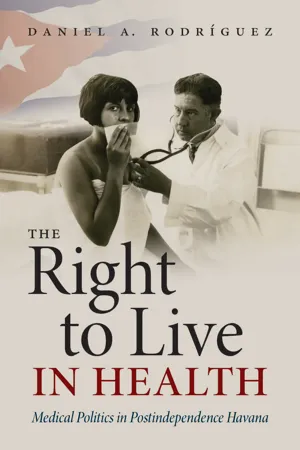
Daniel A. Rodríguez’s history of a newly independent Cuba shaking off the U.S. occupation focuses on the intersection of public health and politics in Havana. While medical policies were often used to further American colonial power, in Cuba, Rodríguez argues, they evolved into important expressions of anticolonial nationalism as Cuba struggled to establish itself as a modern state. A younger generation of Cuban medical reformers, including physicians, patients, and officials, imagined disease as a kind of remnant of colonial rule. These new medical nationalists, as Rodríguez calls them, looked to medical science to guide Cuba toward what they envisioned as a healthy and independent future.
Rodríguez describes how medicine and new public health projects infused republican Cuba’s statecraft, powerfully shaping the lives of Havana’s residents. He underscores how various stakeholders, including women and people of color, demanded robust government investment in quality medical care for all Cubans, a central national value that continues today. On a broader level, Rodríguez proposes that Latin America, at least as much as the United States and Europe, was an engine for the articulation of citizens’ rights, including the right to health care, in the twentieth century.
eBook - ePub
The Right to Live in Health
Medical Politics in Postindependence Havana
- 296 pages
- English
- ePUB (mobile friendly)
- Available on iOS & Android
eBook - ePub
About this book
Information
NOTES
ABBREVIATIONS
| ANC | Archivo Nacional de Cuba, La Habana, Havana, Cuba |
| AH | Audencia de la Habana |
| CPRC | Citizens’ Permanent Relief Committee Records |
| FE | Fondo Especial |
| HFP | Homer Folks Papers, Columbia University Archives, New York, N.Y. |
| HSP | Historical Society of Pennsylvania, Philadelphia |
| LOC | Library of Congress, Manuscripts Division, Washington, D.C. |
| MGC | Records of the Military Government of Cuba, 1898–1903 |
| RA | Registro de Asociaciones |
| SP | Secretaría de la Presidencia |
| USNA | National Archives of the United States of America, College Park, Md. |
| UVA-SP | Library of the University of Virginia, Special Collections Library, Papers of Jefferson Randolph Kean |
INTRODUCTION
1. Congreso de la República de Cuba, Diario de sesiones del Congreso.
2. Congreso de la República de Cuba, Diario de sesiones del Congreso, 90.
3. Congreso de la República de Cuba, Diario de sesiones del Congreso, 91.
4. Congreso de la República de Cuba, Diario de sesiones del Congreso, 92.
5. Departamento de Sanidad de la Habana, Manual de práctica sanitaria, iii.
6. Tomes, Gospel of Germs; Wangensteen and Wangensteen, Rise of Surgery; Rosner, A Once Charitable Enterprise; Starr, Social Transformation of American Medicine; Rosenberg, Care of Strangers; Worboys, Spreading Germs.
7. See Ferrer, Insurgent Cuba; Fischer, Modernity Disavowed; Ferrer, Freedom’s Mirror; Finch, Rethinking Slave Rebellion in Cuba; and Childs, 1812 Aponte Rebellion.
8. See Tone, War and Genocide in Cuba, and Barcia Zequeira, Una sociedad en crisis.
9. Espinosa, Epidemic Invasions; Stepan, “Interplay between Socio-Economic Factors and Medical Science.” On the colonial politics of U.S. public health work abroad, see also Anderson, Colonial Pathologies; Birn, Marriage of Convenience; Laveaga, Jungle Laboratories; Palmer, Launching Global Health; and McCoy and Scarano, Colonial Crucible, 273–326.
10. On postindependence Cuban medicine, see Funes Monzote, El despertar del asociacionismo científico en Cuba; Naranjo Orovio and García González, Medicina y racismo en Cuba; García González and Álvarez Peláez, En busca de la raza perfecta; Palmer, “Beginnings of Cuban Bacteriology”; Gutiérrez, “Disease, Empire, and Modernity in the Caribbean”; Lambe, Madhouse; Urban, “The Sick Republic” and “The ‘Black Plague’”; and Rodríguez Expósito, “La Primera Secretaría de Sanidad,” Carlos J. Finlay, and Dr. Juan N. Dávalos. See also the work of Gregorio Delgado García, editor and major contributor of Cuba’s Cuadernos de la Historia de la Salud Pública.
11. Indeed, these circuits have been at the center of both the Atlantic and Caribbean history fields. See, for example, Scott, Common Wind; Ferreira, Cross Cultural Exchange in the Atlantic World; Rodgers, Atlantic Crossings; Putnam, Radical Moves; and Ferrer, Freedom’s Mirror.
12. On the disease implications of these Atlantic and circum-Caribbean interconnections, see Espinosa, Epidemic Invasions; Markel, Quarantine!; Echenberg, Plague Ports; Palmer, Launching Global Health; Kraut, Silent Travelers; De Barros, Palmer, and Wright, Health and Medicine in the Circum-Caribbean; and McNeill, Mosquito Empires.
13. Among the very few works on Spanish immigrants in Cuba, see Iturria, Españoles en la cultura cubana; Maluquer de Motes Bernet, Nación e inmigración; and Naranjo Orovio and García González, Medicina y racismo en Cuba.
14. On nineteenth- and twentieth-century urban growth, housing, and poverty in Havana, see Bay y Sevilla, La vivienda del pobre; Chailloux Cardona, Síntesis histórica de la vivienda popular; Scarpaci, Segre, and Coyula, Havana; García, Beyond the Walled City; and Horst, “Sleeping on the Ashes.”
15. Scarpaci, Segre, and Coyula, Havana, 43–45.
16. “Sanitation Files Ruined by Flames Started by Arson,” Havana Post, February 7, 1933; “Spain Acts to Help Youth Seized in Cuba,” New York Times, February 7, 1933.
17. “Bomb Blast at Havana Laboratory,” New York Times, December 18, 1932.
18. Antoinette Burton, “Archive Fever, Archive Stories,” in Burton, Archive Stories, 6. See also Trouillot, Silencing the Past, and Stoler, Along the Archival Grain.
19. See, for example, Thomas, Cuba; Ruiz, Cuba; Suchlicki, Cuba, from Columbus to Castro; Pérez, Cuba under the Platt Amendment; and Helg, Our Rightful Share.
20. Palmer, Piqueras, and Sánchez Cobos, State of Ambiguity; Pappademos, Black Political Activism and the Cuban Republic; Riaño San Marful, Gallos y toros en Cuba; Joseph and Nugent, Everyday Forms of State Formation; Sanders, Vanguard of the Atlantic World; Thurner and Guerrero, After Spanish Rule; Thurner, From Two Republics to One Divided; Adelman, Colonial Legacies; Mallon, Peasant and Nation.
21. Foucault, Birth of the Clinic; Tomes, Gospel of Germs; Anderson, Colonial Pathologies; Rogaski, Hygienic Modernity; Meade, Civilizing Rio; McKiernan-González, Fevered Measures; Markel, Quarantine!
22. This book is in close conversation with recent scholarship that looks at struggles over social rights in twentieth-century Latin America, such as Grandin, Last Colonial Massacre; Fischer, Poverty of Rights; Caulfield, In Defense of Honor; Suárez Findlay, Imposing Decency; Adair, In Search of the “Lost Decade”; Romero Sanchez, The Building State; and McDonald, “Peripheral Citizenship.” This work is also indebted to recent scholarship on postcolonial states that looks at how rights were negotiated and contested. See Chambers, From Subjects to Citizens; Ahlman, Living with Nkrumahism; Ahmed, Afghanistan Rising; and Mitchell, Rule of Experts.
23. Brotherton, Revolutionary Medicine.
CHAPTER ONE
1. Parker, Cubans of To-day, 487.
2. Delfín, Treinta años de médico, 7–12
3. Cuba’s third and final War of Independence from Spanish rule began in early 1895. The initial War of Independence, known as the Ten Years’ War, was fought between 1868 and 1878 and was followed by the short-lived Guerra Chiquita, or Little War (1879–80).
4. “Dispensario La Caridad,” Diario de la Marina, November 15, 1899.
5. On the difficulty of assessing the numbers of those killed or displaced by the final War of Independence, see Tone, War and Genocide in Cuba, 209–17.
6. See Tone, War and Genocide in Cuba, 223.
7. See Tyrell, Reforming the World.
8. “Doomed to Die of Starvation,” San Francisco Chronicle, April 26, ...
Table of contents
- Cover Page
- Title page
- Copyright Page
- Dedication
- Contents
- Acknowledgments
- Introduction. The Meanings of Health in Postindependence Havana
- One. A Nation of Spectres: Reconcentration, U.S. Occupation, and the Modernization of the Public Health State
- Two. A Blessed Formula for Progress: Medical Nationalism, U.S. Empire, and the Development of Public Health, 1899–1909
- Three. Salus Populi Suprema Lex: Medical Modernity, Neocolonialism, and the 1914 Bubonic Plague Outbreak
- Four. The Dangers That Surround the Child: Gendered Poverty and the Fight against Infant Mortality
- Five. With All, and for the Good of All: Race, Poverty, and Tuberculosis
- Six. To Fight These Powerful Trusts and Free the Medical Profession: Spanish Mutualism, Medicine, and Revolution, 1925–1935
- Conclusion. The Right to Live in Health in Postcolonial Havana
- Notes
- Bibliography
- Index
Trusted by 375,005 students
Access to over 1.5 million titles for a fair monthly price.
Study more efficiently using our study tools.
Frequently asked questions
Yes, you can cancel anytime from the Subscription tab in your account settings on the Perlego website. Your subscription will stay active until the end of your current billing period. Learn how to cancel your subscription
No, books cannot be downloaded as external files, such as PDFs, for use outside of Perlego. However, you can download books within the Perlego app for offline reading on mobile or tablet. Learn how to download books offline
Perlego offers two plans: Essential and Complete
- Essential is ideal for learners and professionals who enjoy exploring a wide range of subjects. Access the Essential Library with 800,000+ trusted titles and best-sellers across business, personal growth, and the humanities. Includes unlimited reading time and Standard Read Aloud voice.
- Complete: Perfect for advanced learners and researchers needing full, unrestricted access. Unlock 1.5M+ books across hundreds of subjects, including academic and specialized titles. The Complete Plan also includes advanced features like Premium Read Aloud and Research Assistant.
We are an online textbook subscription service, where you can get access to an entire online library for less than the price of a single book per month. With over 1.5 million books across 990+ topics, we’ve got you covered! Learn about our mission
Look out for the read-aloud symbol on your next book to see if you can listen to it. The read-aloud tool reads text aloud for you, highlighting the text as it is being read. You can pause it, speed it up and slow it down. Learn more about Read Aloud
Yes! You can use the Perlego app on both iOS and Android devices to read anytime, anywhere — even offline. Perfect for commutes or when you’re on the go.
Please note we cannot support devices running on iOS 13 and Android 7 or earlier. Learn more about using the app
Please note we cannot support devices running on iOS 13 and Android 7 or earlier. Learn more about using the app
Yes, you can access The Right to Live in Health by Daniel A. Rodríguez in PDF and/or ePUB format, as well as other popular books in Social Sciences & Latin American & Caribbean History. We have over 1.5 million books available in our catalogue for you to explore.