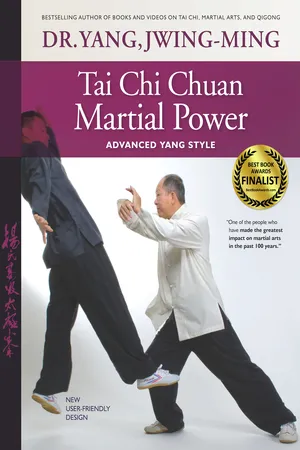
Tai Chi Chuan Martial Power is the next level in Tai Chi Chuan training. This book is written especially for those who have learned the form, begun Pushing Hands, and now want to develop and refine their Tai Chi skills.
Tai Chi Chuan Martial Power focuses on the martial essence of Tai Chi Chuan, an aspect many other books ignore. This book explores in depth the subject of Jing (internal martial power), general Tai Chi theory, and the application of Chi in the Tai Chi form. Because Jing training is essential to martial Tai Chi, this work is a valuable reference that no serious practitioner should be without.
A comprehensive training plan for Jing (power) development.
Understand the difference between true Jing (internal power) and Li (muscular power).
Learn how to accumulate Chi and Jing in the Tai Chi postures.
Discover the essential role your mind plays in Tai Chi and Jing practice.
Includes a special selection of Tai Chi poems (the place the ancient masters hid their theory), translated and with commentary by Dr. Yang.
Qigong is a training system that helps to generate a strong flow of qi (internal energy) inside the body and then circulate it through the entire body. Many martial and nonmartial styles of qigong training have been created in the last four thousand years. The most famous martial styles are Taijiquan (太極拳), Bagua (八卦掌), Xingyi (形意拳), and Liu He Ba Fa (六合八法). These are considered “internal” styles (nei gong, 內功 or nei jar, 內家 in Chinese), as opposed to “external” styles like Shaolin because they emphasize working with qi. The best-known nonmartial styles, which emphasize the enhancement of qi circulation to improve health, are Five Animal Sport (Wu Qin Xi,五禽戲), Eight Pieces Of Brocade (Ba Duan Jin, 八段錦), Da Mo’s Muscle/Tendon Changing Classic (Yi Jin Jing, 易筋經), and twelve postures (shi er zhuang, 十二庄.
Taijiquan, which is said to have been created by Chang, San-feng (張三豐) in the twelfth century, is now the most popular qigong style in the world, even though it was shrouded in secrecy until the beginning of the twentieth century. At present, it is widely practiced not only in China and the East but also in the Western world.
There are several reasons for the rapid spread of this art. The most important, perhaps, is that the practice of taiji can help to calm the mind and relax the body, which are becoming survival skills in today’s hectic and stress-filled world. Secondly, since guns are so effective and easy to acquire, taiji has been considered less vital for personal self-defense than it used to be. For this reason, more taiji masters are willing to share their knowledge with the public. Thirdly, ever since taiji was created, it has been proven not only effective for defense, but also useful for improving health and curing a number of illnesses.
Unfortunately, because of this healthful aspect, the deeper theory and practice of taijiquan, especially the martial applications, are being widely ignored. Most people today think that taiji is not practical for self-defense. To approach the deeper aspects requires much time and patience, and there are very few people willing to make the necessary sacrifices. In addition, some taiji experts are still withholding the secrets of the deeper aspects of the training, and not passing down the complete art.
Anyone who practices this art correctly for a number of years will realize that taiji is not just an exercise for calmness and relaxation—it is a complex and highly developed art. It gives the practitioner a feeling of enjoyment and satisfaction that seems to go beyond that of any other art. This is because taiji is smooth, refined, and elegant, internally as well as externally. The practitioner can sense the energy (qi) circulating within his body, and can achieve the peaceful mind of meditation. Qi circulation can bring good health and may even help you to reach enlightenment. Furthermore, when a taiji practitioner has achieved grand circulation, he can use this qi in self-defense. The principles that taiji uses for fighting are quite different from those of most other martial styles, which rely on muscular force. Taiji uses the soft to defend against the hard, and weakness to defeat strength. The more you practice, the better you will become, and this defensive capability will grow with age instead of weaken. However, because the martial theory of taijiquan is much more profound than that of most other systems, it is much harder to learn and takes a longer time to approach a high level of martial capability. A knowledgeable instructor is very important, for guidance from an experienced master can save many years of wandering and useless practice.
Today there are still a number of interested practitioners who are researching and practicing the deeper aspects of taijiquan with the help of the very few qualified experts and the limited number of in-depth publications. Many questions have arisen. Which is a good style of taijiquan? How can I tell who is a qualified taiji instructor? What is the historical background of the different styles? Which styles can be applied effectively? How do I generate qi? How do I coordinate my breathing with the qi circulation? How do I use qi in self-defense? What is jing (power) and is there more than one kind? How do I train my jing correctly? How does the fighting strategy of taiji differ from that of other styles? All these questions puzzle people even in China.
This book will describe the deeper aspects of taiji training and is written mainly for the reader who has practiced taiji for a few years. Beginning taiji practitioners should also refer to the author’s books Tai Chi Chuan Classical Yang Style and Qigong for Health and Martial Arts, published by YMAA.
1-2. General History of Taijiquan
Many people have learned Yang Style Taijiquan, but few really understand the history, background, and variations of the style. Often a person who has learned Yang Style Taijiquan will see forms that claim to be Yang Style, but that look different from what he has learned. This sometimes causes consternation and doubt about which form, if any, is the correct Yang Style. A knowledge of the history can help to explain this discrepancy.
It is said that taijiquan was created by Chang, San-feng in the Song Hui Zong era (宋徽宗)(c. AD 1101). It is also said that techniques and forms with the same basic principles as taiji were already in existence during the Liang dynasty (梁代) (AD 502–557), and were being taught by Han, Gong-yue (韓拱月), Cheng, Ling-xi (程靈洗), and Cheng, Bi (程珌). Later, in the Tang dynasty (唐代) (AD 713–905), it was found that Xu, Xuan-ping (許宣平), Li, Dao-zi (李道子), and Yin, Li-heng (殷利亨) were teaching similar martial techniques. They were called thirty-seven postures (san shi qi shi, 三十七勢), post-heaven techniques (hou tian fa, 後天法), or small nine heaven (xiao jiu tian, 小九天), which had seventeen postures. The accuracy of these accounts is sometimes questionable, so it is not really known when and by whom taijiquan was created. Because there is more formal history recorded about Chang, San-feng, he has received most of the credit.
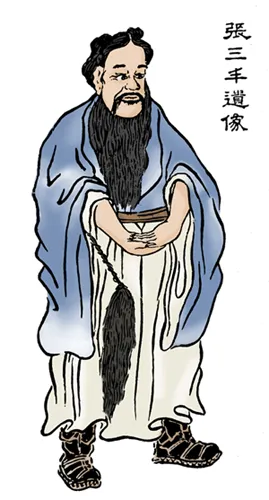
Chang, San-feng.
According to the historical record Nan Lei Ji Wang Zheng Nan Mu Zhi Ming (南雷集王征南墓誌銘): “Chang, San-feng, in the Song dynasty, was a Wudang Daoist. Hui Zong (a Song emperor, 宋徽宗) summoned him, but the road was blocked and he couldn’t come. At night, Hui Zong dreamed Emperor Yuan (元帝), the first Jin emperor, taught him martial techniques. At dawn, he killed a hundred enemies by himself.” Also recorded in the Ming history Ming Shi Fang Ji Zhuan (明史方技傳): “Chang, San-feng, from Liao Dong Yi County (遼東懿州). Named Quan-yi (全一). Also named Jun-bao (君寶). San-feng was his nickname. Because he did not keep himself neat and clean, also called Sloppy Chang, (Chang, La-ta, 張邋遢). He was tall and big, shaped like a turtle, and had a crane’s back. Large ears and round eyes. Beard long like a spear tassel. Wears only a priest’s robe winter or summer. Will eat a bushel of food, or won’t eat for several days or a few months. Can travel a thousand miles. Likes to have fun with people. Behaves as if nobody is around. Used to travel to Wudang mountain (武當山) with his disciples. Built a simple cottage and lived inside. In the twenty-fourth year of Hong Wu (洪武) (c. AD 1392), Ming Tai Zu (明太祖), the first Ming emperor, heard of his name and sent a messenger to look for him but he couldn’t be found.” It was also recorded in the Ming dynasty in Ming Lang Ying Qi Xiu Lei Gao (明郎瑛七修類稿): “Chang the Immortal, named Jun-bao, also named Quan-yi, nicknamed Xuan-xuan (玄玄), also called Chang, La-ta. In the third year of Tian Shun (天順) (AD 1460), he visited Emperor Ming Ying Zong (明英宗). A picture was drawn. The beard and mustache were straight; the back of the head had a tuft. Purple face and big stomach, with a bamboo hat in his hand. On the top of the picture was an inscription from the emperor honoring Chang as ‘tong wei xian hua zhen ren’ (a genuine Daoist who finely discriminates and clearly understands much, 通微顯化真人). This record is suspect, because if it were true, Chang, San-feng would have been at least five hundred years old at that time. Other records state that Chang, San-feng’s techniques were learned from the Daoist Feng, Yi-yuan (馮一元). Another story tells that Chang, San-feng was an ancient hermit meditator. He saw a magpie fighting against a snake, had a sudden understanding, and created taijiquan.
After Chang, San-feng, there were Wang, Zong (王宗) in Shanxi Province (陝西), Chen, Tong-zhou (陳同州) in Wen County (溫州), Zhang, Song-xi (張松溪) in Hai Yan (海鹽), Ye, Ji-mei (葉繼美) in Si Ming (四明), Wang, Zong-yue (王宗岳) in Shan You, and Jiang, Fa (蔣發) in Hebei (河北). The taiji techniques were passed down and divided into two major styles, Southern and Northern. Later, Jiang, Fa passed his art to the Chen family at Chen Jia Gou (陳家溝) in Huai Qing County, Henan (河南懷慶府). Taiji was then passed down for fourteen generations and divided into old and new styles. The old style was carried on by Chen, Chang-xing (陳長興) and the new style was created by Chen, You-ben (陳有本).
The old style successor Chen, Chang-xing, then passed the art down to his son, Geng-yun (耕雲), and his Chen relatives, Chen, Huai-yuan (陳懷遠) and Chen, Huamei (陳華梅). He also passed his taiji outside of his family to Yang, Lu-chan (楊露禪) and Li, Bo-kui (李伯魁), both of Hebei Province (河北). This old style is called Thirteen Postures Old Form (Shi San Shi Lao Jia, 十三勢老架). Later Yang, Lu-chan passed it down to his two sons, Yang, Ban-hou (楊班候) and Yang, Jian-hou (楊健侯). Then Jian-hou passed the art to two of his sons, Yang, Shao-hou (楊少侯) and Yang, Cheng-fu (楊澄甫). This branch of taijiquan is popularly called Yang Style. Also, Wu, Quan-you (吳全佑) learned from Yang, Ban-hou and started a well-known Wu Style.
Additionally, Chen, You-ben passed his new style to Chen, Qing-ping (陳清萍), who created Zhao Bao (趙堡) Style Taijiquan. Wü, Yu-rang (武禹襄) learned the old style from Yang, Lu-chan and new style from Chen, Qing-ping, and created Wü Style Taijiquan. Li, Yi-yu (李亦畬) learned the Wü Style and created Li Style Taijiquan. He, Wei-zhen (郝為禎) obtained his art from Li Style and created He Style Taijiquan. Sun, Lu-tang (孫祿堂) learned from He Style and created Sun Style.
All the abovementioned styles are popular in China and Southeast Asia. Among them, Yang Style has become the most popular. In the next section we will discuss the history of the Yang Style.
1-3. History of Yang Style Taijiquan
Yang Style history starts with Yang, Lu-chan (1799-1872, 楊露禪), also known as Fu-kuai (福魁) or Lu-chan (祿纏). He was born at Yong Nian Xian, Guang Ping County, Hebei Province (河北,廣平府永年縣). When he was young, he went to Chen Jia Gou in Henan Province to learn taijiquan from Chen, Chang-xing. When Chen, Chang-xing stood, he was centered and upright with no leaning or tilting, like a wooden signpost, and so people called him Mr. Tablet. At that time, there were very few students outside of the Chen family who learned from Chen, Chang-xing. Because Yang was an outside student, he was treated unfairly, but he still stayed and persevered in his practice.
One night, he was awakened by the sounds of “heng” (哼) and “ha” (哈) in the distance. He got up and traced the sound to an old building. Peeking through the broken wall, he saw his master Chen, Chang-xing teaching the techniques of grasp, control, and emitting jing in coordination with the sounds heng (哼) and ha (哈). He was amazed by the techniques and from that time on, unknown to master Chen, he continued to watch this secret practice session every night. He would then return to his room to ponder and study. Because of this, his martial ability advanced rapidly. One day, Chen ordered him to spar with the other disciples. To his surprise, none of the other students could defeat him. Chen realized that Yang had great potential and aft...
Table of contents
Cover Page
Title Page
Copyright
Table of Contents
Foreword by Grandmaster Jou, Tsung-Hwa
Preface by Dr. Yang, Jwing Ming (First Edition, 1986)
Preface by Dr. Yang, Jwing-Ming (Second Edition, 1996)
Preface by Dr. Yang, Jwing-Ming (Third Edition, 2015)
Chapter 1: General Introduction
Chapter 2: Qi and Taijiquan
Chapter 3: Jing Martial Power
Chapter 4: Conclusion
Acknowledgements
Appendix A: Taiji Poetry and Songs
Appendix B: Translation and Glossary of Chinese Terms
Editorial Notes
Index
About the Author
Trusted by 375,005 students
Access to over 1.5 million titles for a fair monthly price.
Study more efficiently using our study tools.
Frequently asked questions
Yes, you can cancel anytime from the Subscription tab in your account settings on the Perlego website. Your subscription will stay active until the end of your current billing period. Learn how to cancel your subscription
No, books cannot be downloaded as external files, such as PDFs, for use outside of Perlego. However, you can download books within the Perlego app for offline reading on mobile or tablet. Learn how to download books offline
Perlego offers two plans: Essential and Complete
Essential is ideal for learners and professionals who enjoy exploring a wide range of subjects. Access the Essential Library with 800,000+ trusted titles and best-sellers across business, personal growth, and the humanities. Includes unlimited reading time and Standard Read Aloud voice.
Complete: Perfect for advanced learners and researchers needing full, unrestricted access. Unlock 1.5M+ books across hundreds of subjects, including academic and specialized titles. The Complete Plan also includes advanced features like Premium Read Aloud and Research Assistant.
Both plans are available with monthly, semester, or annual billing cycles.
We are an online textbook subscription service, where you can get access to an entire online library for less than the price of a single book per month. With over 1.5 million books across 990+ topics, we’ve got you covered! Learn about our mission
Look out for the read-aloud symbol on your next book to see if you can listen to it. The read-aloud tool reads text aloud for you, highlighting the text as it is being read. You can pause it, speed it up and slow it down. Learn more about Read Aloud
Yes! You can use the Perlego app on both iOS and Android devices to read anytime, anywhere — even offline. Perfect for commutes or when you’re on the go. Please note we cannot support devices running on iOS 13 and Android 7 or earlier. Learn more about using the app
Yes, you can access Tai Chi Chuan Martial Power by Jwing-Ming Yang in PDF and/or ePUB format, as well as other popular books in Biological Sciences & Sport & Exercise Science. We have over 1.5 million books available in our catalogue for you to explore.