Nervous Fictions
eBook - ePub

Nervous Fictions

Literary Form and the Enlightenment Origins of Neuroscience

  1. 352 pages
  2. English
  3. ePUB (mobile friendly)
  4. Available on iOS & Android
eBook - ePub

Nervous Fictions

Literary Form and the Enlightenment Origins of Neuroscience

About this book

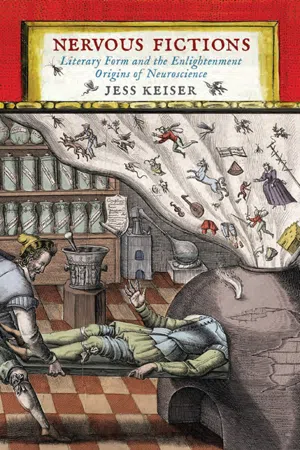
"The brain contains ten thousand cells," wrote the poet Matthew Prior in 1718, "in each some active fancy dwells." In the seventeenth and eighteenth centuries, just as scientists began to better understand the workings of the nerves, the nervous system became the site for a series of elaborate fantasies. The pineal gland is transformed into a throne for the sovereign soul. Animal spirits march the nerves like parading soldiers. An internal archivist searches through cerebral impressions to locate certain memories. An anatomist discovers that the brain of a fashionable man is stuffed full of beautiful clothes and billet-doux. A hypochondriac worries that his own brain will be disassembled like a watch. A sentimentalist sees the entire world as a giant nervous system comprising sympathetic spectators.

Nervous Fictions is the first account of the Enlightenment origins of neuroscience and the "active fancies" it generated. By surveying the work of scientists (Willis, Newton, Cheyne), philosophers (Descartes, Cavendish, Locke), satirists (Swift, Pope), and novelists (Haywood, Fielding, Sterne), Keiser shows how attempts to understand the brain's relationship to the mind produced in turn new literary forms. Early brain anatomists turned to tropes to explicate psyche and cerebrum, just as poets and novelists found themselves exploring new kinds of mental and physical interiority. In this respect, literary language became a tool to aid scientific investigation, while science spurred literary invention.

Frequently asked questions

Yes, you can cancel anytime from the Subscription tab in your account settings on the Perlego website. Your subscription will stay active until the end of your current billing period. Learn how to cancel your subscription.
No, books cannot be downloaded as external files, such as PDFs, for use outside of Perlego. However, you can download books within the Perlego app for offline reading on mobile or tablet. Learn more here.
Perlego offers two plans: Essential and Complete
  • Essential is ideal for learners and professionals who enjoy exploring a wide range of subjects. Access the Essential Library with 800,000+ trusted titles and best-sellers across business, personal growth, and the humanities. Includes unlimited reading time and Standard Read Aloud voice.
  • Complete: Perfect for advanced learners and researchers needing full, unrestricted access. Unlock 1.4M+ books across hundreds of subjects, including academic and specialized titles. The Complete Plan also includes advanced features like Premium Read Aloud and Research Assistant.
Both plans are available with monthly, semester, or annual billing cycles.
We are an online textbook subscription service, where you can get access to an entire online library for less than the price of a single book per month. With over 1 million books across 1000+ topics, we’ve got you covered! Learn more here.
Look out for the read-aloud symbol on your next book to see if you can listen to it. The read-aloud tool reads text aloud for you, highlighting the text as it is being read. You can pause it, speed it up and slow it down. Learn more here.
Yes! You can use the Perlego app on both iOS or Android devices to read anytime, anywhere — even offline. Perfect for commutes or when you’re on the go.
Please note we cannot support devices running on iOS 13 and Android 7 or earlier. Learn more about using the app.
Yes, you can access Nervous Fictions by Jess Keiser in PDF and/or ePUB format, as well as other popular books in History & Early Modern History. We have over one million books available in our catalogue for you to explore.

Information

Index

Abrams, M. H.: The Mirror and the Lamp, 25
Adair, James: Essays on Fashionable Diseases, 251
Addison, Joseph, 140–41, 185, 272n14. See also Spectator
agnosticism, 132, 239, 247, 267n1
Aït-Touati, Frederique, 27, 28
alembic, comparison of brain/mind to, 49–50, 51, 59, 101, 107, 225, 250
anatomy. See dissections; “mock dissection”
animal electricity, discovery of, 252
animal spirits: Addison and, 141, 185; age and experience attributed to, 57–58; biochemical process producing, 48–55; Blackmore and, 235; Boswell and, 221, 223–27, 236, 280n9; Cavendish and, 73, 169; debate over and critiques of animal-spirits physiology, 40, 193–94, 197–98, 252, 275n5; defined, 4; delivering commands from brain or pineal gland, 22, 26, 36, 41, 43, 56–57, 73, 75, 153, 154, 161, 166–69, 206; epistemological gap and, 10, 53, 63, 66, 196–97; Fielding (Henry) and, 199–200; Fielding (Sarah) and, 200; history of use in medical texts, 48, 192, 193, 197, 260n14; Hobbes and, 68; Hume and, 142; hypochondria and, 235; invisibility of, 223; Kinneir and, 194–96, 199, 223; liquor and, 110; Locke and, 111, 135, 138, 185, 268n8, 271n39; madness and, 60–61, 137; mirror to human counterpart’s mental state, 18, 45–46, 52–53, 57–58, 62, 187, 210; ontological strength and weakness of, 50–52; in optic nerves, 123; persisting in mid-eighteenth-century literature, 8, 33, 66, 183–84, 192–93, 199–201, 262n82; personification of, 35–36, 38, 69, 128, 137, 184, 188, 194, 198, 203, 277n44; Prior and, 166, 168–69; Purcell and, 235; as soldiers of the mind, 26, 30, 36, 56–58, 65, 73, 153; Sterne and, 182–91, 193–203, 275n15, 276n21, 277n44; Sw...

Table of contents

  1. Cover
  2. Title Page
  3. Copyright Page
  4. Dedication
  5. Contents
  6. Acknowledgments
  7. Introduction
  8. One Personifying the Brain: Willis’s Neuroscience
  9. Two Nervous Figures: Cavendish’s Panpsychism
  10. Three From Metaphor to Madness: Locke’s History
  11. Four Visionary Dissections: The Satire of Anatomy
  12. Five From the Homunculus to the Great Sensorium of the World: Sterne’s Nerves
  13. Six The Hypochondriac’s Watch: Boswell’s Case
  14. Notes
  15. Bibliography
  16. Index