eBook - ePub
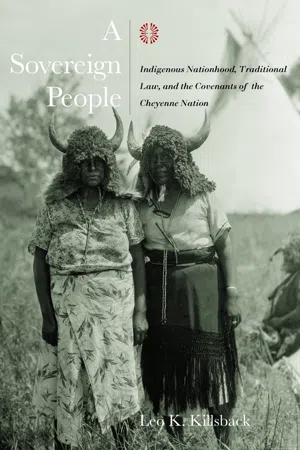
A Sovereign People
Indigenous Nationhood, Traditional Law, and the Covenants of the Cheyenne Nation
- 312 pages
- English
- ePUB (mobile friendly)
- Available on iOS & Android
eBook - ePub
A Sovereign People
Indigenous Nationhood, Traditional Law, and the Covenants of the Cheyenne Nation
About this book
(Volume 2 of 2) Killsback, a citizen of the Northern Cheyenne Nation, reconstructs and rekindles an ancient Cheyenne world--ways of living and thinking that became casualties of colonization and forced assimilation. Spanning more than a millennium of antiquity and recovering stories and ideas interpreted from a Cheyenne worldview, the works' joint purpose is rooted as much in a decolonization roadmap as it is in preservation of culture and identity for the next generations of Cheyenne people. Dividing the story of the Cheyenne Nation into pre- and post-contact, A Sacred People and A Sovereign People lay out indigenously conceived possibilities for employing traditional worldviews to replace unhealthy and dysfunctional ones bred of territorial, cultural, and psychological colonization.
Information
Part I: Ma̍heónėstónestôtse: Sacred Covenants
The Great Plains environment determined how the Cheyenne Nation survived as a living-nation. The environment also determined whether or not the Cheyenne Nation prospered. The Cheyennes had come to respect and to live in balance and harmony with this environment, and their ceremonial cycle reveals the intricacies of a delicate spiritual relationship. The Cheyennes had come to depend heavily on hunting and gathering, and their ceremonial cycle coincided with the seasons. Time was measured by the migrations of herds, the blooming of plants and flowers, and movements of star constellations. The spring and summer were the seasons of plenty for the Plains Indians. The Cheyennes welcomed the arrival of spring when they noticed a shift in the position of the sun, the change in weather, and the return of migratory birds. The sun is at its highest at midday but begins to awaken the beauty and life of the new day as soon as it crests the horizon. This spring morning brings about the best in the Cheyenne people as they begin their days with a ritual offering and smoke from their pipes to greet the gift of power felt in the heat of the sun. While grandmothers and grandfathers brew some hot herbal tea, fathers and mothers awaken their children before the sun touches their skin: “Wake up, children! The day is half over!”
As spring days pass, the morning skies begin to glow of bright reds and oranges, colors that the young men try to capture in their paints and finest clothing. The animals have long shed their winter coats and look fluorescent as they stand out in the morning light and against the green hillsides. Birds sing, flowers are in bloom, and thick green grass covers the prairies. All of the creeks, rivers, and ponds are full of cool, clear water, and their banks are sheltered with thick brush and bright greens and blues from cottonwoods and other sacred trees. The prairies are dotted with purple, white, and yellow wildflowers. Pine trees in the distance appear navy blue but shift into shades of purple and black. The skies are turquoise at midday and sometimes filled with thick, fluffy, white clouds. The late spring days are never too hot for a Cheyenne person. They slowly end as the sun sets and fills the sky with bright purples and pinks, colors that the women try to emulate in their quillwork, dresses, and accessories of beauty and womanhood. The cool evening air soothes and calms the warmth left from the day, returning the night to the stars and a full moon. In the end, the Earth is the ultimate authority and determines the time to begin the ceremonial cycle.
Chapter 1: Ma̍heónohéstanove: A Sacred Nation
Our existence in these lands has not been one of absolute peace and tranquility. We have had to work hard to develop the civilization we enjoy. There was a time when our lands were torn by conflict and death. There were times when certain individuals attempted to establish themselves as the rulers of the people through exploitation and repression. We emerged from those times to establish a strong democratic and spiritual Way of Life.
—A Basic Call to Consciousness1
Life for the Cheyenne people was quite different before they established the Véhoo̍o (Council of Forty-four Chiefs) and the elaborate Nótåxeo̍o (warrior society) system of governance. These institutions formed the foundation of the Cheyenne national government, leadership, and citizenship. Before the establishment of these two systems, the Cheyennes lived in small villages that were governed by one chief. The health and well-being of these small bands depended heavily on the decisions of the chief. Sometimes the small bands suffered because of the poor decisions of their leaders, and sometimes the people suffered directly from the rule of tyrants. During the prenation times, the Cheyenne people were disorganized, and the tragic events and poor leaders were memorialized in stories to prevent history from repeating itself. More important, these stories prevented the proliferation of poor leadership values. Out of the chaos and dysfunction, however, rose prophets and spiritual leaders, like Sweet Medicine and White Buffalo Woman, who brought new philosophies and ways of living based on spiritual principles. The Cheyenne Nation was then able to rebuild itself out of the ashes of previous, failed societies. Eventually the Cheyenne Nation reached prime and pinnacle under sacred teachings, unity, justice, and brotherhood. By the time whites arrived, the Cheyenne Nation operated under a refined system of governance and sacred laws.
plains indian sovereignty and nationhood
In 1803, Lewis and Clark acted as representatives of the United States to proclaim supremacy over lands acquired through the Louisiana Purchase. For the next one hundred years, the United States and its citizens sought to take Indian lands through force, political deception, and violence, even after the supposed purchase and outlandish claims of ownership. The United States was then still an undeveloped nation, yet it was ambitious and its leaders sought dominion over the West. The Indian nations of the Great Plains, as history reveals, were not going to give up their lands and ways of living so easily. The history of the wars for the West, however, is for another time.
The assaults on Plains Indian nationhood and sovereignty began with Lewis and Clark. In 1805 William Clark reported in his journals that the Sioux had “no fixed laws” and that “all the other nations have no other laws.”2 His assessment was inaccurate and contradictory. He had already described the Sioux and other Plains Indians as “nations.” By definition, nations are independent political states with defined territorial boundaries and organized under a single government, and governments are made of political institutions, laws, and customs that serve, protect, and govern their citizens. The public’s view of Plains Indian peoples as “lawless” was shaped by reports like those from Lewis and Clark, and these views often influenced policy-making.3 Years after the Lewis and Clark Expedition, whites still believed that the Plains Indians were lawless nations. Even after the United States affirmed Indian nation sovereignty through the treaty-making process, most whites did not respect these Indian nations as legitimate sovereigns with sovereign rights, especially property and land rights.
Long before the establishment of the United States, the Louisiana Purchase, and the Lewis and Clark Expedition, Plains Indian nations like the Tsėhéstáno (Cheyenne Nation) had built themselves into powerful, stable, and proud nation-states. The Tsėhéstáno were building their nation over the course of nearly one thousand years and in that time developed as a sovereign Indigenous nation based on spiritual beliefs, principles, and responsibilities. Other Plains Indian nations created themselves under similar ideologies, and by the time whites arrived, most of these nations had already forged alliances with one another. The sacred alliances were secured by the unification of cultures, governments, and spiritual practices, not by loyalties, allegiances, or contracts. The sacred means of building alliances were developed under unwritten international laws and customs. Once united, federations like the Cheyenne, Lakota, and Arapaho alliance became strong military forces and were able to sustain and defend themselves within their shared territories.
Throughout the history of the United States, American Indian nations witnessed firsthand the diminishment and destruction of their sovereignty. Before their lands were colonized and they were removed to reservations, American Indian nations exercised absolute sovereignty and complete self-determination. Their vibrant cultures and spiritual practices were infused with these traditional governing structures, customs, and ways of living. While American Indian cultures and spiritual practices continue to survive, their governing structures have been vanquished or adapted to the modern way of living. Some traditional exercises of sovereignty remain embedded in ceremonial practices, language, and oral traditions. There are remnants of traditional American Indian concepts of sovereignty, and when we uncover these concepts, we find that they were much different from European concepts.
Before the establishment of reservations, nearly every Plains Indian nation, including the Lakota, Cheyenne, and Arapaho, depended on the great American bison for sustenance. Nearly every Plains Indian nation also organized under the band system, which fit the buffalo-hunting lifestyle. Typical precontact Plains Indian governments functioned as complex federations that united under principles of “geographical spirituality,” which are ceremonial practices determined by the geography, land, environment, and flora and fauna of a particular area. In the land and environment of the Great Plains, the Sun Dance ceremony is an example of a geo-spiritual ceremonial practice. Other examples are the buffalo dances and the antelope hunting rituals. The nations of the Great Plains had numerous cultural and spiritual similarities, yet they all had differing origins. All nations had unique languages, sacred histories, and local geographic homelands. Most, if not all, Great Plains Indian nations also shared similar political and social characteristics. Indigenous nations in other geographical areas and during different eras did not necessarily follow the same band system as those located on the Great Plains, nor did they have the same ceremonial practices. This unique band system is what aided Plains Indian nations like the Cheyenne in nation building.
As I discussed in A Sacred People, the band system of the Great Plains Indian nations can be described as democratic federations or confederacies, yet no European type of government could compare. These band systems, like their spiritual practices, were adapted to fit the environment and thus those who lived in the system essentially became part of the environment. The bands then moved and functioned in synchrony with patterns of the seasons, the weather, the landscape, the waterways, and the life cycles of plant and animal life. In this system, several smaller, mobile units thrived and functioned as autonomous groups, but they were still part of a larger nation. The small bands were composed of extended families and were organized as small states. In this system, individual citizens had two citizenship identities: one was their local band and the other was their Indigenous nation. Band chiefs were primarily responsible for their respective bands and represented them in the larger national governments. Each band may have had unique customs, but all shared unifying national traditions, which were reinforced when reunited during functions like the Sun Dance ceremonies, intertribal peacemaking ceremonies, and, later, treaty-making ceremonies with the United States. The unified Indigenous nations were sovereign, but individual bands held a degree of sovereignty and autonomy.
decolonizing sovereignty
The mainstream concept of “sovereignty” is not the best term to use when discussing the type of sovereignty that American Indians exercised precontact and before colonization.4 Vine Deloria Jr. (Standing Rock Sioux) explains the flaws in this concept but also defines sovereignty from an Indian perspective:
I think that “sovereignty” was a European word that tried to express the nationhood of a people who could think with one mind. Since the king was the ruler, he was sovereign in the sense that he was supposed to represent what the people of his nation wanted. Indians had spread out the idea of governing to include all activities of life — thus, at times, medicine people would be influential and, at other times, warriors, or hunters, or scouts would be influential. Many tribes did not have “laws” or “religion,” but a single belief system that was described as “our way of doing things.” Sovereignty today, unfortunately, is conceived as a wholly political-legal concept.5
The term sovereignty as understood in mainstream society is an adaptation from a mid-fourteenth-century Anglo-French term, sovereynete, which means “pre-eminence,” and it is primarily used to describe the authority of monarchs. Today sovereignty is defined as the supreme authority of a state; the independence of an entity; and the right to self-government. Throughout the history of the colonization of Native America, Europeans and Americans have relied on their concept of sovereignty to justify and legitimize the thievery of Indigenous peoples’ lands.6
Another term that is widely used is tribal sovereignty. I believe tribal sovereignty is overused as the defining attribute of today’s American Indian and Indigenous nations, and it does not adequately define the Indigenous view of sovereignty. American Indians need to begin raising and answering for themselves some critical questions: What is tribal sovereignty? Where does tribal sovereignty come from? How do Indian “tribes” exercise tribal sovereignty? Today the models of tribal sovereignty under which most tribes operate have deep roots in Western legal thought, since the laws and policies of the United States define tribal sovereignty. Treaties, precedent-setting US Supreme Court rulings, congressional acts, and executive orders shaped tribal sovereignty to what it is today.7 This same tribal sovereignty has allowed Indian tribes to retain and regain some rights and even aided some in the economic growth and prosperity. Yet Indian tribes and tribal governments have remain...
Table of contents
- A Sovereign People
- Part I: Ma̍heónėstónestôtse: Sacred Covenants
- Chapter 1: Ma̍heónohéstanove: A Sacred Nation
- Chapter 2: The Communal Ceremonies
- Chapter 3: The Covenant Ceremonies
- Chapter 4: Ma̍heónetanohtôtse: The Sacred Way of Thinking
- Part II: Noónêho̍emanestôtse: Traditional Law
- Chapter 5 : Tsėhéstanove naa Nevo̍êstanémaneo̍o: The Cheyenne Way and Kinship
- Chapter 6: Tsėhéstanove naa Ho̍emanestôtse: The Cheyenne Way and Law
- Chapter 7: Tsėhéstanove naa Néé̍éve: The Cheyenne Way and Marriage
- Chapter 8: Ma̍hëö̍o Hesto̍emanestôtse: Sacred Laws
- Part III : Néstaxeo̍o: Allies
- Chapter 9 : Tsėhéstáno naa Xamaevo̍êstaneo̍o: The Cheyenne Nation and Indigenous Peoples
- Chapter 10: Ho̍óhomo̍eo̍o: The Lakota Nation
- Chapter 11: Xamaevo̍êstaneo̍o Ho̍emanestôtse: Indigenous Nations Law
- Chapter 12 : Tsėhéstanove and War
- Part IV: Colonizing the Tsėhéstáno
- Chapter 13: Vé̍hó̍e: The White Man
- Conclusion : Decolonizing the Tsėhéstanove
Trusted by 375,005 students
Access to over 1.5 million titles for a fair monthly price.
Study more efficiently using our study tools.
Frequently asked questions
Yes, you can cancel anytime from the Subscription tab in your account settings on the Perlego website. Your subscription will stay active until the end of your current billing period. Learn how to cancel your subscription
No, books cannot be downloaded as external files, such as PDFs, for use outside of Perlego. However, you can download books within the Perlego app for offline reading on mobile or tablet. Learn how to download books offline
Perlego offers two plans: Essential and Complete
- Essential is ideal for learners and professionals who enjoy exploring a wide range of subjects. Access the Essential Library with 800,000+ trusted titles and best-sellers across business, personal growth, and the humanities. Includes unlimited reading time and Standard Read Aloud voice.
- Complete: Perfect for advanced learners and researchers needing full, unrestricted access. Unlock 1.5M+ books across hundreds of subjects, including academic and specialized titles. The Complete Plan also includes advanced features like Premium Read Aloud and Research Assistant.
We are an online textbook subscription service, where you can get access to an entire online library for less than the price of a single book per month. With over 1.5 million books across 990+ topics, we’ve got you covered! Learn about our mission
Look out for the read-aloud symbol on your next book to see if you can listen to it. The read-aloud tool reads text aloud for you, highlighting the text as it is being read. You can pause it, speed it up and slow it down. Learn more about Read Aloud
Yes! You can use the Perlego app on both iOS and Android devices to read anytime, anywhere — even offline. Perfect for commutes or when you’re on the go.
Please note we cannot support devices running on iOS 13 and Android 7 or earlier. Learn more about using the app
Please note we cannot support devices running on iOS 13 and Android 7 or earlier. Learn more about using the app
Yes, you can access A Sovereign People by Leo K. Killsback in PDF and/or ePUB format, as well as other popular books in History & North American History. We have over 1.5 million books available in our catalogue for you to explore.