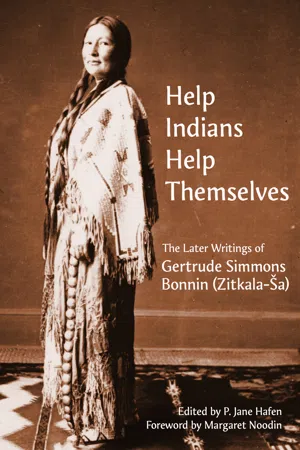
eBook - ePub
“Help Indians Help Themselves”
The Later Writings of Gertrude Simmons-Bonnin (Zitkala-Ša)
- 400 pages
- English
- ePUB (mobile friendly)
- Available on iOS & Android
eBook - ePub
“Help Indians Help Themselves”
The Later Writings of Gertrude Simmons-Bonnin (Zitkala-Ša)
About this book
Zitkala-Ša, also known as Gertrude Simmons Bonnin, was born on the Yankton Sioux reservation in 1876 and went on to become one of the most influential American Indian writer/activists of the twentieth century. "Help Indians Help Themselves": The Later Writings of Gertrude Simmons Bonnin (Zitkala-Ša) is a critical collection of primary documents written by Bonnin who was principally known for the memoir of her boarding school experience, "Help Indians Help Themselves" expands the published work of Zitkala-Ša, adding insight to a life of writing and political activism on behalf of American Indians in the early twentieth century. Edited by P. Jane Hafen, "Help Indians Help Themselves" documents Bonnin's passion for justice in Indian America and outlines the broad scope of her life's work. In the American Indian Magazine, the publication of the Society of American Indians, and through her work for the National Council of American Indians, Bonnin developed her emphasis, as Hafen writes, on "resistance, tribal nationalism, land rights and call for civil rights." "Help Indians Help Themselves" also brings to light Bonnin's letters, speeches, and congressional testimony, which coincide with important developments of the relationship between American Indians and the U.S. federal government. Legislation such as the Citizenship Act of 1924, the Meriam Report of 1928, and the Indian Reorganization Act of 1934 is reflected through the work collected in "Help Indians Help Themselves". In these writings, in newsletters, and in voluminous correspondence—most of which have never before been published—Bonnin advocates tirelessly for "the Indian Cause."
Information
Topic
StoriaSubtopic
Storia nordamericanaSide by Side (Earlham Speech)1
The universe is the product of evolution. An ascending energy pervades all life. By slow degrees nations have risen from the mountain foot of their existence to its summit. In the wild forests of northern Europe two thousand years ago roamed the blue-eyed Teuton. To the lowlands by the northern sea came the war-like Saxon, ere long to begin his bloody conquest of Britain. Yet fierce and barbarous as he was, the irrepressible germ of progress lay deeply implanted in his nature. His descendants have girdled the globe with their possessions. To-day it is no longer a debatable question whether it shall be Anglo-Saxon or Cossack, constitutional law or imperial decree, that is destined to mould the character of governments and to determine the policies of nations.
Out of a people holding tenaciously to the principles of the Great Charter has arisen in America a nation of free men and free institutions. On its shores two oceans lavish the products of the world. Among its rivers, mountains and lakes, in its stately forests and on its broad prairies, like rolling seas of green and gold, millions of toiling sovereigns have established gigantic enterprises, great factories, commercial highways, and have developed fruitful farms and productive mines. The ennobling architecture of its churches, schools, and benevolent institutions; its municipal greatness, keeping pace with social progress; its scholars, statesmen, authors and divines, giving expression and force to the religious and humanitarian zeal of a great people — all these reveal a marvelous progress. Thought is lost in admiration of this matchless scene over which floats in majesty the starry emblem of liberty.
But see! At the bidding of thought the tide of time rolls back four hundred years. The generations of men of all nations, kindreds, and tongues, who have developed this civilization in America, return to the bosom of the old world. Myriad merchantmen, fleets, and armaments shrink and disappear from the ocean. Daring explorers in their frail crafts hie to their havens on the European shore. The fleet of discovery, bearing under the flag of Spain the figure of Columbus, recedes beyond the trackless sea. America is one great wilderness again. Over the trees of the primeval forest curls the smoke of the wigwam. The hills resound with the hunter’s shout that dies away with the fleeing deer. On the river glides his light canoe. In the wigwam Laughing Water weaves into moccasins the rainbow-tinted beads. By gleaming council fire brave warriors are stirred by the rude eloquence of their chief. In the evening-glow the eyes of the children brighten as the aged brave tells his fantastic legends. The reverent and poetic natures of these forest children feel the benign influence of the Great Spirit; they hear his voice in the wind; see his frown in the storm cloud; his smile in the sunbeam. Thus in reverential awe the Red Man lived. His was the life that is the common lot of human kind. Bravely did he struggle with famine and disease. He felt his pulses hasten in the joyous freedom of the hunt. Quick to string his bow for vengeance; ready to bury the hatchet or smoke the pipe of peace; never was he first to break a treaty or known to betray a friend with whom he had eaten salt.
The invasion of his broad dominions by a paler race brought no dismay to the hospitable Indian. Samoset voiced the feeling of his people as he stood among the winter-weary Pilgrims and cried “Welcome, Englishmen.” Nor did the Indian cling selfishly to his lands; willingly he divides with Roger Williams and with Penn, who pay him for his own. History bears record to no finer examples of fidelity. To Jesuit, to Quaker, to all who kept their faith with him, his loyalty never failed.
Unfortunately civilization is not an unmixed blessing. Vices begin to creep into his life and deepen the Red Man’s degradation. He learns to crave the European liquid fire. Broken treaties shake his faith in the new-comers. Continued aggressions goad him to desperation. The White Man’s bullet decimates his tribes and drives him from his home. What if he fought? His forests were felled; his game frightened away; his streams of finny shoals usurped. He loved his family and would defend them. He loved the fair land of which he was rightful owner. He loved the inheritance of his fathers, their traditions, their graves; he held them a priceless legacy to be sacredly kept. He loved his native land. Do you wonder still that in his breast he should brood revenge, when ruthlessly driven from the temples where he worshipped? Do you wonder still that he skulked in forest gloom to avenge the desolation of his home? Is patriotism a virtue only in Saxon hearts? Is there no charity to cover his crouching form as he stealthily opposed his relentless foe?
The charge of cruelty has been brought against the Indian; but the White Man has been the witness and the judge. Anglo-Saxon England, with its progressive blood, its long continued development of freedom and justice, its eight centuries of Christian training, burned the writhing martyr in the fires of Kenith field from a sense of duty. In the name of religion and liberty, the cultured Frenchman, with his inheritance of Roman justice, ten centuries of Christian ideas, murders his brother on that awful night of St. Bartholomew, and during the Reign of Terror swells the Seine with human blood. Let it be remembered, before condemnation is passed upon the Red Man, that while he burned and tortured frontiersmen, Puritan Boston burned witches and hanged Quakers, and the Southern aristocrat beat his slaves and set blood hounds on the track of him who dared aspire to freedom. The barbarous Indian, ignorant alike of Roman justice, Saxon law, and the Gospel of Christian brotherhood, in the fury of revenge has brought no greater stain upon his name than these.
But what have two centuries of contact with the foremost wave of Anglo-Saxon civilization wrought for him?
You say they all have passed away,
That noble race — and brave;
That their light canoes have vanished
From off the crested wave:
That mid the forests where they roamed
There rings no hunter’s shout;
You say their conelike cabins
That clustered o’er the vale
Have disappeared — as withered leaves
Before the autumn’s gale.2
If in their stead, we have to-day a race of blighted promise, will you spurn them? You, whose sires have permitted the most debasing influences to surround these forest children, brutalizing their nobler instincts until sin and corruption have well nigh swept them from the Earth?
Today the Indian is pressed almost to the farther sea. Does that sea symbolize his death? Does the narrow territory still left to him typify the last brief day before his place on Earth “shall know him no more forever?”3 Shall might make right and the fittest alone survive? Oh Love of God and of His “Strong Son,” thou who liftest up the oppressed and succorest the needy, is thine ear grown heavy that it cannot hear his cry? Is thy arm so shortened, it cannot save? Dost thou not yet enfold him in thy love? Look with compassion down, and with thine almighty power move this nation to the rescue of my race.4 To take the life of a nation during the slow march of centuries seems not a lighter crime than to crush it instantly with one fatal blow. Our country must not shame her principles by such consummate iniquity. Has the charity which would succor dying Armenia no place for the Indian at home? Has America’s first-born forfeited his birthright to her boundless opportunities? No legacy of barbarism can efface the divine image in man. No tardiness in entering the paths of progress can destroy his divinely given capabilities. No lot or circumstance, except of his own choosing, can invalidate his claim to a place in the brotherhood of man or release more fortunate, more enlightened people from the obligation of a brother’s keeper. Poets sing of a coming federation of the world, and we applaud. Idealists dream that in this commonwealth of all humanity the divine spark in man shall be the only test of citizenship, and we think of their dream as future history. America entered upon her career of freedom and prosperity with the declaration that “all men are born free and equal.” Her prosperity has advanced in proportion as she has preserved to her citizens this birthright of freedom and equality. Aside from the claims of a common humanity, can you as consistent Americans deny equal opportunities with yourselves to an American people in their struggle to rise from ignorance and degradation? The claims of brotherhood, of the love that is due a neighbor-race, and of tardy justice have not been wholly lost on your hearts and consciences.
The plaintive melodies, running from his tired but bravely enduring soul, are heard in heaven. The threatening night of oblivion lifts. The great heart of the nation sways us with the olive branch of peace. Some among the noblest of this country have championed our cause. Within the last two decades a great interest in Indian civilization has been awakened; a beneficent government has organized a successful system of Indian education; training schools and college doors stand open to us. We clasp the warm hand of friendship everywhere. From honest hearts and sincere lips at last we hear the hearty welcome and Godspeed. We come from mountain fastnesses, from cheerless plains, from far-off low-wooded streams, seeking the “White Man’s ways.” Seeking your skill in industry and in art, seeking labor and honest independence, seeking the treasures of knowledge and wisdom, seeking to comprehend the spirit of your laws and the genius of your noble institutions, seeking by a new birthright to unite with yours our claim to a common country, seeking the Sovereign’s crown that we may stand side by side with you in ascribing royal honor to our nation’s flag. America, I love thee. “Thy people shall be my people and thy God my God.”5
A Protest Against the Abolition of the Indian Dance
(Word Carrier of Santee Normal Training School 31 (1902): 2)
Almost within a stone’s throw from where I sit lies the great frozen Missouri. Like other reptiles, the low murmuring brown river sleeps through the winter season underneath its covering of blue sheening ice.
A man carrying a pail in one hand and an axe in the other trudges along a narrow footpath leading to the river. Close beside the frozen stream he stands a moment motionless as if deliberating within himself. Then, leaving his pail upon the ground, he walks cautiously out upon the glassy surface of the river. Fearless of the huge sleeper underneath, he swings his axe like one accustomed to the use of his weapon. Soon with the handle as a lever he pries up a round cake of ice. Hereupon great moans and yawnings creak up from some unfathomable sleep and reverberate along the quiet river bottom. The sleeping river is disturbed by the mortal’s tapping upon its crusty mantle; and — restless — turns, perchance, in its bed, gently sighing in its long winter sleep.
The man stoops over the black hole he has made in that pearly river shell and draws up a heavy pail. Apparently satisfied, he turns away into the narrow path by which he came. Unconscious is he of the river’s dream, which he may have disturbed; forgetful, too, of the murmuring water-songs he has not released through his tiny tapping! The man’s small power is great enough to gain for him his small desire, a pail of winter-buried water!
Here I should have stopped writing had not the man I saw retracing safely his footsteps returned — in fancy — possessed with a strange malady. Under some wild conceit regarding the force of his pigmy hammer stroke, he labors now to awaken the sleeping old river in midwinter. Vainly he hacks at the edge of acres of ice, while Natu...
Table of contents
- Contents
- List of illustrations
- Foreword
- Introduction
- Acknowledgments
- Introduction
- 1926
- 1932
- Introduction
- A Year’s Experience in Community Service Work Among the Ute Tribe of Indians
- Chipeta, Widow of Chief Ouray
- Editorial Comment
- Indian Gifts to Civilized Man1
- Editorial Comment1
- America, Home of the Red Man1
- The Coronation of Chief Powhatan Retold1
- Letter to the Chiefs and Headmen of the Tribes
- Secretary’s Report in Brief
- Editorial Comment
- Editorial Comment
- An Indian Praying on the Hilltop
- Address by Mrs. Gertrude Bonnin, Secretary-Treasurer
- Introduction
- Side by Side (Earlham Speech)1
- A Protest Against the Abolition of the Indian Dance
- The Sherman Bulletin,1 April 4, 1917
- The Menace of Peyote1
- California Indian Trails and Prayer Trees
- Lost Treaties of the California Indians (California Indian Herald 1923)
- Heart to Heart Talk
- The California Indians of Today
- Americanize the First Americans1 1920
- Our Sioux People
- Oklahoma Indians
- What It Means to Be an Indian Today1
- Address before the Indian Rights Association
- The Indian Side of the Question (Lake Mohonk Conference on the Indian. Mohonk Lake, New York. 35 (1930): 92–95)
- Red Men Who Taught Pilgrims How to Exist: Guests on First Thanksgiving Day in 1621
- Introduction
- CONSTITUTION AND BY-LAWS OF NATIONAL COUNCIL OF AMERICAN INDIANS
- Indian Citizens
- Letterhead
- Colton Bill
- INDIAN OIL BILL BULLETIN NO. 3
- Indian Newsletter Number 2
- NCAI Indian News Letter
- Introduction
- PEYOTE, 1918
- INDIAN APPROPRIATION BILL 1919: PEYOTE
- “A DACOTAH ODE TO WASHINGTON” BY MRS. BONNIN
- PETITION OF THE NATIONAL COUNCIL OF AMERICAN INDIANS
- OIL AND GAS LEASES ON INDIAN RESERVATIONS
- SURVEY OF CONDITIONS OF THE INDIANS
- SURVEY OF CONDITIONS OF INDIANS IN UNITED STATES, january 1928
- THE MIDDLE RIO GRANDE CONSERVANCY DISTRICT
- SENATE HEARINGS FOR THE SISSETON AND WAHPETON INDIANS
- SURVEY OF CONDITIONS OF INDIANS IN UNITED STATES
- CREATION OF INDIAN TRUST ESTATES, 1930
- INCORPORATION OF THE KLAMATH INDIAN CORPORATION
- SURVEY OF CONDITIONS OF THE INDIANS IN THE UNITED STATES, PART 11, 1931
- SURVEY OF CONDITIONS OF INDIANS IN UNITED STATES, 1932
- ADDITIONAL NAMES IN ROLL OF YANKTON SIOUX INDIANS, 1932
- INTERIOR DEPARTMENT APPROPRIATION BILL, 1934
- Notes
- Bibliography and Suggested Readings
- Index
Trusted by 375,005 students
Access to over 1.5 million titles for a fair monthly price.
Study more efficiently using our study tools.
Frequently asked questions
Yes, you can cancel anytime from the Subscription tab in your account settings on the Perlego website. Your subscription will stay active until the end of your current billing period. Learn how to cancel your subscription
No, books cannot be downloaded as external files, such as PDFs, for use outside of Perlego. However, you can download books within the Perlego app for offline reading on mobile or tablet. Learn how to download books offline
Perlego offers two plans: Essential and Complete
- Essential is ideal for learners and professionals who enjoy exploring a wide range of subjects. Access the Essential Library with 800,000+ trusted titles and best-sellers across business, personal growth, and the humanities. Includes unlimited reading time and Standard Read Aloud voice.
- Complete: Perfect for advanced learners and researchers needing full, unrestricted access. Unlock 1.5M+ books across hundreds of subjects, including academic and specialized titles. The Complete Plan also includes advanced features like Premium Read Aloud and Research Assistant.
We are an online textbook subscription service, where you can get access to an entire online library for less than the price of a single book per month. With over 1.5 million books across 990+ topics, we’ve got you covered! Learn about our mission
Look out for the read-aloud symbol on your next book to see if you can listen to it. The read-aloud tool reads text aloud for you, highlighting the text as it is being read. You can pause it, speed it up and slow it down. Learn more about Read Aloud
Yes! You can use the Perlego app on both iOS and Android devices to read anytime, anywhere — even offline. Perfect for commutes or when you’re on the go.
Please note we cannot support devices running on iOS 13 and Android 7 or earlier. Learn more about using the app
Please note we cannot support devices running on iOS 13 and Android 7 or earlier. Learn more about using the app
Yes, you can access “Help Indians Help Themselves” by P. Jane Hafen in PDF and/or ePUB format, as well as other popular books in Storia & Storia nordamericana. We have over 1.5 million books available in our catalogue for you to explore.